This isn’t exactly what I do for a living….but some people think it’s like this!
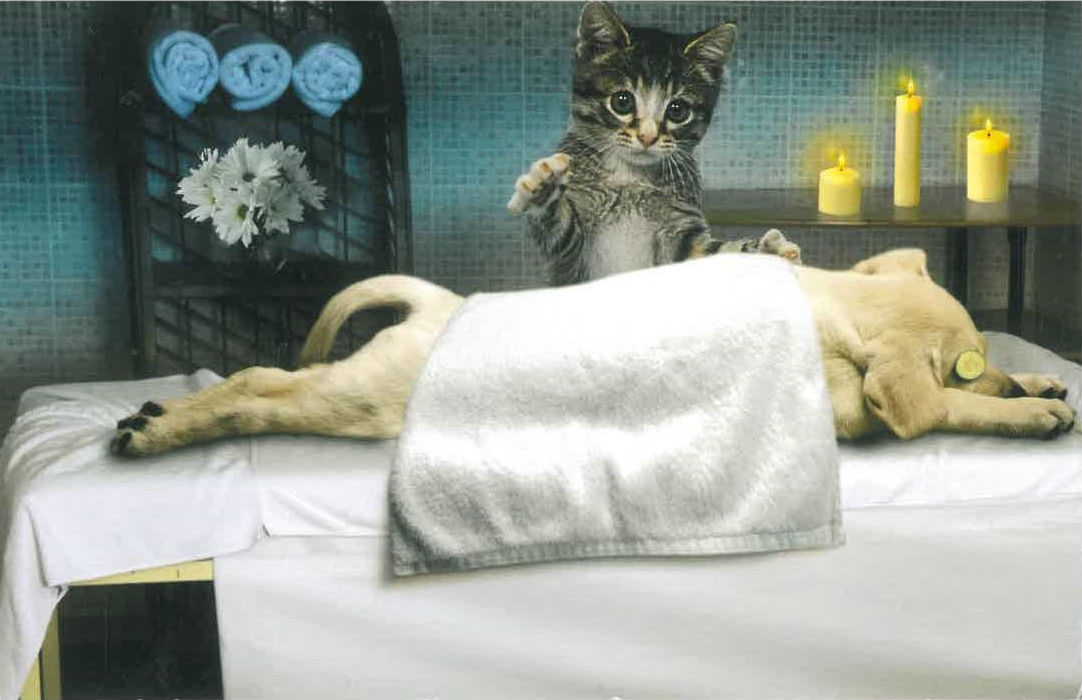

This isn’t exactly what I do for a living….but some people think it’s like this!
If Daisy was a commercial airline, she’d happily report a 100% on time percentage for flight arrivals and departures. But Daisy isn’t an airline, she’s my adored dog who doesn’t understand public holidays.
Today is Waitangi Day in New Zealand and many people would have taken the opportunity to sleep in for a while. Not me.
Daisy arrived at my bedside at 6:30 am to remind me that it was time for breakfast. I fed her and then tried to go back to sleep. At 7:00 am she was back – what are you doing in bed?! It’s time for walkkies!

Daisy reminds me that it is 7:00 am and time for walkkies
Dogs have a remarkable grasp of time and routine. I think it is essential for dog owners to establish a good routine for their dog, because it gives the dog security and a sense of well-being – they know their needs will be taken care of.
I just wish we could establish a Plan B routine – for public holidays….
Tagged dogs, on time percenttage, routine, time, well-being
It’s been a really hot summer here in Christchurch and, as Daisy is a senior dog, I want her to be as comfortable as possible.
In the spring, the folks at Jose Cuervo tequila gave me some molds for freezing water into shot glasses when I bought a bottle of their tequila. Well, I use them, but I fill the insides with beef stock and then re-freeze…
The result? Doggy shot glasses filled with frozen stock! It probably won’t be much of a marketing tool for Jose Cuervo, but Daisy loves them.
These shot glasses of ice are re-frozen after I fill them with beef stock
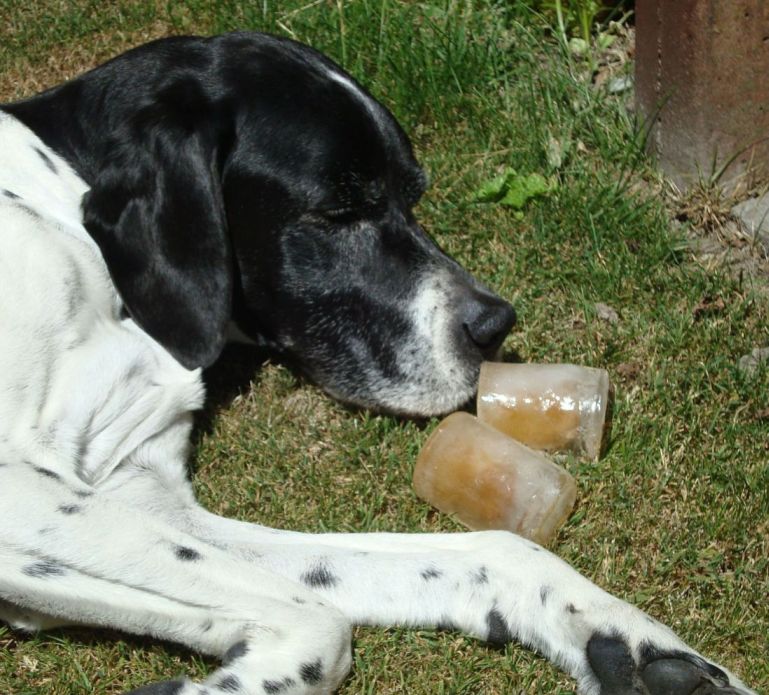
Daisy loves her specially made ice blocks
Posted in dog care
Tagged beef stock, Dog, freezing water, ice, ice block, Jose Cuervo, jose cuervo tequila, shot glasses, summer, tequila
Researchers at the Cummings School of Veterinary Medicine at Tufts University and the University of Guelph have some news for you about bully sticks.

Photo courtesy of Tufts University
The research team analysed the treats for caloric density and bacterial contamination and they asked owners about their knowledge of the treats through a survey.
The sample size in the study was 26 bully sticks, purchased from different places in the United States and Canada.
The bully sticks contained between nine and 22 calories per inch, meaning that the average sized stick packed 88 calories or 9 percent of the daily caloric requirements of a 5o pound (22.7 kg) dog or 30 percent of the requirement for a 10 pound (4.5 kg) dog.
‘With obesity in pets on the rise, it is important for pet owners to factor in not only their dog’s food, but also treats and table food,’ said Lisa M Freeman, Professor of Nutrition.
The 26 treats were also tested for bacterial contamination. One (4%) was contaminated with Clostridium difficile, one (4%) contaminated with methicillin-resistant Staphylococcus aureus (MRSA), and seven (27%) were contaminated with Escherichia coli including one sample that was resistant to treatment with tetracycline.
Although the sample size in this project was small, the researchers advise all pet owners to wash their hands after touching treats. The risk could be higher for the very young, elderly, pregnant or immuno-compromised dog owners. They acknowledge that research on a larger sample size is also needed.
The survey portion of the study showed that many dog owners are not aware of the ingredients in their dog’s treats, with many demonstrating ignorance of the definition of a ‘by-product.’
The results of the study have been published in the January 2013 issue of the Canadian Veterinary Journal.
Source: Tufts Now media statement
“I think breeds of dogs and breeds of men are quite a bit alike. If you think it’s insulting that I compare people and with animals, well, if you knew how I love animals, you would understand that coming from me, this is a compliment.”
– Zsa Zsa Gabor
Heska Corporation has announced the winners of its 2012 Inspiration in Action awards. They are:
 Grand prize winner ($25,000) – Peter Emily International Veterinary Dental Foundation

Second place ($10,000) – Kindred Canines in Motion

Third place ($5,000) – Christian Veterinary Mission (a veterinary shuttle for the Navajo Nation)
Congratulations to the winners and to Heska Corporation for giving back to the community!
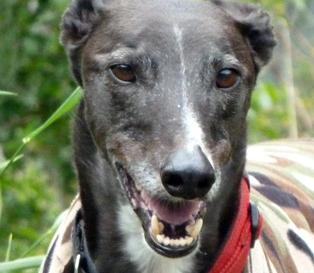
The Greyhound Protection League in New Zealand claims that there are over 10,000 greyhounds unaccounted for in the country at present, with a further one thousand unaccounted for annually. You can sign a petition that requests that the relevant Ministers use their statutory powers to conduct an independent investigation into New Zealand’s greyhound racing industry, and that this information be made publicly available.
By signing this petition, you ask for an independent investigation that makes public:
*Private rehoming can typically fall into two categories: household pets or breeding stock for pig hunting. As the welfare implications of greyhounds as pig hunting stock may be significantly different than those of a household pet, it would be prudent to define whether a “private adoption” is for the purpose of hunting stock or pet.
Interested? SIGN HERE.
Posted in animal welfare, dog breeds
Tagged Greyhound, Greyhound Protection League, greyhounds as pets, investigation, New Zealand, pig hunting
I often have dog hair on my sweaters. But dog hair sweaters?
Yes – it’s true. You can have a sweater (jumper) made of dog hair. Dog hair is a natural fibre and, after washing and spinning, it can be made into yarn for knitting of garments. Once washed, it doesn’t retain a dog odor.
For some dog lovers, having garments made from their dog’s fur is a novel way of re-using the hair. Many find it a consolation when their dog passes to have a garment made from their dog’s hair.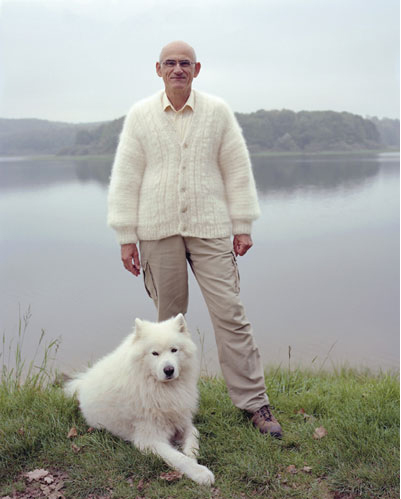

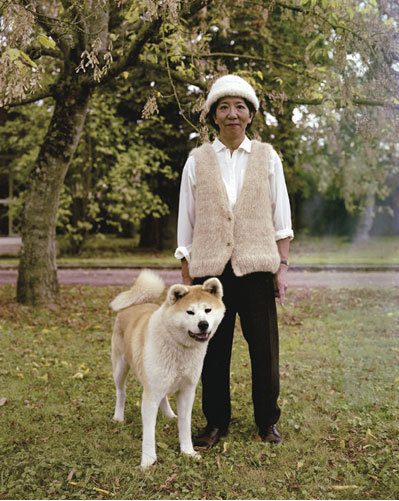 These photos of people wearing dog hair sweaters were taken by photographer Erwan Fichou in his series entitled Dogwool.
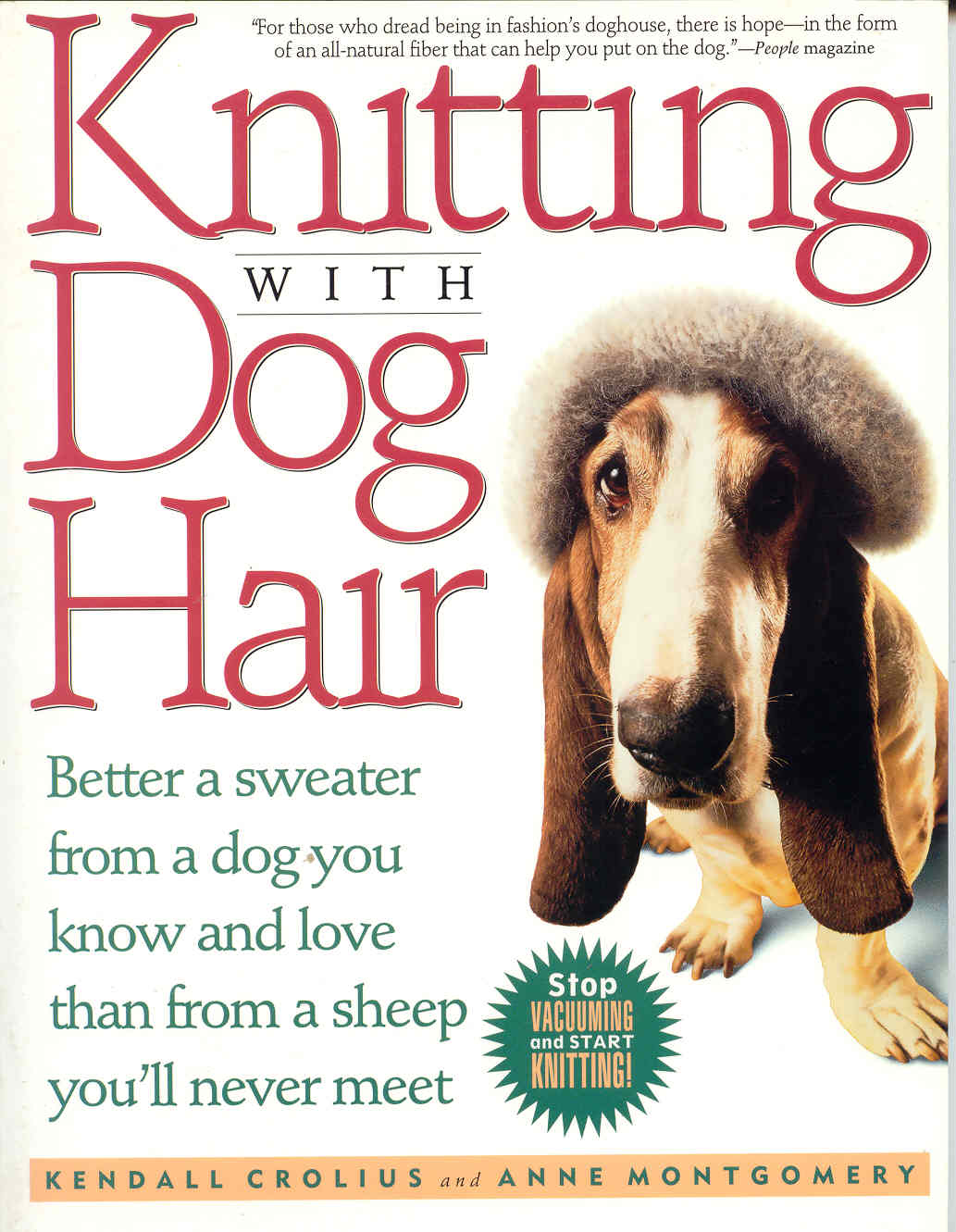
If you’re interested in finding out how you can collect and use your dog’s hair, the woman to speak to is Kendall Crolius. She’s the author of Knitting With Dog Hair.
This YouTube video takes you through the sweater-making process.
Like the book says…if you’re interested, stop vacuuming and starting knitting! (I’m not really sure I want to get into this particular hobby)
Posted in Dogs
Tagged crafts, dog hair sweaters, erwan fichou, Kendall Crolius, knitting, knitting with dog hair, photographer, spinning, sustainability
Most of my regular readers know that I work as a canine massage therapist and helping elderly dogs and those recovering from injuries is very rewarding for me. Many of my clients use massage for their dogs as a way of staving off the need for non-steroidal inflammatory drugs (NSAIDs), or at least to keep the dosages of these drugs as low as possible.
So here’s a wee story of something that happened to me this week.
I was working on a dog who I have been seeing for 18 months. He’s a lovely Labrador and he is starting to have the aches and pains of old age. With a regular 5-weekly regime of massage, he’s been pain free.
Because I know this boy well, I could pick up that he was tight through his hind legs – a muscle called the biceps femoris. When I said ‘he’s tight down here’ to his owner, she replied, ‘I didn’t want to say anything…I wanted to see if you’d notice.’
This happens fairly often. Some people like to test me to see if I actually know what I’m doing (some owners remain doubtful about complementary therapies) but most of the time it is because owners doubt if the changes they observe are real. When you live with someone with a chronic health condition and see them on a daily basis, it is often hard to pick up changes in their condition.
In this case, it was the latter. This lady wasn’t confident that she was really seeing her dog running stiffly. He was tight, but was moving freely when he left after his massage.
Success for the week!
What’s the lesson here? It’s unrealistic to expect a massage therapist to ‘solve’ a dog’s problem in a single visit. Dogs have to get used to the therapist and massage is a new experience for them. So, the first visit is usually a time when they aren’t as relaxed because they are uncertain.
Because I keep notes on every massage session, I can refer back to these to track a dog’s condition. This is no different than what your vet does. When I am familiar with a dog and their unique characteristics, I’m much better able to pick up changes and act swiftly to help.
Please consider your dog’s therapist as a member of your healthcare team and part of your dog’s preventative healthcare regime. It’s much better than the ‘ambulance at the bottom of the cliff.’

Kathleen at work with Zara (another happy customer) copyright June Blackwood









 DoggyMom.com