I have been in professional practice since 2009 and one of the more consistent battles I have fought over the years is to ensure that dog massage is recognized for the professional skills and training it requires. Consequently, I have never turned down an opportunity to promote my practice and the benefits to customers – both human and canine.
So when accounting software company Xerosent me its October newsletter last year with a little item – if you’d like to feature in one of our Customer Stories, please tell us about your business and how you use Xero – I replied and didn’t think much else about it after receiving an acknowledgement of receipt.
Then suddenly it was early 2021 and I received a request for a Skype interview with a copywriter from Xero. It was a lengthy interview- and very detailed – and I was totally comfortable telling Roz about my business and passion for dogs. And then I was invited to another meeting, with an Executive Producer and another when I was told that the Xero team had considered many businesses – and The Balanced Dog kept popping up to the top of the team’s list.
It was a little like going down the proverbial rabbit hole.
I had clients to contact to ask if they would lend their dogs and homes to be filmed. My lovely clients all said yes (only two were chosen once the logistics of filming were worked out). I then wrote a brief biography of each dog and information on address, logistics, etc. Special massage table coverings were ordered using my company logo, and lots of questions were asked and answered in email exchanges as we prepared for the shoot.
The date was set. The weekend of 1st and 2nd of May with an initial meeting at my home on the Friday afternoon. It turned out to be an entourage of four people who turned up that afternoon: the Director, the Social Media Director, the Producer and the Director of Photography. Little did I realize there would be more…
Saturday dawned. My hair and make-up artist arrived at 6:30 am and then I dropped Izzy with a friend and drove across town.
….to meet a crew of 13!
A Stills Photographer would be taking photos throughout the two days, I was told. We’d be filming a Customer Story that would be edited into several versions. There would be other filming for social media and stories. The Set Dresser would take care of props and arranging furniture and everything would be put back in its place.
They’ll tell me what to do. Just relax.
Thankfully, Canterbury turned on exceptional weather on both days – frosty and chilly for one day, warming up nicely the next.
Our first hill location above Halswell Quarry was perfect in the light of the morning, shame about the rounds of gunfire going off in the background at times. 1st May was the start of duck shooting season, you see.
Timings were monitored carefully by the Producer; everyone got down to work including wiring me for sound and checking lighting. Furniture was moved, my massage table and gear were set up.
I was told that Bryce, the Director, was ready to film. And we do it over and over again. I soon learned that ”one more time” wasn’t to be taken literally. He seemed trustworthy enough on other issues – just don’t believe him about the one more time… Walking up a flight of stairs with my massage table in hand was also becoming serious aerobic exercise.
Then while the film crew set up for another segment, I was needed outside for other filming for social media. There was another director, Cat, for those segments and yet another Director of Photography, Mike, for those.
Stephen, the Stills Photographer, kept asking me to smile. He was always there. I hate having my photo taken, but if anyone was going to be able to make me look good, I figured it would be a professional.
Then a carefully timed lunch break followed by wiring my car for sound. Don’t use the visor for the sunshine, I was told, because there’s a microphone hidden in there. Drive to our second filming location with Arlo and Neisha and their parents while being interviewed behind the wheel at the same time. This was live action filming!
Day 1 was soon over. Pick up Izzy and re-heat leftovers for dinner. Get some sleep.
Day 2 transformed my home into a film studio and we would also walk in our neighbourhood so that Izzy could show off her pram-riding skills and stellar personality. Another carefully timed lunch break in between.
Here’s what my lounge looked like from the other side of the lens during my filmed interview:
Two film cameras and one still – all pointing at me. Izzy was resting in the bedroom at this point (smart dog).
Then everyone rushed to pack up my house to take a drive across town to set up at sunset on Waimairi Beach.
Izzy and I were filmed using a long lens and also a drone.
And just like that, a whirlwind two days came to an end. It was hard to wind down after all the excitement.
I had plenty of time to wind down, as it turned out. This was probably the hardest time of all – wanting to share the experience with friends and clients but keeping quiet about it until the final product was ready for release.
Production takes time. A lot of patient waiting for the professionals to do their jobs editing, followed by scheduling of social media releases. A second Covid-19 lockdown in New Zealand postponed things a bit further.
It was worth the wait. Versions of my story are now making their way into regular posts onto Facebook and other social media.
Here it is – The Business of Dog Massage – HERO story version.
With thanks to everyone at Xero for choosing to profile my business and to the professional crew. I have a new appreciation for the long line of credits that are shown after a full length feature film!
Left to right: Set Dresser Chris Reddington; Production Assistant Harriette Logan; Hair and Makeup Artist Simone Thurlow; Copywriter and Director Roz Sanderson; Xero Producer & Director for Social Stories Cat Montford, Director of Photography & Hero film Ado Greshoff; Kathleen Crisley & Izzy from The Balanced Dog (also known as ‘Talent’); Bryce McNamara Creative Lead and Director of Hero film; Alix Wilson Workparty Producer; Kelly Chen 1st AC/Focus Puller; Director of Photography Social Stories and Drone Mike Sherrell; Best Boy Zac Beckett-Knight; and Sound Recordist Joseph Veale. Stephen Tilley, the Stills Photographer managed to stay behind the camera for this photo.
Kathleen Crisley, Fear-Free certified professional and specialist in dog massage, rehabilitation and nutrition/food therapy, The Balanced Dog, Christchurch, New Zealand
A study published in Scientific Reports compared dogs’ spontaneous reactions to intentional and unintentional human behavior and found that dogs reacted differently depending on the condition.
Over our long shared history, dogs have developed a range of skills for bonding with human beings. Their ability to make sense of human actions, demonstrated by every “sit,” “lay down,” and “roll over,” is just one such skill. But whether dogs understand human intentions, or merely respond to outcomes, remains unclear. The ability to recognize another’s intentions – or at least conceive of them – is a basic component of Theory of Mind, the ability to attribute mental states to oneself and others, long regarded as uniquely human. Do dogs have this basic component of Theory of Mind, the ability to tell the difference between something done on purpose and something done by accident?
To answer this question, a team of researchers in Germany conducted an experiment that examined how dogs reacted when food rewards were withheld, both intentionally and unintentionally. They found that dogs respond differently depending on whether the actions of the experimenter were intentional or unintentional. This, the researchers say, shows that dogs can distinguish between actions that were done on purpose or accidentally.
To reach their conclusions, the researchers conducted an experiment using the “unable vs. unwilling” paradigm. This works by examining whether test subjects react differently towards a human experimenter who either intentionally (the unwilling condition) or unintentionally (the unable condition) withholds rewards from them. Despite being an established paradigm in studies of human and animal cognition, the unable vs. unwilling paradigm had never been previously used to investigate dogs.
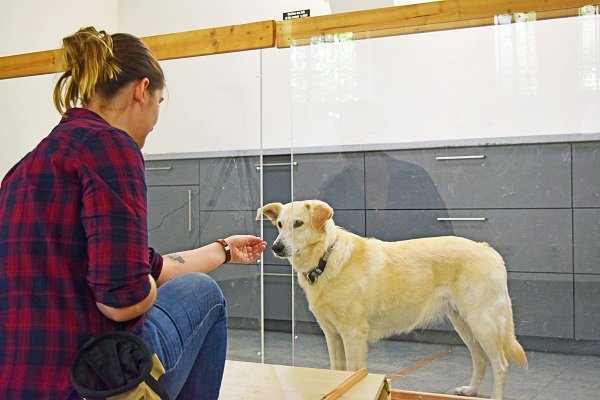
The experiment was conducted with 51 dogs, each of which was tested under three conditions. In each condition, the dog was separated from the human tester by a transparent barrier. The basic situation was that the experimenter fed the dog pieces of dog food through a gap in the barrier. In the “unwilling” condition, the experimenter suddenly withdrew the reward through the gap in the barrier and placed it in front of herself. In the “unable-clumsy” condition, the experimenter brought the reward to the gap in the barrier and “tried” to pass it through the gap but then “accidentally” dropped it. In the “unable-blocked” condition, the experimenter again tried to give the dog a reward, but was unable to because the gap in the barrier was blocked. In all conditions, the reward remained on the tester’s side of the barrier.
“If dogs are indeed able to ascribe intention-in-action to humans,” says Dr. Juliane Bräuer, “we would expect them to show different reactions in the unwilling condition compared to the two unable conditions. As it turns out, this is exactly what we observed.”
The primary behaviour measured by the researchers was the time dogs waited before approaching the reward they were denied. The researchers predicted that, if dogs are able to identify human intentions, they would wait longer before approaching the reward in the unwilling condition, where they were not supposed to have the reward, than in the two unable conditions in which the reward was, in fact, meant for them.
Not only did the dogs wait longer in the unwilling condition than in the unable conditions, they were also more likely to sit or lie down – actions often interpreted as appeasing behaviours – and stop wagging their tails.
“The dogs in our study clearly behaved differently depending on whether the actions of a human experimenter were intentional or unintentional,” says Britta Schünemann, the first author of the study. “This suggests that dogs may indeed be able to identify humans’ intention-in-action,” adds Hannes Rakoczy from the University of Göttingen.
The team acknowledges that their findings may be met with scepticism and that further study is needed to address alternative explanations, such as behavioural cues on the part of experimenters or knowledge transfer from prior dog training.
“Nevertheless,” the paper concludes, “the findings present important initial evidence that dogs may have at least one aspect of Theory of Mind: The capacity to recognize intention-in-action.”
Last week, a new review report into the greyhound racing industry in New Zealand was released. As most of you know, greyhound welfare is a topic near and dear to my heart because Izzy is an ex-racer.
This review, by the Hon Sir Bruce Robertson, is not the first review of the industry. It’s not even the second (but the second, known as the Hansen report was a whopping 93 pages. I discussed that earlier report in my blog post How many hounds needing a home?). The 2021 review is the third review of greyhound racing in this country.
So the report made some headlines last week in the news because the Minister of Racing, Grant Robertson, says he’s putting the industry ‘on notice.’ Frustratingly, none of the mainstream news sources provided a link to a copy of the actual report. Being the information geek that I am, I tracked down the report and read it thoroughly over the weekend – with highlighter pen in hand.
Before I go into some of the key findings, you should be aware that a major reason why this review was undertaken is that Greyhound Racing NZ (GRNZ) wrote to the Minister for Racing in June 2020 stating that all 20 recommendations stated in the Hansen review had been successfully implemented and so they would no longer be providing progress reports. The National Animal Welfare Advisory Committee felt that the information provided was insufficient and, with more deaths and injuries of greyhounds on the track, this review was commissioned.
I like this review, for one reason because it is PITHY. 19 pages including the appendices, it gets straight to the heart of the matter.
Key points:
Kennel audits were supposed to have been undertaken regularly; GRNZ reported that audits were done annually. This review says that comprehensive information on both the regularity of the audits and their outcomes is not available.
The database on greyhounds was to have been updated to ensure it is easily accessible, and contains accurate information on every greyhound born in NZ or imported into New Zealand until it is de-registered. This review found that not only are the data difficult to access but even the National Animal Welfare Advisory Committee cannot obtain even the simplest of information. “There does not appear to be any reason why information regarding the welfare of greyhounds should be outweighed by reasons of privacy, commercial confidentiality, or otherwise.”
The first review of racing recommended that dogs privately re-homed (as in, not through an adoption agency), should be audited to verify their whereabouts. Yet, through submissions to this review, it was found that there is not sufficient information to give any true assurance about the welfare of these dogs.
GRNZ has expanded re-homing efforts BUT it has not established any form of public reduction targets, population projections, or estimated the number of dogs needed for the industry each year. In other words, there is nothing to stop the unchecked breeding of greyhounds for the industry which expects others to take care of their dogs for their lifetimes once they are no longer deemed suitable for racing. The Hansen report clearly said that re-homing alone was not going to solve the industry’s problems.
The negative impacts of racing on overall health often do not present until a dog is settled into a new home.
“No reason given” is still the most common reason for euthanising a greyhound – and by a significant margin.
It is unclear what education and experience standards are in place for individuals employed to assist with breeding and managing kennels.
Conclusions
It has become clear that no matter the outcome of this report, or any reports henceforth, the social license of the industry will continue to be challenged for the foreseeable future. If GRNZ wishes to secure a future for the industry it governs, then it must set out to demonstrate the decency of the greyhound racing industry at every possible opportunity.
GRNZ has made its job harder by unnecessarily obfuscating information and pushing back against those with an interest. All information should be recorded, and it should be available. Arguably GRNZ has data to support its stances on the issues raisedin this report but is seen as unwillingto share this.
For those of you who have an interest, I encourage you to read the report in its entirety and share it with others. The current NZ Government says the industry is on notice and must report by the end of 2022 on its actions in response.
My view is that greyhound racing has been banned in many countries because of the animal welfare considerations. New Zealanders must ask themselves why those animal welfare issues don’t exist here. Because clearly this review has found that they do.
Kathleen Crisley, Fear-Free certified professional and specialist in dog massage, rehabilitation and nutrition/food therapy, The Balanced Dog, Christchurch, New Zealand
Note from DoggyMom: Not all statistics are created equal. This study relied upon comments in pet forums and other social media. It fails to recognise, for example, that the Labrador Retriever consistently ranks as #1 as the top family dog in the UK and the USA. If there are more of them, then they will feature more highly in statistics.
Home is where your dog is – and with good training, consistency and a bit of luck, you won’t experience major damage requiring an insurance claim
They bring us comfort, company and thousands of cute photo opportunities, but pets can also cause their fair share of utter chaos. From knocking over fragile decorations, through to leaving mud (and worse) all over our floors, rarely does a day go by where pet owners don’t find something a little surprising.
But for some animals, the chaos goes way beyond occasional accidents. We’ve scoured pet forums to work out the most destructive breeds of all. The damaging dogs who leave our homes in ruins, through to the catastrophic cats leaving us frantically checking our home insurance policies.
Dogs are more destructive than cats
Based on the number of people on pet forums lamenting their dog’s behavior, we’ve ranked the most calamity-causing canines.
Sorry, dog lovers, but your four-legged best friend has caused more damage than any feline. Despite the tendency of cats to climb into what they should keep out of, and occasionally knock things over out of spite, the chaos they cause pales in comparison to that of dogs.
The energy and excitability of dogs means they occasionally forget how big they are, crashing into things as they rush to show you how happy they are to see you. Cats, on the other hand, are like tiny gymnasts, and are far more laid back about expressions of emotion.
The top 10 most destructive dog breeds
We delved deeper into the pet forums to decipher which dog breeds are the most destructive, causing all kinds of chaos throughout their owners’ homes.
Loveable labs are the biggest home destroyers
One of the most-loved breeds around the world, the labrador has come out top of our naughty list for wreaking havoc in their owner’s home. With 6% of all mentions of various destruction centered around the breed on pet forums, it’s safe to say that their ‘butter wouldn’t melt’ faces have deceived us all!
In second place, and well known for their antics, is the beagle. Their amazing strength and huge amounts of energy have gotten them into a lot of trouble according to our research, with 5% of all mentions of household carnage including this breed.
Though some prangs may be a fact of life for pet owners, the costs don’t have to be. Finding the best home insurance policy for you could save you money and give you the peace of mind to let your perfect pooch have the free rein they deserve.
The things pets love to break
From looking all adorable curled up on your lap, to suddenly ripping up your brand new carpet, pets can decide to ruin your home at the flick of a switch. While they’re probably just doing it because they’re bored, and not because they’ve got some master plan to ruin the no claims discount on your home insurance, the things pets destroy can still end up costing a lot of money.
Here are the things most likely to meet their maker at the paws of your pets.
Item % of all mentions of damage
1
Cable/cables
26%
2
Door
24%
3
Carpet
14%
4
Wire/wires
12%
5
Sofa
8%
But don’t fret – there are ways to keep your home (relatively) pet friendly. Cats in particular love playing with anything dangly, making cables an obvious target. By using cable tidies and hiding them behind furniture, you’ll limit the temptation for cats to bat at them.
Doors are often a victim of excitable scratching. By putting vertical scratching pads on them, you can give your pets a place to vent their feelings without ruining your decorations. A good selection of scratching posts will also keep cats’ claws busy.
Carpets, meanwhile, can fall victim to many animal habits. For the messier ones, we’d recommend a good carpet cleaner to mop up any stains. If sharp claws are more of a concern, both cats and dogs can be trained to leave your carpets alone, so long as they have other options to play with.
Generally, lots of playing and exercise with your pets will stop them playing havoc with your house, and save you having to make a claim on your home insurance. Remember, they’re only doing it because they love you.
Destructive dog breeds and what they love to wreck
We took a look at what the most common form of destruction is for each breed, by matching their mentions on pet forums with each type of damage.
Keep your fragile ornaments away from blundering bull terriers
Staffordshire bull terriers are the clumsiest breakers of the breeds, with 1 in 20 mentions of broken phones, plant pots, glasses and more involving them. They’re a powerful breed with incredible muscles, meaning any excited indoor play could easily result in broken possessions. They love outdoor exercise though, and the more of that they get, the more tired they’ll be when you get them home.
Labradors, however, prefer to destroy things in a much wetter way. They’re the most likely dog to confuse your furniture and carpet for their toilet, so consistent training is essential if you want to keep your home stain free.
Coming home to a chewed skirting board or nibbled sofa is a common occurrence for collie owners, with the breed being mentioned the most for this type of damage. They also received the top mentions for the total destruction of property and the snapping of small household objects, like dustpans, dog bowls and mops. If you have a collie in your home, expect chaos!
In the garden, it’s the shih tzu that will dig up your favourite flower bed to bury that bone, so gardeners beware! For food-lovers, it’s the beagle that you need to watch out for. This breed will steal the food off your plate, tip over the bin for a rummage and ransack any cupboard in reach, with 1 in 15 mentions of food theft including their name.
If you compare home insurance, you can make sure your policy covers your pet’s particular habits – from secret scavenging to amateur gardening.
The cat breeds most likely to destroy things at home
Bengal cats might be beautiful, but their wee certainly isn’t. This breed tops the charts of destructive cats, mainly for their love of urinating in their owners’ homes. Cat pee has a smell that really sticks with you, especially when it’s in the middle of your floor. With 1 in 3 mentions of cats behaving badly linked to the Bengal, this is one sassy cat to look out for.
Ragdolls also enjoy their turn at wrecking things. They’re a very needy breed, and if you leave them alone for too long they may well take that neediness out on your belongings.
Tabby cats come in third place. These cats crave exercise, and keeping them inside for too long could see your furniture fall victim to their pent-up aggression. By letting them roam and explore their surroundings, you can prevent the destruction of your home.
The most loved pets on the internet
It’s not all bad news for pet lovers. While they might occasionally scratch/chew/eat/wee on something important, they’ll more than make up for it in the love they show you.
We analysed social media sentiment to see which pets were receiving the most heart eyes and laughing faces from posts about pets online.
Golden retrievers are the most loved pet on the internet
The popular and adorable golden retriever is officially the most loved pet online, with an average of 222 ‘love’ reactions per online post around the breed, far ahead of the cocker spaniel in second place with 84 loves for every post. The golden retriever also received the most posts online, with 4.4 million in the last year alone.
The sass and mischievous behaviour of the Bengal cat received the second-highest number of posts, with 2.4 million in the last year. Bengals have also earned the title of the funniest pet on the internet, with 17 laughing emojis per post. The clumsy and comical Great Dane took a close second place for the dogs with 16 reactions a post. Great Danes are also racking up the sad face emojis, with its puppy dog eyes gaining the sympathy vote online.
Labradoodles and their owners are getting into the most trouble with their energetic antics online, with the highest amount of angry reactions at 79 reactions for every post.
BreedTotal online reactions
1
Golden retriever
4,400,000
2
Bengal cat
2,400,000
3
German shepherd
2,300,000
4
Chihuahua
1,300,000
5
Bulldog
1,200,000
6
Labrador
1,000,000
7
Great Dane
754,600
8
Boxer
711,900
9
French bulldog
509,400
10
Dachshund
445,000
The secret price of pet ownership
When buying a pet, there’s much more than the initial cost to think about. When you add the price of food, toys and pet insurance to the list, the price quickly adds up.
On top of that, it’s well worth thinking about the impact they’ll have on your home. If you compare home insurance, you should be able to find a policy that can cover the cost of accidental damage, letting you enjoy all the company your pet brings without having to worry about them wrecking your property.
Methodology
We collected over 20,000 posts from pet owners at petforums.co.uk, analysing each for mentions of specific breeds alongside descriptive words for damage, to figure out which breed was most frequently mentioned, and therefore, the most destructive. We then broke down the mentions of breed into specific types of damage, through mentions of key words like ‘chew’ and ‘wee’ alongside household objects, to reveal the breeds causing each type of damage.
To identify the most loved pets on the internet we used social listening tool Buzzsumo to analyse the number of each type of reaction each breed received on all posts in the last year, and divided this by the number of posts about the breed, to get the average number of each type of reaction per social post.
Domestic dogs show many adaptations to living closely with humans, but they do not seem to reciprocate food-giving, according to an Austrian study published in the open-access journal PLOS ONE.
Photo: chalabala 123RF
Researchers at the University of Veterinary Medicine in Vienna trained 37 domestic dogs to operate a food dispenser by pressing a button, before separating the button and dispenser in separate enclosures.
In the first stage, dogs were paired with two unfamiliar humans one at a time. One human partner was helpful—pressing their button to dispense food in the dog’s enclosure—and one was unhelpful.
The researchers also reversed the set-up, with a button in the dog’s enclosure that operated a food dispenser in the human’s enclosure.
They found no significant differences in the dogs’ tendency to press the button for helpful or unhelpful human partners, and the human’s behaviour in the first stage did not affect the dog’s behaviour towards them in free interaction sessions after the trials.
Previous studies have demonstrated that dogs are capable of directing helpful behaviours towards other dogs that have helped them previously—a behaviour known as reciprocal altruism—and research suggests dogs are also able to distinguish between cooperative and uncooperative humans.
However, the present study failed to find evidence that dogs can combine these capabilities to reciprocate help from humans. This finding may reflect a lack of ability or inclination among dogs to reciprocate, or the experimental design may not have detected it.
An international team of researchers including scientists from the Institute of Genetics of the University of Bern has unraveled the enigma of inheritance of coat color patterns in dogs. The researchers discovered that a genetic variant responsible for a very light coat in dogs and wolves originated more than two million years ago in a now extinct relative of the modern wolf.
The inheritance of several coat color patterns in dogs has been controversially debated for decades. Researchers including Tosso Leeb from the Institute of Genetics of the University of Bern have now finally been able to solve the puzzle. Not only did they clarify how the coat color patterns are genetically controlled, but the researchers also discovered that the light coat color in white arctic wolves and many modern dogs is due to a genetic variant originating in a species that went extinct a long time ago. The study has just been published in the scientific journal Nature Ecology and Evolution.
Two pigments and a “switch” for all coat colors
Wolves and dogs can make two different types of pigment, the black one, called eumelanin and the yellow, pheomelanin. A precisely regulated production of these two pigments at the right time and at the right place on the body gives rise to very different coat color patterns. Prior to the study, four different patterns had been recognized in dogs and several genetic variants had been theorized which cause these patterns. However, commercial genetic testing of these variants in many thousands of dogs yielded conflicting results, indicating that the existing knowledge on the inheritance of coat color patterns was incomplete and not entirely correct.
During the formation of coat color, the so-called agouti signaling protein represents the body’s main switch for the production of yellow pheomelanin. If the agouti signaling protein is present, the pigment producing cells will synthesize yellow pheomelanin. If no agouti signaling protein is present, black eumelanin will be formed. “We realized early on that the causative genetic variants have to be regulatory variants which modulate the rate of protein production and lead to higher or lower amounts of agouti signal protein”, Tosso Leeb explains.
Five instead of four distinct coat color patterns
The gene for agouti signaling protein has several initiation sites for reading the genetic information, which are called promoters. Dogs, on the one hand, have a ventral promoter, which is responsible for the production of agouti signaling protein at the belly. On the other hand, dogs have an additional hair cycle-specific promoter that mediates the production of agouti signaling protein during specific stages of hair growth and enables the formation of banded hair.
For the first time, the researchers characterized these two promoters in detail, in hundreds of dogs. They discovered two variants of the ventral promoter. One of the variants conveys the production of normal amounts of agouti signaling protein. The other variant has higher activity and causes the production of an increased amount of agouti signaling protein. The researchers even identified three different variants of the hair cycle-specific promoter. Starting with these variants at the individual promoters, the researchers identified a total of five different combinations, which cause different coat color patterns in dogs. “The textbooks have to be rewritten as there are five instead of the previously accepted four different patterns in dogs”, Leeb says.
Unexpected insights on the evolution of wolves
As many genomes from wolves of different regions on earth have become publicly available, the researchers further investigated whether the identified genetic variants also exist in wolves. These analyses demonstrated that the variants for overactive ventral and hair cycle-specific promoters were already present in wolves prior to the domestication of modern dogs, which started approximately 40,000 years ago. Most likely, these genetic variants facilitated adaptation of wolves with a lighter coat color to snow-rich environments during past ice ages. Today, the completely white arctic wolves and the light colored wolves in the Himalaya still carry these genetic variants.
Further comparisons of the gene sequences with other species of the canidae family yielded very surprising results. The researchers were able to show that the overactive variant of the hair cycle-specific promoter in light-colored dogs and wolves shared more similarities with very distantly related species such as the golden jackal or the coyote than with the European grey wolf.
“The only plausible explanation for this unexpected finding is an ancient origin of this variant, more than two million years ago, in a now extinct relative of wolves”, Leeb says. The gene segment must have been introgressed more than two million years ago into wolves by hybridization events with this now extinct relative of wolves. Thus, a small piece of DNA from this extinct species is still found today in yellow dogs and white arctic wolves. “This is reminiscent of the spectacular finding that modern humans carry a small proportion of DNA in their genomes from the now extinct Neandertals”, Leeb adds.
Things have been so busy this year that I have had to start scheduling time off so I can attend to my own business and have special time with Izzy.
Today, we started the day at the vet for a full health check. We are awaiting some urinalysis to double-check on Izzy’s kidney function but her vet notes tell me that she’s in good shape for a 12 1/2 year old greyhound:
Her musculature is ‘reasonable’ despite her arthritic wrists (carpi).
She has mild dental wear ‘but otherwise great oral health for age.’
Izzy was ready to go at the vet’s while I paid the bill
Then, we met our friends Marie and Ben for a late breakfast.
Izzy was more interested in watching the wild winter weather out of the window in the cafe than she was in paying any attention to her friend, Ben.
And then, it was time for me to drop Izzy home for a rest. I always leave Izzy with an activity of some type; today was a food toy:
Izzy is a priority for me and it’s very important that we have quality time together; you make time for the ones that you love.
Kathleen Crisley, Fear-Free certified professional and specialist in dog massage, rehabilitation and nutrition/food therapy, The Balanced Dog, Christchurch, New Zealand
Every year, thousands of dogs end up in a shelter in the Netherlands. Experts expect an increase in this number in the upcoming period, when people go back to the office after working from home during the corona crisis.
Despite the good care of staff and volunteers, the shelter can be a turbulent experience for dogs. Researchers at Utrecht University investigated if dogs can adapt to their new environment based on their nocturnal activity.
Photo: Janneke van der Laan
Janneke van der Laan and fellow researchers from Utrecht University’s Faculty of Veterinary Medicine compared the nocturnal activity of 29 shelter dogs and 29 pet dogs in their own homes – similar in breed, age and sex – with the help of night cameras and a small activity tracker on their collar.
They found that shelter dogs rest much less at night than pet dogs, especially during the first two nights in the shelter. This restlessness did decrease over time, but even after twelve days in the shelter, the dogs still rested less at night than the pet dogs.
“We also saw this restlessness in hormone measurements in the urine of shelter dogs” says Janneke van der Laan. Shelter dogs had higher values of the stress hormone cortisol in their urine than pet dogs, especially during the first two days but also after twelve days. It was also striking that smaller shelter dogs, for instance Shi Tzu’s and Chihuahua’s, were more restless during the first two nights than larger shelter dogs, and they also had higher cortisol values.
The researchers found big differences between individual dogs: some were already quite calm during the first night in the shelter, while others barely slept for a few nights. “It seems that dogs need at least two days, but often longer to get used to their new environment, in this case the shelter,” Van der Laan explains. “Humans usually also sleep less good during the first night in a new environment, for example at the beginning of a vacation.”
“With our follow-up research we will zoom in even further on the welfare of dogs in shelters. But our current findings already show that it is important to pay close attention to dogs that are unable to rest properly after several nights. The shelter staff may already be able to help these dogs by for example moving them to a less busy spot in the shelter.”












 DoggyMom.com