Collars risk causing neck injuries in dogs, study shows

A study led by a canine scientist at Nottingham Trent University looked at the potential impact of pulling on the lead and the related pressure on the neck, using a variety of of collar-types and styles.

Young Woman Walks Her Dog In California Park

The collars and a slip lead were tested on a canine cylinder neck model with a pressure sensor.

A range of forces were applied to the lead representing different interactions—a firm pull (40 Newtons) strong pull (70N) and a jerk (141N) – with the contact area of the collar and the pressure on the neck being recorded.

The study, which also involved the University of Nottingham, found that with all the collar types and styles tested—even those that were padded or had a wide fitting—the pressure exerted on the model neck would be sufficient to risk injury to the dog.

No single collar tested provided a pressure considered low enough to reduce the risk of injury when pulling on the lead, they found.

Lead jerks on the collar may occur when dogs on extendable leads abruptly come to a stop, when a dog lunges on a lead, or is ‘corrected’ by the handler.

The researchers argue that as all collar types will pose some risk, dogs should be trained to walk on a loose lead without pulling, or walked using a harness which applies no pressure to the neck.

“All types of dog collar have the potential to cause harm when the dog pulls on the lead,” said Dr. Anne Carter, a researcher in Nottingham Trent University’s School of Animal, Rural and Environmental Sciences.

She said: “While collars provide a means to identify a dog or demonstrate ownership, they are also frequently used as a connection between handler and dog and to facilitate control, restraint or movement.

“Even the ‘best’ type of collar is putting too much pressure on the dog’s neck if they pull on the lead and this is risking injury. We suggest that collars should be used to display ID tags and dogs should be walked on a harness or loose lead that avoids any pressure on the neck.

“It is not recommended that collars be used as a means of control for any dogs that may pull on the lead.”

Study co-author Dr. Amanda Roshier, from the School of Veterinary Medicine and Science, University of Nottingham, said: “Using sophisticated engineering tools, we simulated collar pressures that dogs may be exposed to on the lead and how this varies with different collar models, and the force exerted by a handler. Our tests aimed to give practical insight into how the choice of collar and its use impacts the welfare of dogs.”

Rachel Casey, Director for Canine Behaviour and Research at Dogs Trust, said: “It’s a common problem for owners that their dog pulls on the lead, when excited to get out on a walk. The findings of this research highlight the extent to which all collars exert pressure on the sensitive tissues of dogs’ necks when there is tension on the lead. It is for this reason that we recommend that owners attach a lead to a well fitted harness—particularly if their dog is likely to pull on the lead during a walk or if they use a long line during walks.

“Walks are also made more pleasurable for pet and owner if dogs are taught to walk calmly on a loose lead. Taking a bit of time to teach your dog that he or she can get to the park without pulling, will save a lifetime of pulled arms as well as avoiding possible injury to your dog. We have a range of resources available online on how to teach your dog to walk on a loose lead using a reward-based approach.”

The study was undertaken at the Wolfson Labs, in the Faculty of Engineering with support from bioengineer Professor Donal McNally, also of the University of Nottingham.

The research is reported in the journal Vet Record.

Source:  Nottingham Trent University

Beyond Izzy’s pram (managing dogs through to old age) Part 9 – medications

Today, I’m talking about medications and their role in your dog’s care.  Medications are the 7th rung of our ladder…

Arthritis management diagram - the ladder

Medications are prescribed by your veterinarian after they have examined your dog and are confident on the match between the medication and your dog’s conditions.  For dogs with multiple health problems, it’s incredibly important to use the same veterinarian or to declare all medications you are using with every vet to ensure there are no adverse drug interactions.

As with healthcare for people, we now have more drugs than ever to support and treat health conditions in our dogs. Although we have been talking a lot in this series about arthritis, aging dogs often develop other health conditions.  These include things like urinary incontinence and kidney disease, as examples.

My English Pointer, Daisy, took Propalin syrup for many years because of urinary incontinence (she would leak urine, usually while asleep).  Thanks to the liquid form of the medication, I was able to gradually get her to the lowest effective dose – and that’s something I really liked because I didn’t want her to be over-medicated.

Words of advice #1:  Always ask if your dog’s medication comes in a liquid form.  Many pet parents struggle to give their dog a pill, whereas liquid is often easier to put over food or down the throat.  And, as noted above, with a liquid medication you have greater ability to adjust dosages than with pill formats.

Medications have a huge role to play in the management of arthritis, an inflammatory disease that causes pain and discomfort.  The most common group of drugs used to help patients with arthritis are the non-steroidal anti-inflammatory drugs (NSAIDs).  These include:

  • Rimadyl
  • Carprieve
  • Metacam
  • Previcox
  • Trocoxil
  • Pentosan Polysulfate

Other pain medications which are not in the NSAID class include:

  • Gabapentin
  • Codeine
  • Fentanyl
  • Ketamine
  • Amantadine
  • Paracetemol

It is fairly common for me to meet dog parents who are concerned about giving their dogs medications because they’ve heard that they can have side effects.  That concern is valid to a point, but not to the point that you allow your animal to live with enduring pain.  Pain is an animal welfare issue.

In addition, I have never met a person who said that they would withhold arthritis medication from their aging mother, father or grandparents because they were worried about side effects.  If it’s good enough for your human loved ones, this approach is also good enough for your dog.

Words of advice #2:  Adopt a trial approach to pain medication.  I’m not talking about ‘free samples’ here – I’m talking about a medication trial that lasts a few weeks to see what effects they have on your dog and to help you get accustomed to the idea of giving them medication.  Many veterinarians will endorse this approach.  After a consultation, your vet will prescribe several weeks worth of pain medication.  Your job is to follow the dosage instructions and to watch your dog’s behavior…

By the end of many pain medication trials,  it is common for me to hear that the dog is bouncing around again, walking for longer distances, eating more robustly, etc.  That tells us how much pain they have been in and justifies prolonged usage of the medication.

Remember, arthritis is a degenerative disease.  It’s not going away – and so neither is the pain.

During New Zealand’s Covid-19 lockdown, a woman contacted me about her dog who, she said, prior to lockdown had been reluctant to walk on an intermittent basis. But since she was home more and walking him regularly, she had noticed that some days he wouldn’t walk at all and on others, he’d want to head for home a lot sooner than planned.

She described his behavior to me and, since I was unable to work with clients at the time, I suggested she talk to her vet about a pain management trial.  Vets were classified as essential services during the lockdown.

She took my advice and when I followed up with her, she told me that her dog was a puppy again.  He’s going for x-rays now because in post-lockdown, the vet is able to admit the dog for x-rays.  The images will tell us the extent of his suspected/likely arthritis.  And we’ll use massage, laser and exercise to manage him along with the medication.    (Remember, we can go up and down our ladder)


Izzy the greyhound in her pram

In closing, I’ll bring this post back to Izzy.  She has corns and arthritis and, based on our experience with NSAIDs after surgeries, they weren’t an option for her for longer term pain management.  Her stomach doesn’t tolerate them.  Our vet suggested gabapentin, which she takes twice each day.

The pain management is part of her daily regime which includes, of course, rides in her pram when she is too tired or sore to continue walking.  We review Izzy’s health and degree of lameness on a regular basis with our vet before getting a refill of her gabapentin.

Over time, medication needs can change.  If one medication doesn’t work, there is usually something else that the vet can prescribe for your dog.


Got questions about this post?  Please feel free to post a message or contact me through my practice, The Balanced Dog.

Kathleen Crisley, Fear-Free certified professional and specialist in dog massage, rehabilitation and nutrition/food therapy, The Balanced Dog, Christchurch, New Zealand

In a world with Covid-19, an in-home pet service offers peace of mind

Balanced Dog Facebook banner

If Covid-19 has taught us anything, it is that your home is where your heart is…where your dog is… and where you are in control.  You control who comes in and who doesn’t, and you also have complete control over cleaning of surfaces and airing of rooms.

For this reason, I think more than ever, the pet services that can offer an in-home service offer true value.

Each in-home service should provide you (the customer) with a comprehensive Covid-19 safety plan which has details about their equipment cleaning, personal hygiene and contact tracing procedures.  Since in-home services are 1:1, it means that you and your dog are kept at a distance (literally) from the service’s other customers and this reduces your risk of exposure.

For distancing purposes, you can also set up your home in a configuration that works for you and your dog – while still keeping your social distance from your groomer/therapist/trainer.  Again, this is a win for you and also a win for your visiting professional.  Distance = safety.

And when your service provider has left your home, you know exactly what areas of your home to clean; I recommend using a main room that has easy access to your front or back entrance door.  This means that your visiting professional doesn’t need to walk through other rooms – further restricting the areas you will want to clean when they have finished.

I know that some pet services can’t be provided in-home.  But many can.   We live in uncertain times.  Control of your surroundings can keep you and your family safe.

Kathleen Crisley, Fear-Free certified professional and specialist in dog massage, rehabilitation and nutrition/food therapy, The Balanced Dog, Christchurch, New Zealand


Dogs can detect traces of gasoline down to one billionth of a teaspoon

Detection dog

Eza waiting for her handler, Jeff Lunder, to initiate a search of a residential structure fire to check for any indication of ignitable liquid. Photo credit: Joe Towers

Trained dogs can detect fire accelerants such as gasoline in quantities as small as one billionth of a teaspoon, according to new research by University of Alberta chemists. The study provides the lowest estimate of the limit of sensitivity of dogs’ noses and has implications for arson investigations.

During an arson investigation, a dog may be used to identify debris that contains traces of ignitable liquids—which could support a hypothesis that a fire was the result of arson,” explained Robin Abel, graduate student in the Department of Chemistry and lead author of the study. “Of course, a dog cannot give testimony in court, so debris from where the dog indicated must be taken back to the laboratory and analyzed. This estimate provides a target for forensic labs when processing evidence flagged by detection dogs at sites of potential arson.”

The study involved two dog-and-handler teams. The first was trained to detect a variety of ignitable liquids, while the other was trained primarily with gasoline. Results show that the dog trained on a variety of liquids performed well detecting all accelerants, while the dog trained on gasoline was not able to generalize to other accelerants at extremely low concentrations.

Another outcome of the study was the development of a protocol that can be used to generate suitable ultra-clean substrates necessary for assessing the performance of accelerant-detection dogs for trace-level detection.

“In this field, it is well-known that dogs are more sensitive than conventional laboratory tests,” said James Harynuk, associate professor of chemistry and Abel’s supervisor. “There have been many cases where a dog will flag debris that then tests negative in the lab. In order for us to improve laboratory techniques so that they can match the performance of the dogs, we must first assess the dogs. This work gives us a very challenging target to meet for our laboratory methods.”

So, just how small a volume of gasoline can a dog detect?

“The dogs in this study were able to detect down to one billionth of a teaspoon—or 5 pL—of gasoline,” added Harynuk. “Their noses are incredibly sensitive.”

This research was conducted in collaboration with Jeff Lunder, vice president of the Canine Accelerant Detection Association (CADA) Fire Dogs. Funding was provided by the Natural Sciences and Engineering Research Council of Canada (NSERC).

The paper, “A novel protocol for producing low-abundance targets to characterize the sensitivity limits of ignitable liquid detection canines,” was published in Forensic Chemistry (doi: 10.1016/j.forc.2020.100230).


Source:  University of Alberta media release

Things happen for a reason

I’m a big believer that things happen for a reason.  For example, there are many proven benefits for having dogs in office-based workplaces.  These include:

  • stress relief for employees
  • a dog parent is more likely to be more productive and work longer hours if they are able to have their dog at work with them
  • staff retention – a dog-friendly workplace is one of the best staff benefits you can get if you’re a dog parent – why would you leave?
  • happy staff are more efficient and engaged with their workplace; dogs at work make for happy staff!

Yet, in the face of this growing body of evidence, many workplaces are still not dog-friendly.

dog at desk

The solution:  a pandemic requiring people to work from home for an extended period of time.

For office-based jobs, how many of those staff will now ask to work from home a lot more – even when the pandemic has passed?

Kathleen Crisley, Fear-Free certified professional and specialist in dog massage, rehabilitation and nutrition/food therapy, The Balanced Dog, Christchurch, New Zealand

Doggy quote of the month for May

People love dogs

Kathleen Crisley, Fear-Free certified professional and specialist in dog massage, rehabilitation and nutrition/food therapy, The Balanced Dog, Christchurch, New Zealand

Beyond Izzy’s pram (managing dogs through to old age) Part 8 – adding complementary therapies

This is the post I’ve been wanting to write – the 6th rung on our ladder is complementary therapies – my specialty!

At the outset, I need to say that you will find some professionals/websites who believe that you need your vet’s permission to use complementary therapies.  That is not correct.

While you should always make your vet (and any other member of your healthcare team) aware of what treatments you are using with your dog, you are your dog’s guardian.  The decisions you make about your dog’s healthcare are up to you – provided of course that what you are doing for your dog meets accepted ethical standards and is within the law.

(Read further to navigate the interface between traditional veterinary care and complementary care….)

Arthritis management diagram

In my experience, the reasons why dog parents are interested in complementary therapies varies.

  • I meet people who have a mistrust of medications (which will be the subject of Part 9 in my series) and they want to lower their dog’s dependency on them
  • Others have used complementary therapies successfully for their own healthcare and seek to do the same with their pet
  • Some just want to ensure that they have done everything they can for their dog and feel that they have reached the maximum benefits with traditional veterinary care alone
  • And others see complementary therapies as a cheaper option than traditional veterinary care and seek it instead of going to the vet.  (There’s a difference between complementary and alternative!  I will not take clients into my practice who cannot provide records to show that their animal has been under the care of a qualified veterinarian.)

Key Point 1:  If you meet a complementary therapist who speaks badly about veterinary care, or actively encourages you not to go to the vet, then my advice is simple: walk away.


As a pet parent, I have used various complementary therapies with my dogs over the years.  These have included:

  • acupuncture
  • acupressure
  • massage
  • laser therapy
  • supplements
  • hydrotherapy
  • TCM food therapy
  • homeopathy
  • flower essences
  • herbal medicine
  • medicinal mushrooms
  • crystals
  • animal communication

It’s important to understand the modality of the therapy and what it aims to achieve.  Every practitioner should be able to give you a clear understanding of what they do with your dog and whether their therapy is a match for your dog’s situation.

Key Point 2:  Ask the practitioner about their qualifications and commitment to further study.  Have they attended specific training in their modality?

Be cautious of claims such as  “I mentored with…”  Mentoring is not structured training with examination, case studies, or a standard that the student must meet to become qualified.

While online study is useful for continuing professional development (and I use this mode myself), I am wary of ‘core’ qualifications which are achieved online exclusively.  A professional tutor or trainer should have been able to communicate with the student and seen their work firsthand and you just can’t get this quality of instruction through videos alone.  Moreover, if a practitioner is prepared to pay money to travel to achieve their qualifications, it gives you added assurance that they were prepared to invest in their career.

Key Point 3:  Look for other signs of professionalism like professional affiliations and, if the modality is regulated where you live, are they compliant?

Professional associations exist to support their professions with continuing education requirements, peer support, group insurance policies for liability/indemnity and networking.  In the dog care field, there are developments happening all the time.  Modalities need to adjust as new information comes to hand.  So if your practitioner isn’t connected to any associations, you have to ask why…

Key Point 4:   Ask your vet for recommendations, but ask questions about why they recommend a practice, too.

Many veterinarians are not familiar with complementary therapies or understand the range of what is available in your area so their ability to refer may be limited.  You should do your own research about what’s available and cross-check it with your vet’s recommendations/referrals.  Also, with more practices taking a corporate approach (the days of the independent vet practice are numbered if not gone altogether in many areas), they also enter into preferred supplier agreements which have a financial motive behind their referral.

Key Point 5:  Look for a robust intake process to any complementary practice.

A practitioner should take time to understand your dog’s health status and your concerns.  Satisfy yourself that these are in-depth questions and that the practitioner is not simply ticking boxes.  Every dog is different and so the approach for complementary therapy should be suited to each individual dog.

Key Point 6:  Treatment shouldn’t happen behind closed doors – you should be there!

As your dog’s guardian, you should be present when anyone is working with your dog.   Not only should you witness what the treatment entails, but also your dog’s reaction to it.   As a Fear-Free certified professional, my approach relies on watching the dog’s non-verbal communication and reactions and going at their speed.  A session should not just be about ‘get this done in 30 minutes.’

Key Point 7:  Understand the costs

Just as with veterinary care, complementary care incurs costs.  Make sure you budget for your dog’s care – from buying supplements to more hands-on therapies.  In this, I would say that while drug-based solutions can often kick in rapidly, the effects of some complementary therapies – such as supplements and homeopathics – take a bit of time to build in the dog’s system.  Factor in the time it takes to see results when you are budgeting.

And finally, if you aren’t seeing results with a complementary therapy within a reasonable amount of time, then stop and re-evaluate.  Remember that we can go up and down our ladder and that our dogs are aging at a faster rate than we do.


Got questions about this post?  Please feel free to post a message or contact me through my practice, The Balanced Dog.

Kathleen Crisley, Fear-Free certified professional and specialist in dog massage, rehabilitation and nutrition/food therapy, The Balanced Dog, Christchurch, New Zealand

There is no such thing as too many collars

Little things matter in these tough isolation times.  Today, Izzy’s new collar arrived from Collaration Martingales

Well of course we had to fit it and then, what’s a girl to do?  Go out in for walks in your pram to show it off!

I don’t recommend collars for walking (Izzy wear’s a harness which is not visible in the video).  When walked in collars, there is a high risk of pulling and pressure which can cause trachea injuries and neck strain.  Many older dogs I work with have issues in their necks from long-standing walking and pulling on a dog collar.

I also do not support the use of prong, citronella, and shock collars.  All of these are aversives and are not Fear-Free.

Kathleen Crisley, Fear-Free certified professional and specialist in dog massage, rehabilitation and nutrition/food therapy, The Balanced Dog, Christchurch, New Zealand

The origin of feces (aka shit happens)

The archaeological record is littered with feces, a potential goldmine for insights into ancient health and diet, parasite evolution, and the ecology and evolution of the microbiome. The main problem for researchers is determining whose feces is under examination. A recent study published in the journal PeerJ, led by Maxime Borry and Christina Warinner of Max Planck Institute for the Science of Human History (MPI-SHH), presents “CoproID: a reliable method of inferring sources of paleofeces.”

After thousands of years, the source of a particular piece of feces can be difficult to determine. Distinguishing human and dog feces is particularly difficult: they are similar in size and shape, occur at the same archaeological sites, and have similar compositions. In addition, dogs were on the menu for many ancient societies, and our canine friends have a tendency to scavenge on human feces, thus making simple genetic tests problematic, as such analyses can return DNA from both species.

Shit happens

H35 (Ash pit number 35) coprolites from Xiaosungang archaeological site, Anhui Province, China © Jada Ko, Courtesy of the Anhui Provincial Institute of Cultural Relics and Archaeology

In order to access the insights contained within paleofeces, the researchers developed coproID (coprolite identification). The method combines analysis of ancient host DNA with a machine learning software trained on the microbiomes within modern feces. Applying coproID to both newly sequenced and previously published datasets, the team of researchers from the MPI-SHH, Harvard University, and the University of Oklahoma were able to reliably predict the sources of ancient feces, showing that a combination of host DNA and the distinct colonies of microbes living inside humans and dogs allow their feces to be accurately distinguished.

Classification capability provides insights into digestive health

“One unexpected finding of our study is the realization that the archaeological record is full of dog poop,” says Professor Christina Warinner, senior author of the study. But Warinner also expects coproID to have broader applications, especially in the fields of forensics, ecology, and microbiome sciences.

The ability to accurately identify the source of archaeological feces enables the direct investigation of changes in the structure and function of the human gut microbiome throughout time, which researchers hope will provide insights into food intolerances and a host of other issues in human health. “Identifying human coprolites should be the first step for ancient human microbiome analysis,” says the study’s first author, Maxime Borry.

“With additional data about the gut metagenomes of non-Westernized rural dogs, we’ll be better able to classify even more ancient dog feces as in fact being canine, as opposed to ‘uncertain,’” Borry adds. As the catalog of human and dog microbiome data grows, coproID will continue to improve its classifications and better aid researchers that encounter paleofeces in a range of geographic and historical contexts.

Source:  Max Planck Institute for the Science of Human History

Beyond Izzy’s pram (managing dogs through to old age) Part 7 – making adjustments to your home

Thanks to Covid-19, a lot of us are spending a lot more time at home.  This is the perfect time to assess your home and to address the adjustments you should make for an aging dog.

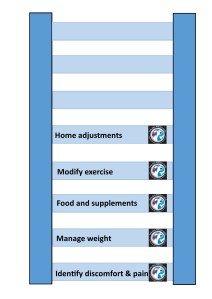
Arthritis management diagram with 5 rungs

Think of the older people you’ve had in your life.  Perhaps Grandma or Grandpa.

Older people may not be able to handle steps as well as they used to, and because they are not as agile on their feet with reduced reflexes, they are more susceptible to slips, trips and falls when navigating obstacles.

The same is true for dogs.

Polished wood, tiles, and linoleum are all slippery surfaces.  You don’t want your dog to lose its footing ever – it only takes one slip to cause an injury.  Non-slip rugs and floor coverings can work wonders to protect your dog before an accident happens.

Stairs and steps are always dangerous surfaces for dogs – even a healthy dog can have an accident on these surfaces.  If you do not have a workaround for your dog using steps (such as going in and out of another door), add non-slip treads in rubber or carpet tiles to the stairs and supervise your dog when going up and down whenever possible.  A harness helps greatly with this.

One of the areas I feel is overlooked when making home adjustments is the possible loss of your dog’s eyesight and the need for better lighting.  Eyesight, particularly during nighttime, can diminish in older dogs.

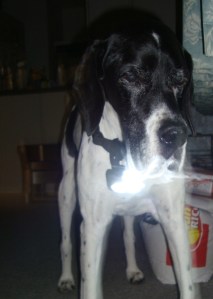
I had personal experience of this with my English Pointer, Daisy.  I noticed that she was becoming reluctant to go outside at night (where we had 2 steps leading down to our walk and yard).  When I’d flip on the light, she was happy again.  I was concerned not just that she could slip/trip on the steps, but also that she may not be able to navigate our garden and could bump into a bush, damage her eyes, etc.English Pointer with Puplight  I could have installed several floodlights to light up the section (but somehow, I didn’t think this was an economical option and one that may also not please the neighbors).

While not a home adjustment per se, I chose a PupLight – a lighted dog collar that I could clip on before sending her out in the dark.  Although marketed as a safety feature for walking dogs at night, the PupLight was ideal in lighting her way ahead of her.

Here’s an example of why I chose the ladder for my diagram on managing older dogs. 

Remember that I said we can go up and down the management steps as we need to?

Well, I had clients with an elderly Golden Retriever.  They initially made adjustments to their home which worked well for a few months.  But then their dog’s mobility got worse.  They were living in a modern two-storey townhouse and all the bedrooms were upstairs with a winding staircase which had a landing halfway up.

Their solution?  Time for another home adjustment.  Only this time they moved their own queen-sized bed into the lounge downstairs and placed their mattress directly onto the floor to reduce its height.

Their elderly Golden Retriever could still sleep with them in bed and navigate ‘jumping’ into bed with them safely!

Got questions about this post?  Please feel free to post a message or contact me through my practice, The Balanced Dog.

Kathleen Crisley, Fear-Free certified professional and specialist in dog massage, rehabilitation and nutrition/food therapy, The Balanced Dog, Christchurch, New Zealand