The Diplomatic Dog

Gracie is the fun, feisty, cute and sporty Yorkie owned by US Ambassador Scott Brown, who recently relocated to New Zealand for his diplomatic post.

Gracie has her own Twitter account.

That makes perfect sense, given that Gracie is an extended member of President Trump’s administration – and Mr Trump is well known for his like and use of Twitter.

News from Gracie so far has been limited because she’s been in quarantine since arriving in New Zealand (she got out yesterday).   New Zealand is blessed with some very unique flora and fauna and it relies on a strong agricultural economy.  Because of this (and the fact that our country is free of diseases like heartworm and rabies), dogs that arrive here from other countries need to have a period of quarantine.

Unlike most dogs who arrive in New Zealand, however, Gracie didn’t arrive as baggage.  Ambassador Brown tweeted a photo of Gracie sitting on his lap on the plane trip to New Zealand.  The perks of being a diplomatic dog!

Scott Brown with Gracie

Scott Brown and his dog, Gracie, on their flight to New Zealand. —Scott Brown via Twitter

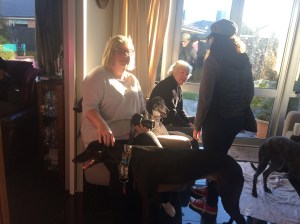
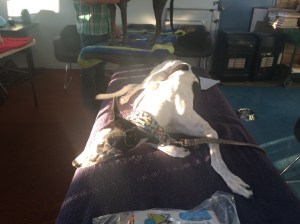
According to Gracie, Brown and his wife visited her in quarantine earlier this month.

Ambassador Brown with Gracie in quarantine

Scott Brown with Gracie in quarantine

Since Gracie is now out of quarantine, she’ll be able to experience all that New Zealand has to offer.

If you ask me (a transplanted American of 23+ years), Scott Brown is very lucky in his posting to this beautiful country.

We hope Scott brings Gracie for a massage.

Kathleen Crisley, specialist in dog massage, rehabilitation and nutrition/food therapy, The Balanced Dog, Christchurch, New Zealand
Dogs help in breast cancer research

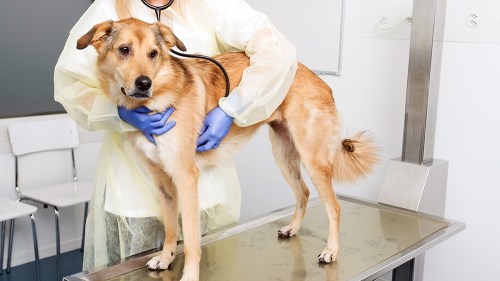
Cancer is one of the most frequent diseases not only in people, but in pets as well. Like people, dogs can also suffer from cancer of the mammary glands (mammary tumors). Dog mammary tumors are very similar to breast carcinoma in humans, and much more so than those of rats or mice, for example. For this reason, research on canine mammary tumors is important for human medicine as well. A study performed at the University of Zurich has now shown how similar mammary tumors are in both people and dogs.

Enni Markkanen, Vetsuisse-Fakultät Zürich, Untersuch Hund

Cancerous cells reprogram healthy cells

For the development of tumors and the progression of a carcinoma, not only the characteristics of the cancer cells themselves are decisive, but also the cells surrounding the tumor play a major role in this. Many tumors even have the capability to reprogram healthy cells in the tumor environment in a way that they start to support the growth of the cancerous cells. This mechanism plays an essential role in human breast carcinoma – but is it the same for dogs? The similarity of breast carcinoma in dogs and humans has been known for a long time. “But whether these tumor cells also influence the surrounding tissue in dogs the same way they do in humans was unknown until now”, explains Enni Markkanen of the Institute of Pharmacology and Toxicology of the Vetsuisse Faculty of the University of Zurich.

Archived tissues are of great value to the research

The researchers analyzed the surrounding tissue of canine mammary tumors using molecular biology and immunohistological methods. To do this, they could access the tissue archive of the Institute of Veterinary Pathology located at the Animal Hospital. “With the permission of our patient’s owners, we conduct pathological tests to better understand diseases,” says animal pathologist Alexandra Malbon. “In the process, we archive samples of various organs and tissues as these samples can be of great value to answer future research questions.”

Dogs suffering from cancer aid cancer research for humans

In the archived samples of mammary tumors from dog patients, Enni Markkanen and her team were able to prove that some cells in the vicinity of tumors behave the same way as the corresponding cells in humans: In the healthy tissue surrounding the tumor, substances are produced that promote tumor growth. “Simply speaking, the tumor enslaves its environment: It forces the surrounding cells to work for its benefit,” Markkanen adds. This mechanism works the same in both humans and dogs. For research on breast carcinoma, tumor tissue of dogs is therefore, among other reasons, much better suitable than tissue from rats or cells cultivated in the laboratory. “Importantly, however, we don’t view our dog patients as test subjects for cancer research,” Markkanen says. “But they can help us to better understand breast carcinoma in both dogs and humans and fight it more effectively.”

Source:  University of Zurich media statement

Ben and Mouse have a birthday

Today Ben and Mouse celebrated their 5th birthday and we were invited.

Ben and Mouse

Mouse (left) and Ben (right)

We see Ben and Mouse at greyhound walks and we are lucky that we have developed friendships with their humans and other humans/greyhounds who were at the party.

In total, 7 hounds attended the party – with no incidents including feeding them their own doggy birthday cake.

Here are some photos of the day:


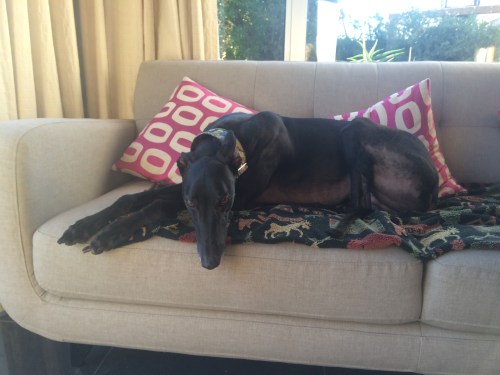
Ben

Ben makes himself at home on the sofa at Mouse’s house

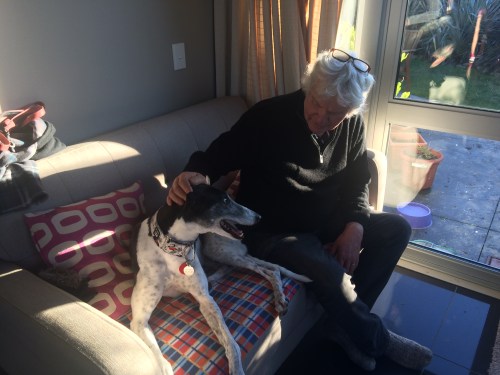
Geoff and Elsie

Elsie charms Geoff

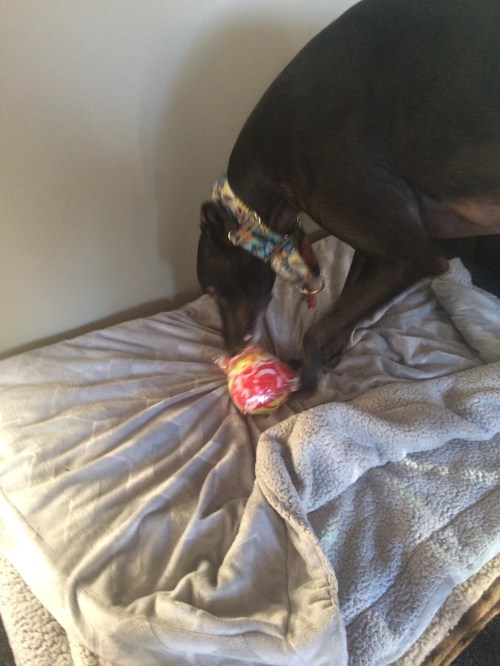
Ben opens his present

Ben opens his present

IMG_1605

A good time was had by all.

Kathleen Crisley, specialist in dog massage, rehabilitation and nutrition/food therapy, The Balanced Dog, Christchurch, New Zealand
Origami dogs

It’s been a terrible week of weather in Canterbury – we’re experiencing deep winter with lots of rain and cold.  It’s also school holidays and one of my clients was telling me that she uses the winter school holidays for rest with the kids.  They do outdoor activities but also lots of puzzles and crafts.

I’ve been wanting to post for a while about origami – the Japanese art of paper folding – and the large range of dogs that can be depicted using this craft.  Let’s start with the rather easy dog face:

Origami dogs

Here are the instructions for creating one:

Origami dog face instructions

Fairly easy.  But have a look at the more complicated origami designs all featuring dogs:

The above dogs were folded by Steven Casey, who has a Flickr account.

Greyhound origami by John Montroll

Greyhound origami by John Montroll

Papillon by Hideo Komatsu

Papillon by Hideo Komatsu

The variety is endless!

Just don’t let these dogs go outside in the rain or snow….

Kathleen Crisley, specialist in dog massage, rehabilitation and nutrition/food therapy, The Balanced Dog, Christchurch, New Zealand
Eddie

Eddie is a one-year old Staffordshire Bull Terrier, and a regular client for massage.

This little boy gets up on the table all by himself…

Kathleen Crisley, specialist in dog massage, rehabilitation and nutrition/food therapy, The Balanced Dog, Christchurch, New Zealand

Another date

Izzy and Bergie had a Date Night Afternoon yesterday.  It’s incredibly satisfying to have them off-lead and able to run and play even with the cold winter weather.

Bergie likes to dig holes.  Izzy seems to admire his skills, taking a front row seat to watch.

These two mean something special to one another and it is a joy to watch them play together.

Kathleen Crisley, specialist in dog massage, rehabilitation and nutrition/food therapy, The Balanced Dog, Christchurch, New Zealand

Sun Seekers

IMG_1552

Izzy the greyhound rests in the late winter sun after a day of teaching a massage workshop for other greyhound owners

Our dogs are warm-blooded mammals, just like we are.  It’s no wonder that so many dogs love sitting in the sun and will move as the sun moves.

Based on the meridian theory of Traditional Chinese Medicine, it makes sense to me that the sun’s warmth will gently warm acupoints, stimulating blood and qi flow and releasing endorphins which make the dog feel better.

Dogs also produce Vitamin D in their skin, it’s a bit like humans only harder because the sun’s rays have to penetrate through their fur.  Dogs aren’t as efficient in converting 7-Dehydrocholesterol, which is the precursor to vitamin D.

If there’s a wound on the dog, sunlight will help to dry it out.  Sunlight is also a natural anti-bacterial (which is why our mothers and grandmothers swore by the need to hang towels and sheets in the sunlight to brighten and freshen them.)  Sunlight can help kill excess yeast which is particularly useful for dogs that fight skin problems relating to yeast.

Even though a dog can sit inside during winter to enjoy the warmth of the sun, windows will filter out some of the sun’s rays which we probably want to have in terms of penetrating through the fur to help with Vitamin D production.  That’s why in winter, I like to exercise Izzy on sunny days without her coat so she receives the full effect of the sun.

Thin coated dogs (like Izzy) have to be protected from UV radiation during summer and the warmer months.  White-coated dogs and those with thin skin over the muzzle or under the arms also need to be protected from sun damage.

But that’s not much of a worry right now, during the depths of the southern hemisphere winter.

Kathleen Crisley, specialist in dog massage, rehabilitation and nutrition/food therapy, The Balanced Dog, Christchurch, New Zealand
Training of explosive-detecting dogs

With a sense of smell much greater than humans, dogs are considered the gold standard for explosive detection in many situations. But that doesn’t mean there isn’t room for improvement.

In a study appearing in the journal Analytical Chemistry, scientists report on a new, more rigorous approach to training dogs and their handlers based on real-time analysis of what canines actually smell when they are exposed to explosive materials.

Vapor analysis training

New training techniques based on real-time analysis of what a dog smells could improve explosives detection. Credit: wellphoto/Shutterstock.com

Explosives are often used in terrorist attacks. Dogs trained to detect odors emanating from TNT, nitroglycerin and other explosives are a crucial part of the first-line defense against these incidents. But delivering low-concentration vapor during training sessions is a challenging task. Cross-contamination of training materials with samples from different explosives can skew results and confuse both dogs and handlers. To address these concerns, Ta-Hsuan Ong and colleagues sought to better understand the components within explosive odors that cue a dog’s reaction.

The researchers developed a real-time vapor analysis mass spectrometer to more accurately measure the vapor plumes from explosives that trigger a canine response.

In field trials, they used the device and found that some mistakes the dogs made were indeed correct identifications. For example, some “blanks” were used that were ostensibly prepared without explosive material, but the dogs indicated an explosive was present. When the researchers used the mass spectrometer on such blanks, they found evidence of explosive vapors, indicating cross contamination occurred or other interferents were present.

Based on these findings, the researchers suggest that use of real-time vapor analysis could help differentiate canine mistakes from cross contamination and other issues during training.

Source:  American Chemical Society

Doggy quote of the month for July

“Acquiring a dog may be the only time a person gets to choose a relative.”

– Mordecai Siegal, author

Izzy the greyhound

Quantifying the Effects of Service Dogs for Veterans with PTSD

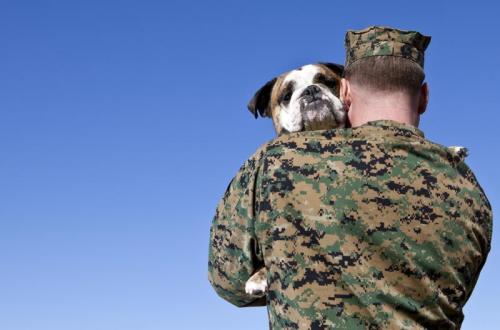
veteran with dog


Researchers from the Purdue University College of Veterinary Medicine’s Center for the Human Animal Bond will analyze the influence service dogs have on the lives of military veterans suffering from post-traumatic stress disorder (PTSD) in a unique clinical trial.

According to the United States Veterans Administration, 22 veterans commit suicide each day, and at least 40 percent have been diagnosed with PTSD. The rate could be even higher, as many cases of PTSD go undiagnosed.

Previous studies have suggested that individuals who bond with their pet dogs exhibit elevated levels of oxytocin – sometimes referred to as the “cuddle hormone” because it sparks emotional responses that contribute to relaxation and trust. Additionally, the National Center for PTSD claims dogs can encourage veterans to communicate more through commands and training, and prompt them to spend more time outdoors and meet new people.

These benefits support anecdotal reports that show an increase in the prevalence of service dogs for individuals with PTSD, but scientific evidence examining this growing trend and its effects on PTSD patients is still lacking.

“Many veterans are increasingly seeking complementary interventions for PTSD, including service dogs,” stated Maggie O’Haire, lead researcher and assistant professor of human-animal interaction at Purdue. “Yet, even with the well-meaning intentions of service dog organizations that are working to meet the demand, our systematic review of scientific literature confirms a lack of published, empirical research on the effects that service dogs have on veterans and their spouses.”

To help carry out the study, the research team has partnered with K9s for Warriors – one of the nation’s leading providers of service dogs to military vets suffering from a variety of conditions including PTSD, traumatic brain injuries, or sexual trauma as a result of service post-9/11.

The team hopes to determine what sort of PTSD symptom changes veterans may experience as a result of having a service dog, as well as any effects on social functioning and physiological biomarkers.

According to a university release, standardized survey instruments and objective measures of physiology will be used to track stress and functioning. The researchers will also use a novel ecological momentary assessment protocol to capture the role and function of the dogs in everyday life.

The results will be the first evidence-based data to be published that quantitatively identifies the roles and effects of service dogs for military veterans with PTSD.

The study is unique because it applies research methodology and evidence-based science to an area that has typically relied on emotion, according to O’Haire.

“Without scientifically sound studies that establish proof-of-concept for the therapeutic efficacy of PTSD service dogs, this animal-assisted intervention strategy will continue to be minimized as an unsupported and potentially unsound practice, despite anecdotal reports that the dogs may have a significant impact,” added O’Haire.

Source:  www.laboratoryequipment.com