Tag Archives: belgian malinois

Genetic links to herding behaviours

It’s a win for Darwin’s Dogs and open access data! A new study published in the journal Science Advances has identified genomic links to the behaviours of herding breeds. The study used data entirely sourced from open-access databases.


Researchers at Korea’s Gyeongsang National University and the U.S. National Institutes of Health analyzed data exclusively from publicly available repositories, including genomic and behavioral data from the community science initiative, Darwin’s Dogs. Their findings are powerful examples of how open science—making research data freely and publicly available—can accelerate discovery by helping scientists leverage existing data in innovative ways.

Herding breeds carry genes linked to cognitive function

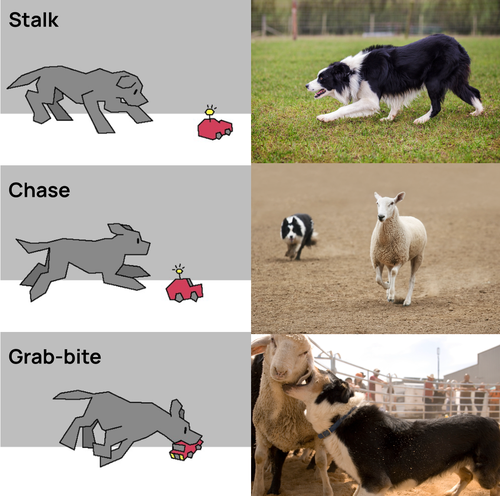
Herding breeds like the Australian cattle dog, Belgian Malinois, and border collie have a long history of helping humans move and manage livestock. These dogs are renowned for their precise motor control, sharp intellect, and unwavering drive. In fact, motor patterns required for effective herding—like eyeing, stalking, and chasing animals without killing them—have been so deeply ingrained in herding dogs through generations of selective breeding that even non-working lines often display these traits. But while herding behaviors have been recognized and refined for centuries, their genetic roots have remained largely unknown.

To explore the genetic foundations of herding behaviors, researchers conducted a large-scale genomic comparison across dogs from 12 herding breeds and 91 nonherding breeds. They identified hundreds of genes that have been naturally selected in herding breeds, several of which, through additional analysis, they found linked to cognitive function.

Narrowing their focus to the border collie, a breed celebrated for its intelligence, the research team identified more than eight genes strongly associated with cognition. One of the standouts was EPHB1, a gene involved in spatial memory. Several variants of EPHB1 appeared across herding breed genomes, suggesting that this gene may support the array of complex motor patterns and decision-making skills essential for herding.
Darwin’s Dogs’ database connects genomic discoveries with behavioral insights

Identifying genes associated with breeds is one thing, but understanding their function is another. This is where Darwin’s Dogs’ open-access behavioral and genomic datasets became critical to expanding the impacts of the study’s findings.

Darwin’s Dogs invites dog owners to participate in scientific research by taking behavioral surveys about their dogs and contributing DNA samples for whole genome sequencing. As part of Darwin’s Ark’s open science commitment, this data is de-identified and made available to researchers around the world, creating a unique open-access resource that allows scientists to explore connections between canine DNA and behavioral traits.

The researchers analyzed data from 2,155 dogs in the Darwin’s Dogs database to see whether dogs with the EPHB1 gene behaved differently than dogs without the gene. They found a strong link between EPHB1 and behavior: dogs with this gene were significantly more likely to show toy-oriented behaviors such as stalking, chasing, and grab-biting toys. These actions closely resemble motor patterns seen in herding behaviors.

This link held true even among dogs with mixed breed ancestry, and within border collies from working versus non-working lines, reinforcing the strong connection between EPHB1 and herding-related behaviors.

Open science opens doors to discovery

This study’s discoveries were made possible through open science. Data from open science initiatives like Darwin’s Dogs—and the thousands of community scientists who shared behavioral insights about their dogs—helped researchers connect genomic markers to observable behaviors. The scale and scope of the Darwin’s Dogs database helped the research team analyze behavioral associations to the EPHB1 gene across dogs with varied breed ancestry.

This research serves as a model for how professional researchers and community scientists can come together to accelerate scientific progress. When community scientists contribute to open repositories like Darwin’s Dogs, the possibilities for discovery are endless.


Resources

Read the paper published in Science Advances: Hankyeol Jeong et al. , Genomic evidence for behavioral adaptation of herding dogs. Sci. Adv. 11,eadp4591(2025).DOI:10.1126/sciadv.adp4591

Source: Darwin’s Ark blog

Military dogs on stamps

The United States Postal Service has announced a new release of stamps for 2019 dedicated to military dogs.

The Forever stamp set includes five, four-stamp blocks (20 stamps in total). Each block has a German Shepherd stamp, a Labrador Retriever stamp, a Belgian Malinois stamp and a Dutch Shepherd stamp.

The release date for the stamps isn’t known yet; but they are going to be hot property for dogs lovers and stamp collectors alike!


Military Dog stamp set

Kathleen Crisley, Fear-Free certified professional and specialist in dog massage, rehabilitation and nutrition/food therapy, The Balanced DogChristchurch, New Zealand

The prescription for a soldier’s PTSD

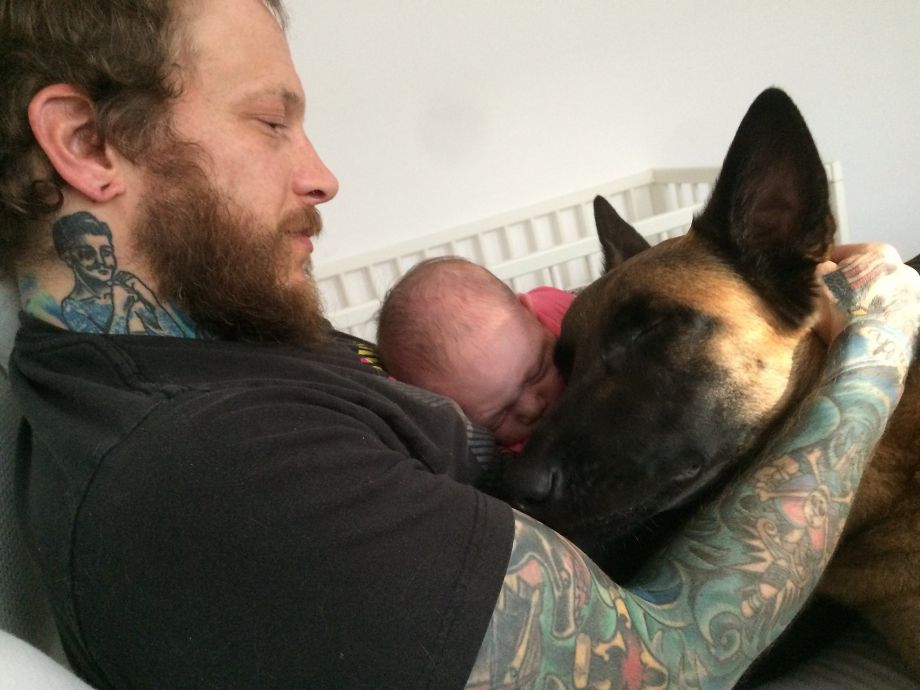
I just found this very short item on the San Francisco Chronicle website.  A photo of a heavily tattooed man, his baby and his dog….

 Photo: Patty Snijders

Photo: Patty Snijders

The man is Ari Sonnenberg with his daughter, Nila Louise Sonnenberg, born April 1, 2015, and his Belgian Malinois dog, Sigmund Freud (also known as  Siggy).

Patty Snijders (Ari’s wife) says: “The dog has helped both Ari and me tremendously. He’s made our marriage stronger and prepared us for parenthood in many ways.”

A simple photograph and a lovely sentiment.  Siggy sounds very special and his presence has clearly been a help to the couple.

The body of knowledge about the value of dogs for our physical and mental health continues to grow, with research and study and stories like those of Siggy and his owners.

Kathleen Crisley, specialist in dog massage, rehabilitation and nutrition/food therapy, Canine Catering Ltd, Christchurch, New Zealand

Secret Service guard dogs are in spotlight after latest White House fence jumping

Meet the special dogs guarding The White House in Washington DC…

Secret Service K-9 Hurricane - black Belgian Malinois, left, and Jordan - black/tan Belgian Malinois. (Courtesy of U.S. Secret Service)

Secret Service K-9 Hurricane – black Belgian Malinois, left, and Jordan – black/tan Belgian Malinois. (Courtesy of U.S. Secret Service)

Secret Service guard dogs are in spotlight after latest White House fence jumping

Hero Dogs – National Geographic June 2014

National geographic June 2014

I have just finished reading the June 2014 issue of National Geographic.  As you can see, the feature story is about the military dogs and the magazine has done a really wonderful job depicting the lives of the soldiers and their bomb detecting dogs.

Some facts:

  • at the height of the wars in Afghanistan and Iraq, the US military had a force of approximately 2,500 working dogs
  • MWDs is the abbreviation for Military Working Dogs
  • A dog’s sense of smell is up to 100,000 times more acute than a human’s
  • The Belgian Malinois has been particularly successful in Iraq and Afthanistan because it can withstand the hot temperatures

Happy reading!

Officer Nikka, Vaughn Police Department

News broke this week that the Town of Vaughn, New Mexico has only one qualified police officer on staff.  And he’s a dog.

The town’s human police chief resigned after it was found that he was not allowed to carry a gun because he’s a convicted felon with a large outstanding sum in child support.  The only other human officer was convicted in 2010 of battery, leaving him unable to carry a gun or make arrests.

That leaves Nikka, who was purchased for the sum of $10,000 to sniff out drugs (drug traffickers work in the area because of its remoteness).

There’s only about 500 residents in the town and no one seems bothered that their only sworn officer is a canine.   Given the character deficiencies of the town’s human officers, some would say that Nikka is an improvement!

Source:  The Times

Kathleen Crisley, specialist in dog massage, rehabilitation and nutrition/food therapy, The Balanced Dog, Christchurch, New Zealand

Top 5 detection jobs for dogs

The American Kennel Club has marked the importance of working dogs by naming the top 5 detection jobs which are performed by dogs.  These jobs are:

  1. Bed bug sniffing  (best performed by breeds such as Beagles, Labrador Retrievers and Belgian Malinois)
  2. Search and rescue  – tracking missing persons, disaster rescue, etc.  (many mixed breeds perform well in this category – just ask the NZ USAR team!)  Also performed by Bloodhounds, Labrador and Golden Retrievers and German Shepherds
  3. Explosives detection (the AKC says that Belgian Malinois, German Shepherds and Vizsla do well in this category)
  4. Cancer detection (Labrador Retrievers – again!)
  5. Allergy alert dogs (Poodles, Portuguese Water Dog and Golden Retrievers seem suited to this work)

Wouldn’t it be nice to see more of these working dogs in use in New Zealand?  (See my previous article on Deak Helton’s research – September 2011)