Tag Archives: dogs

The Throver – the throw made with dogs in mind

I don’t give product recommendations very often but I have to say that the Crypton® Throver is  made with the dog owner in mind.  These all-purpose throws come in various designs, some including dog motifs.  I purchased the Dogland pattern when I purchased my new settee.  Now both Daisy and I enjoy our new furniture.  Here she is.  She’s comfortable and happy and the settee isn’t covered in dog hair.

Throvers are made from Crypton® super fabric that is permanently stain, moisture, mildew, bacteria and odor-resistant.   Made in the U.S.A., this fabric is perfect for the dog-owning household.  We’ve had our Throver for several months, it’s in constant use and it still looks new.  Pet beds and mess mats are also available in this durable fabric.

The Throver is more expensive than other throws on the market (currently retailing for $99.00 for a throw measuring 48″ x 54″) but it’s worth it.

Purchase your throver online from Crypton®.

Olympic torch passes through the Battersea Dogs Home

The Olympic torch is making its way through all 32 boroughs of London in advance of Friday’s start to the Olympic Games.

Dogs haven’t been left out of these preparations!  Earlier today Michael Owen, a former player with Manchester United, carried the torch through the Battersea Dogs Home with a Staffordshire Bull Terrier named Rory on lead.

Tune in here for the photos…

Dog intelligence

Most dog owners have an opinion about their dog’s intelligence.  I regularly hear comments like, “He’s so smart, he’s ahead of the rest of his obedience class” or “He’s not very bright, but we love him.”

 When I was working on my management qualification years ago, we were told to go home and ask our partner/flatmate about how they solved problems.  Ebony, my Labrador flatmate at the time, came up with these tips, which I thought were very intelligent:

  1. Remember that chasing your tail does not get you anywhere.  It also makes you dizzy and less able to focus on the task at hand.
  2. Eat regularly and often.  Problem solving is hard work and requires energy.
  3. Don’t underestimate the value of a nap.  A problem looks different after you’ve had a good sleep.
  4. If you stare at a problem long enough, it might move on its own.
  5. Don’t be afraid to ask for help.  Try looking cute.
  6. If looking cute doesn’t work, try whining.
  7. If whining fails, loud retching noises are guaranteed to get the attention of those around you.
  8. Some problems soften over time.  Burying them in the garden hastens this process.
  9. Some problems require more immediate attention.  An immediate problem, if left unattended, is likely to result in a much more smelly mess to be cleaned up later.

There are many published works on the subject of dog intelligence.  Over the years, I’ve read countless research studies into this subject.  There are many institutions involved in the research.  All projects have the goal of understanding how dogs think.

Professor Stanley Coren of the University of British Columbia has authored several books about dog intelligence.  He states that dogs have the intellectual capacity of a two-year old and can understand more than 150 words.[1]

Researchers at the Max Planck Institute for Evolutionary Anthropology have studied the ability of dogs to interpret human gestures.  When researchers hid food beneath one container in a group and pointed to the ‘right’ container, dogs consistently picked up on those cues better than even chimpanzees (a species widely studied because of the evolutionary link between apes and humans).

Earlier this year, a research team at the University of Otago reported on their study that showed that dogs could readily distinguish happy human sounds from sad or angry ones, suggesting an ability to understand human emotions.

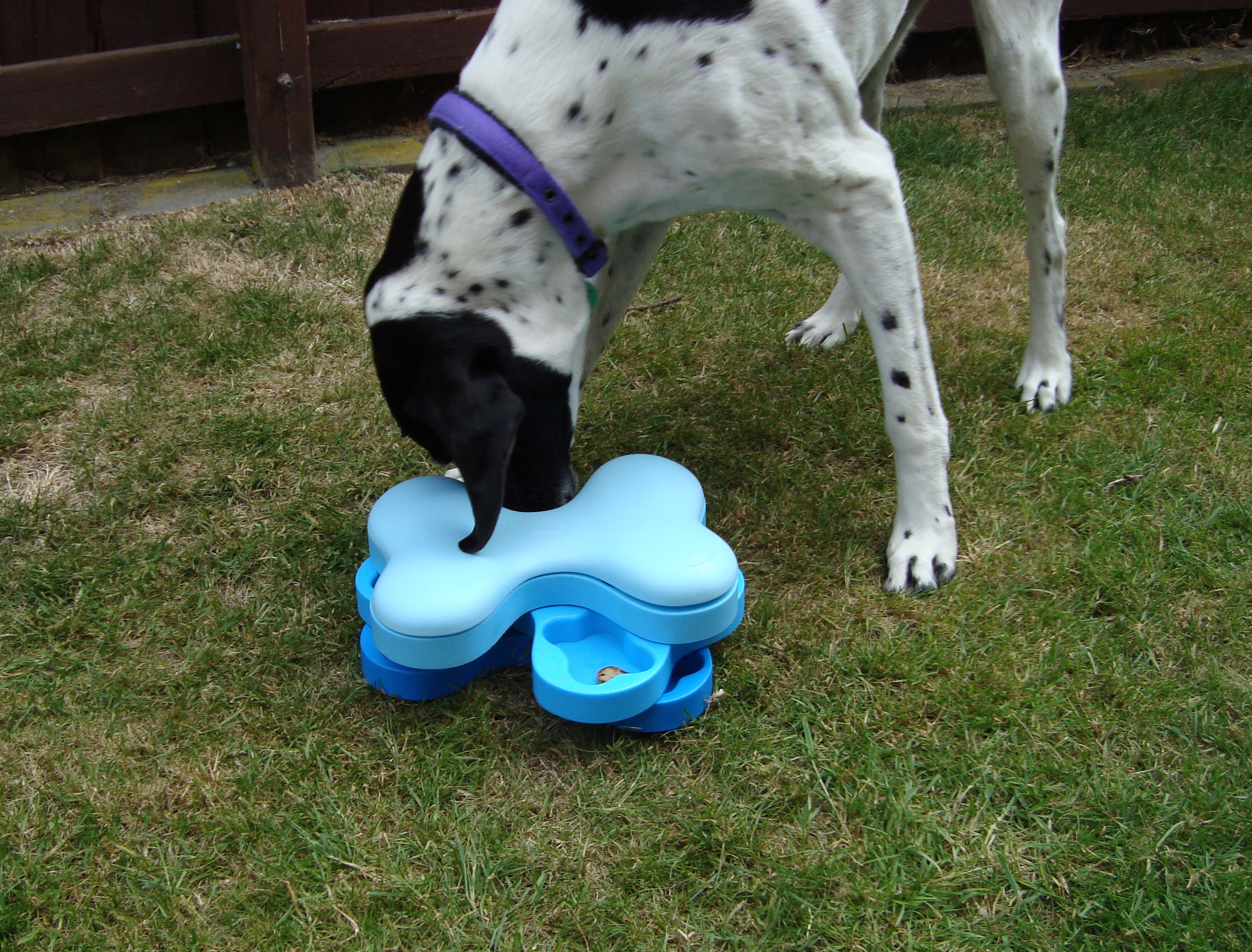
Even the dog toy market has recognised that dogs need mental stimulation.  The Nina Ottosson range, for example, offers a range of skill level toys designed to make your dog think about how to reveal their food reward.

Daisy demonstrates her intelligence with a Nina Ottosson toy

Despite all of this evidence, including videos of my Daisy using her interactive toys, many of the non-dog people in my life remain unconvinced about the intelligence of dogs.  I believe that persistence will pay off.  Over time we will see more and more research about the intellectual capacity of our dogs.  The non-believers will become believers.


[1] Science Daily, 10 August 2009

Of dogs, house dust and asthma…

This is a tale of how owning a dog can help protect your child from asthma.  Strange, but true.

Researcher Dr Kei Fujimura used mice to test the impact of house dust from homes where a dog lived and from those that didn’t.  She found (and her study was presented at a recent meeting of the American Society for Microbiology) that the dust from households with dogs seemed to have a beneficial effect.

Mice who were fed dust from these households developed an immune response to RSV(respiratory syncytial virus).  Infants who contract this virus have a marked increase in their risk of developing asthma.  RSV affects 90% of children worldwide.  That makes this study significant.

Dr Fujimura says these results support the hypothesis that exposure to animals in early childhood stimulates the immune system to resist the development of asthma and other allergies.

Another reason to introduce your children to the wonders of dog ownership at an early age!

Source:  Discovery News

The importance of pain management

Whenever I take on a new client, I use a health questionnaire that covers current conditions as well as the dog’s health history.  One of the issues I address is any recent changes to the dog’s behaviour or living conditions.

What I am trying to ascertain is if a dog is in pain or having adjustment difficulties. There is a clear link between pain and aggression and this has been supported in a recent study by researchers at the Autonomous University of Barcelona in Spain.

In the Spanish study, which has been published in the Journal of Veterinary Behavior, 12 dogs that were brought in by their owners for ‘aggression problems’ were studied.  All were found to have pain-induced aggression with eight diagnosed as having hip dysplasia.

The breeds in the study were:  a Giant Schnauzer, Irish Setter, Pit Bull, Dalmatian, two German shepherds, Neapolitan Mastiff, Shih-tzu, Bobtail, Catalan Sheepdog, Chow Chow and Doberman.

The researchers concluded “if the pet is handled when in pain, it will quickly act aggressively to avoid more discomfort without the owner being able to prevent it.”

So, when a dog is behaving differently or is “out-of-sorts”, a visit to the vet is recommended.  Behaviour changes can be the first indicator that something is wrong and your vet can help to run appropriate tests to see if there is an underlying health problem.

Dogs have a way of not telling us they are in pain until a problem is more pronounced because their natural instinct is to protect themselves by not exhibiting any noticeable vulnerabilities.  Therapies such as massage and low level laser (which I employ in my canine rehabilitation practice) are useful in helping to manage pain through appropriate stimulation of acupressure points and managing muscle, tendon and ligament condition.  I’m also a strong supporter of acupuncture and refer clients to a local vet who is trained in veterinary acupuncture.

These complementary therapies can be employed alongside traditional pain medications such as NSAIDs to support your dog’s quality of life.  When pain is managed, quality of life improves for everyone in the household.

Source:  Plataforma SINC. “If your dog is aggressive, maybe it is in pain.” ScienceDaily, 13 Jun. 2012. Web. 15 Jun. 2012.

Dog dreaming

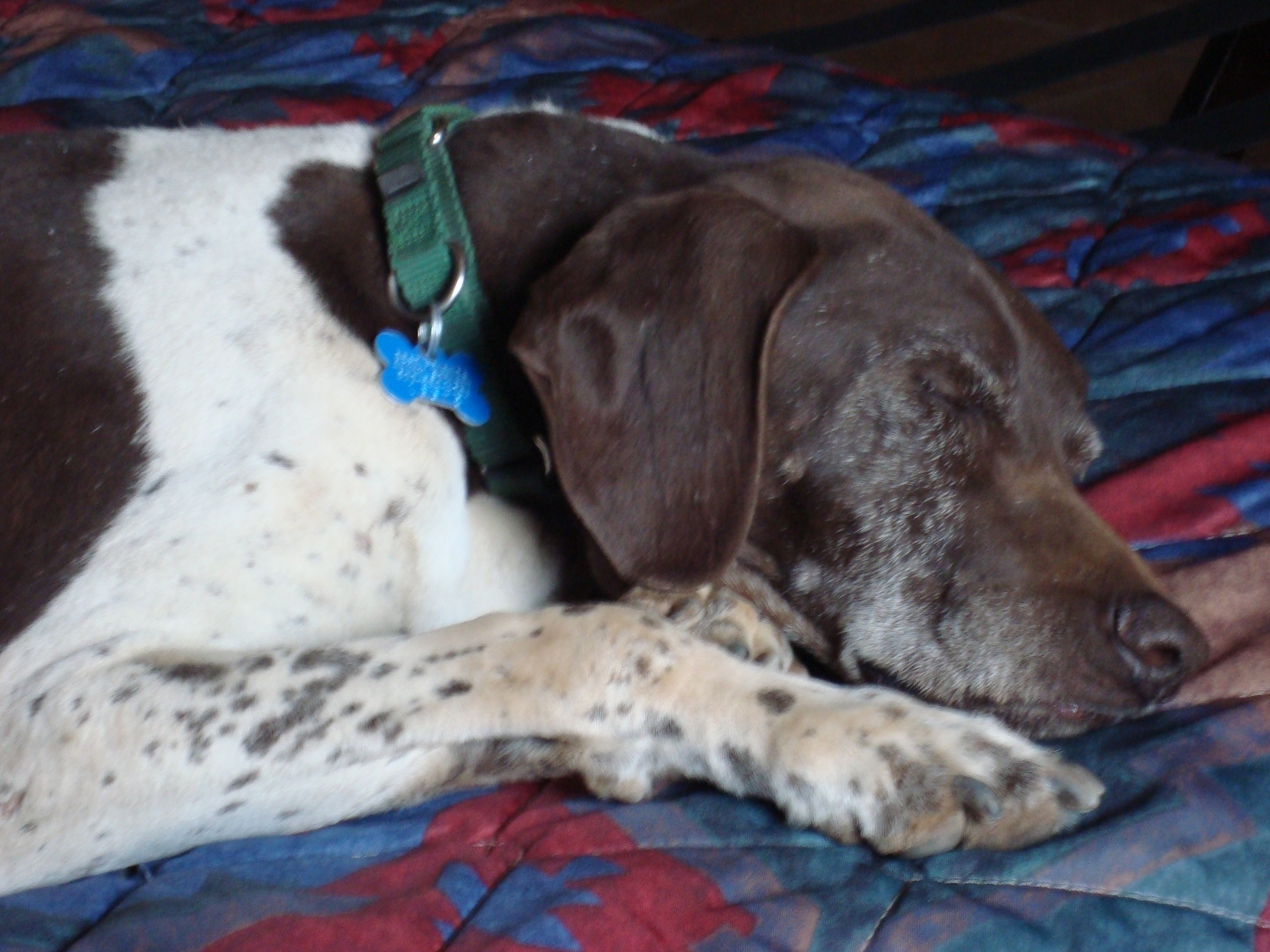
We’ve all seen our dogs deeply asleep, with paws and legs twitching.  There have even been times when my dog puts her head up while sleeping and howls like a wolf.  (She usually wakes herself up, too).

Do our dogs dream?

All evidence points to an answer of ‘yes’.

Researchers know, for example, that the EEGs (electroencephalograms) of sleeping dogs show brain wave activity similar to humans during sleep.  There is a period of sleep known as REM sleep (REM means rapid eye movement) when breathing becomes irregular and the eyes twitch.  Sound familiar?

When humans have been wakened during REM sleep, they report that they have been dreaming and so there is no reason to think that our dogs aren’t dreaming. 

Matthew Wilson, Associate Professor of Brain and Cognitive Sciences at the Massachusetts Institute of Technology says that animals have complex dreams and are able to retain and recall long sequences of events while they are asleep. 

His work involved rats and monitoring their brain wave activity when they were asleep and awake.  He also tracked the effect of sleep on learning of repetitive tasks.

Professor Wilson has said of his work “dreams are the ultimate off-line experience. This work demonstrates that animals are capable of re-evaluating their experiences when they are not in the midst of them.”

By the way, dogs, cats and rabbits are crepuscular which means that they naturally tend to be more active at dawn and at dusk.  Humans are diurnal which means they are most active during the day (which explains why night shifts are so hard on people).  Dogs seem to adjust their own sleep habits to match those of their owners.

What is your dog thinking? Researchers are on the case!

Researchers at Emory University have published new research into canine cognition.  Entitled Functional MRI in Awake Unrestrained Dogs, the paper outlines findings of research that required two dogs to remain motionless in an MRI machine.

Yes – that’s right. Motionless.  The two dogs were outfitted with special ear muffs to protect them from the noise of the MRI and trained to rest their heads on a chin rest inside the machine.   As the MRI took scans of the dog’s brain activity,  hand signals were used to show the dogs whether there was or wasn’t a food reward.

This is a first-ever study on awake dogs, rather than those that have been sedated.  Importantly, part of the animal ethics of the study was to ensure the dogs were willing participants.

The findings show a definite brain activity response when the hand signals indicated a food reward.  Those dogs are paying attention!

The lead researcher, Professor Gregory Berns, says “We hope this opens up a whole new door for understanding canine cognition and inter-species communication. We want to understand the dog-human relationship, from the dog’s perspective.”

Professor Bern’s dog Callie in training in a mock-up of the MRI scanner (copyright Emory University)

Listen to Professor Berns talk about this project in the Emory University YouTube video:

Source:  Emory University press release 4 May 2012

Dogs of the Titanic

This week, the world will commemorate the 100th anniversary of the Titanic’s maiden voyage and sinking in the North Atlantic.  As with many moments in history, dogs were part of this event.

Dogs were among the passengers of the Titanic and the ship had dedicated kennel facilities.  A dog show had been planned on board the ship for Monday 15th April. When the ship was sinking, it was reported that a passenger went to the kennels and released the dogs to save them from drowning in their cages.

According to (mixed) records, between 10 and 12 dogs were on board the ship.  The Astors  (perhaps the richest passengers on board) were traveling with their Airedale named Kitty.   Each day a member of Titanic’s crew would exercise the dogs on deck.

The Astors with their dog

A photo (unattributed) reported to be staff of the Titanic taking dogs for a walk on deck.

Three dogs survived the sinking. There was a Pomeranian owned by Miss Margaret Hays of New York; the pair escaped in lifeboat Number 7.  Elizabeth Rothschild escaped in lifeboat Number 6 with her Pomeranian.   The other dog was Pekingese named Sun Yat Sen owned by Henry Sleeper; owner and dog escaped in lifeboat Number 3.

The Titanic Museum in Branson, Missouri has established the world’s first tribute to dogs of the Titanic.  Mascots Molly and Carter greet guests each day from Wednesday to Sunday  and show them the kennel facilities of the ship, along with stories of dogs aboard.  This creative commercial for the exhibit is found on YouTube:

Not to be confused with actual history, a book by Marty Crisp for young adults tells the story of White Star:  A Dog on The Titanic.  In this fictional story, a 12-year old named Sam Harris is traveling from England to America.  Sam volunteers to help out in the Titanic’s kennels and meets Star, an Irish Setter. The boy and dog live through the sinking.

White Star: A Dog on the Titanic

Ms Crisp compiled the following canine passenger manifest when she researching for her book about White Star:

Owners Breed Boarded Home Cabin # Lifeboat Survived?
Robert Williams Daniel, 27,
a banker traveling alone
1) French bulldog“Gamin de Pycombe” Southampton Philadelphia Went down with the ship and was pulled aboard by a lifeboat Daniel- yes; Bulldog- no, although it was seen in the water by R.N. Williams
Henry Sleeper Harper, 48,a publishing scion traveling with his wife, Myra, 49, a manservant, and an Egyptian dragoman 2) Pekinese“Sun Yat Sen” Cherbourg New York City D-33 Lifeboat 3 wife, servant and companion all escaped in LB3 Harper-yes; Pekinese-yes
Helen Bishop, 19,newlywed, honeymooning with Dickinson H. Bishop 3) small, unknown breed“Frou Frou” Cherbourg Dowagiac, Michigan B-49 Lifeboat 7 Bishop and her husband- yes; Frou Frou- no, left locked in cabin
Harry Anderson, 47,stockbroker, traveling alone 4) Chow Southampton New York City E-12 Lifeboat 3 Anderson- yes; Chow- no
William Ernest Carter, 36,traveling with his wife, Lucile, 36, daughter, also Lucile, 14, and son, William the II, 11. Also traveling with a maid and manservant 5) and 6) two small dogs.One was a King Charles Spaniel and the other  breed is unknown. Southampton Bryn Mawr, PA. B-96 and B-98 Collapsible C; wife and children left the ship in Lifeboat 4; servants were both lost All members of family- yes; dogs- no
Margaret Hays, 24,traveling alone 7) Pomeranian Cherbourg New York City C-54 Lifeboat 7 Hays-yes; Pomeranian-yes
Col. John Jacob Astor, 47,real estate tycoon traveling with his pregnant wife, Madeleine, 19, and a maid and a manservant 8) and 9) Airedale, “Kitty,” and a second dog, probably also an Airedale,per a report from survivor Edwiga Goldenberg Cherbourg New York City C-62 Astor went down with the ship and was crushed by a falling funnelManservant was lost. Wife and maid survived on Lifeboat 4. Astor- no; Airedales- no; wife- yes
William Crothers Dulles, 39,attorney, traveling alone 10) unknown breed,listed in channel crossing records simply as “dog.” Possibly a Pomeranian or a fox terrier Cherbourg Philadelphia A-18 Went down with the ship Dulles- no; dog- no
Ann Isham, 50,spinster expatriate who had been living in Paris with her sister for the previous nine years (Isham is a possible, not a verified, dog owner.) 11) Great Dane(could also have been a Saint Bernard or a Newfoundland) Cherbourg Paris and New York City C-49 Refused to get in a lifeboat without her dog. Isham- no; dog-no.  A woman was spotted by passengers on the German liner “Bremen” two days after the sinking, floating in her lifejacket with her arms wrapped around a large dog.
Elizabeth Barrett Rothschild, 54,wife of leather magnate Martin Rothschild, traveling with her husband 12) Pomeranian Cherbourg New York City Lifeboat 6 Rothschild- yes; Pomeranian-yes Mrs. Rothschild and her dog were on the same boat as the famously unsinkable Molly Brown. Martin Rothschild went down with the ship.
FICTIONAL Sam Harris, 12,returning to the U.S. after three years of boarding school in England. Irish setter,”White Star,” owned by J. Bruce Ismay, president of the White Star Line and also a passenger on the Titanic. Southampton for Sam; Queenstown, Ireland for the dog Lancaster, PA. B-47 Lifeboat 4 Sam- yes; Star- yes.  Boy and dog were rescued from the water right after Lifeboat 4 was lowered.

Benefits of taking Fido to work may not be far ‘fetched’

The  benefits of dogs in the workplace are the subject of new research published in the March issue of the International Journal of Workplace Health Management.

Researchers at Virginia Commonwealth University  found that the presence of dogs in the workplace may buffer the impact of stress during the work day in both their owners and the people that they come into contact with.

In this YouTube video, principal investigator Dr Randolph T Barker (no pun intended) talks about the costs of stress to employers through lost work time and the benefits of increased productivity.

The researchers conducted their study at Replacements Ltd, the pet-friendly workplace that I featured here in March 2011.

Although Dr Barker is a Professor of Management, he collaborated with specialists in psychiatry and biostatistics for this study.  The researchers emphasise that their results are preliminary and that the next step is to expand the study to a larger sample size in an organisational setting.

I wonder which firm will put their hand up for that study?

Doggy quote of the month for April

“I like animals.  If you talk to a dog or a cat it doesn’t tell you to shut up.”

–  Marilyn Monroe