Tag Archives: german shepherd

Tail chasing – an obsessive compulsive disorder?

The genetics research group at the University of Helsinki has published its findings into a study of tail chasing in dogs.  The study involved 400 dogs and questionnaires to the owners about their dog’s behaviour.  Samples of each dog’s blood were also taken.

The questionnaires covered behaviours, aspects of the dog’s puppyhood and daily routines.  Owners were also asked to evaluate their dog’s personality.

Compulsive tail chasing can occur in any dog but is common in breeds such as the Bull Terrier and German Shepherd.  These breeds were included in the research, as were the Miniature Bull Terrier and the Staffordshire Bull Terrier.

The study aimed to describe the characteristics of tail chasing in dogs and to ascertain the environmental risk factors for the disorder.  The researchers also wanted to know if a previously identified gene that has been associated with obsessive compulsive disorder (OCD)  had a role to play.

What they found

  • The OCD gene that had been linked to other compulsive disorders in dogs was not associated with the tail chasing disorder
  • Dogs responded with less tail chasing when fed supplements of vitamins and minerals, although the researchers feel that more study is warranted to prove this link
  • Early separation from their mothers and/or poor care from their mother also predisposed dogs to compulsive tail chasing

Dogs may be a good model for studying OCD in humans because they are physiologically similar and share our environment.  Consequently, this research has wider implications.

The research paper is available in the 27 July 2012 edition of PloS ONE

Source:  University of Helsinki press release

Kathleen Crisley, Fear-Free certified professional and specialist in dog massage, rehabilitation and nutrition/food therapy, The Balanced Dog, Christchurch, New Zealand

The Lucky One

I’ve just finished reading The Lucky One by Nicholas Sparks.  What attracted me to the book was the fact that the story is predominantly set at a boarding kennel and that one of the main characters, Zeus, is a German Shepherd.  It helped that the book was previously on the New York Times Bestseller list and so others must have liked it too.

I hadn’t realised that Nicholas Sparks is a the author of novels like The Notebook and Nights in Rodanthe, which were successfully made into movies (I liked both movies).  As it turns out, The Lucky One has just been made into a film starring Zac Efron but it hasn’t shown here in New Zealand yet (more on that later).

This is a story of Logan, a veteran of the conflict in Iraq, who finds a photograph in the desert of a woman.  The photo goes unclaimed at the camp and so Logan keeps it and it becomes his good luck charm.  When he leaves the US Marines and returns to the United States, he goes on a quest to find the woman in the photo – with Zeus his loyal German Shepherd for company.

He finds Elizabeth, a divorced mother, living with her grandmother who runs a boarding  kennel.  He starts working there and through the book we learn about the original owner of the photo and the traumatic experiences that Logan endured during his time in Iraq.  We also learn about his best friend, Victor, who encouraged him to find the woman in the photo…

There’s some suspense at the end of the book (but I found this didn’t really live up to the marketing on the book’s cover).  I won’t tell you whether or not Logan and Elizabeth end up together, either.  I will say that this was a solid story and it’s pleasing to see a dog take up a major role in the book.  It’s worth a read.

And so back to the movie thing.  When I read the book, I definitely didn’t picture Zac Efron as Logan.  He’s too young and fresh-faced and lacks the solid build of a Marine – at least that’s my opinion.  I don’t think I’ll be going to see the film when it shows here – I liked the story but I didn’t love it.  (And I’m sorry if this offends the many Nicholas Sparks fans that are out there).

The importance of pain management

Whenever I take on a new client, I use a health questionnaire that covers current conditions as well as the dog’s health history.  One of the issues I address is any recent changes to the dog’s behaviour or living conditions.

What I am trying to ascertain is if a dog is in pain or having adjustment difficulties. There is a clear link between pain and aggression and this has been supported in a recent study by researchers at the Autonomous University of Barcelona in Spain.

In the Spanish study, which has been published in the Journal of Veterinary Behavior, 12 dogs that were brought in by their owners for ‘aggression problems’ were studied.  All were found to have pain-induced aggression with eight diagnosed as having hip dysplasia.

The breeds in the study were:  a Giant Schnauzer, Irish Setter, Pit Bull, Dalmatian, two German shepherds, Neapolitan Mastiff, Shih-tzu, Bobtail, Catalan Sheepdog, Chow Chow and Doberman.

The researchers concluded “if the pet is handled when in pain, it will quickly act aggressively to avoid more discomfort without the owner being able to prevent it.”

So, when a dog is behaving differently or is “out-of-sorts”, a visit to the vet is recommended.  Behaviour changes can be the first indicator that something is wrong and your vet can help to run appropriate tests to see if there is an underlying health problem.

Dogs have a way of not telling us they are in pain until a problem is more pronounced because their natural instinct is to protect themselves by not exhibiting any noticeable vulnerabilities.  Therapies such as massage and low level laser (which I employ in my canine rehabilitation practice) are useful in helping to manage pain through appropriate stimulation of acupressure points and managing muscle, tendon and ligament condition.  I’m also a strong supporter of acupuncture and refer clients to a local vet who is trained in veterinary acupuncture.

These complementary therapies can be employed alongside traditional pain medications such as NSAIDs to support your dog’s quality of life.  When pain is managed, quality of life improves for everyone in the household.

Source:  Plataforma SINC. “If your dog is aggressive, maybe it is in pain.” ScienceDaily, 13 Jun. 2012. Web. 15 Jun. 2012.

Heroic dogs in the face of house fires

Our local newspaper ran a story recently about a little dog that woke her owners when their garage caught fire.  Luckily, the damage was fairly minor and all (including the dog) escaped harm.

It was that story that got me thinking about all of the stories we hear, year in and year out, about dogs that act instinctively to warn their owners of danger or to get help.  Here’s just a few dog hero stories that I’d like to share about dogs who have saved their owners or alerted others about fires.

_____________________________________________________

Brutus alerts sleeping family to burning garage (February 2012)

Dog alerts sleeping family to house fire (December 2011)

Dogs saves owner during house fire – Clyde the Great Dane! (November 2011)

Dog warns Daytona man of fire in house (November 2011)

Dog warns man of house fire (October 2010)

And one last video, taken from the camera on board the vehicle of an Alaskan State Trooper – showing the family dog Buddy leading the officer to the family’s home which was on fire…

Kathleen Crisley, specialist in dog massage, rehabilitation and nutrition/food therapy, The Balanced Dog, Christchurch, New Zealand

When your comrade is your dog

News broke this week that Megan Leavey, a former corporal with the US Marines, has won her fight to be reunited with her ex-partner Rex.  Rex, her comrade-in-arms in Iraq, is a bomb-sniffing dog who is retiring at the age of 11.

Leavey originally asked to adopt Rex five years ago and was refused.

Both Megan and Rex were injured in 2006 when a bomb exploded in Ramadi.  Corporal Leavey was awarded a Purple Heart and subsequently discharged in 2007.   After her request to adopt Rex was declined, she followed the dog and his progress from afar.  When it became clear that Rex was to be retired from duty and likely to be put down, Leavey lobbied again for her chance to take care of Rex.

These photos, courtesy of Megan Leavey, show the pair together.

This slideshow requires JavaScript.

Dogs on the Hollywood Walk of Fame

Along a stretch of about 15 blocks of Hollywood Boulevard in Hollywood, California is the Hollywood Walk of Fame.   Stars are embedded in the pavement to honor achievements in the entertainment industry and are a major tourist attraction for anyone visiting Hollywood.

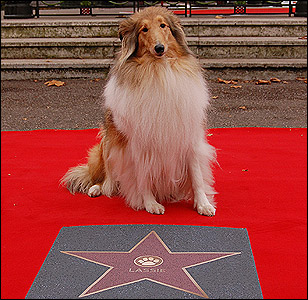
Three members of the Walk of Fame are canines:  Rin Tin Tin, Lassie and Strongheart (a canine star of silent films).

Strongheart was a German Shepherd that was born in 1917 and lived until 1929.  He starred in a number of films including White Fang and was sadly injured on a movie set when he was burned by a studio light.  The burn became tumorous and was responsible for his death.

Strongheart, an early canine star in Hollywood

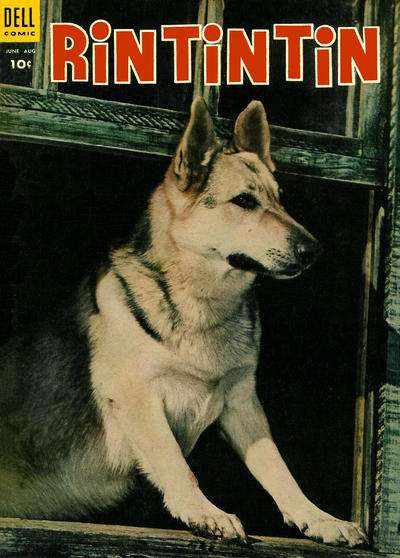
Rin Tin Tin, another German Shepherd, is probably more well known.  The first Rin Tin Tin was born in 1918 and featured in 26 films for Warner Brothers studios.  There have been many successors to the first Rin Tin Tin and the dog has featured in comic books and other memorabilia.  You can learn lots more by visiting his official web site.

Most dog lovers will know about Lassie, a Collie dog who starred in Lassie Come Home in 1943.  The film was based on a novel that was published several years earlier.    Lassie was played by a dog named Pal.  Lassie went on to feature in a television programme, comic books, animated films, radio and other children’s books.  Like Rin Tin Tin, there have been a number of Lassies over the years.  Lassie also has an official web site.

Lassie on the Hollywood Walk of Fame

If you are visiting California, why not honour the dog stars of Hollywood by visiting them on the Walk of Fame?