“It is the same with dogs as with children, if one wants them to be loved, they must be well brought up.”
– Madame Charles Boeswilwald, 19th century French author

“It is the same with dogs as with children, if one wants them to be loved, they must be well brought up.”
– Madame Charles Boeswilwald, 19th century French author
Posted in dog quotes
Tagged 19th century, children, dogs, French author, Madame Charles Boeswilwald
I’ve just signed Izzy up so we can complete a C-Barq questionnaire for her.
I know what you are thinking: you don’t ‘see’ barks, you hear them. Well actually, C-Barq stands for ‘Canine Behavioral Assessment and Research Questionnaire’ and it’s another example of citizen – or participatory – science.
Created by Dr. James Serpell who is a behaviorist at the Center for the Interaction of Animals and Society (CIAS) in Pennsylvania, the questionnaire is designed to provide dog owners and professionals with standardized evaluations of temperament and behavior. The Center is based within the School of Veterinary Medicine at the University of Pennsylvania.

Tested extensively for reliability and validity on large samples of dogs of many breeds, the current version consists of 101 questions describing the different ways in which dogs typically respond to common events, situations, and stimuli in their environment. It should take about 15 minutes to complete (I haven’t done this yet).
Please pay attention, however, to the sign-in page where questions are asked about your dog’s breed, background, and behavior. This helps in coding the answers for analysis.
So far, over 80,000 dogs have been included in the study. Dr Serpell says, “There is no other breed or species of animal with such a wide variety of appearance and behavior.”
Between 10 percent and 15 percent of dogs can show very high levels of aggression, Serpell says, while 20 or 30 percent show no aggression.
Pit bulls and Akitas, popular breeds for fighting and guard dog duty, show serious aggression toward other dogs. But the title for most aggressive overall actually goes to tiny dachshunds, which display heightened aggression toward dogs, strangers and even their owners.
Source: Science Friday on pri.org
Kathleen Crisley, specialist in dog massage, rehabilitation and nutrition/food therapy, Canine Catering Ltd, Christchurch, New Zealand
More on tomorrow’s Oscar awards…
…look out for the new commercial by Coldwell Banker Real Estate. Entitled “Home’s Best Friend,” the commercial is part of a new project partnership – Homes for Dogs – with website Adopt-A-Pet.com to find 20,000 animals new homes in 2015.
Of course this commercial is designed to garner customers for Coldwell Banker. But animals will also benefit…and that’s fine by me!
See also how pets will benefit from this year’s awards at And the Oscar goes to…
Kathleen Crisley, specialist in dog massage, rehabilitation and nutrition/food therapy, Canine Catering Ltd, Christchurch, New Zealand
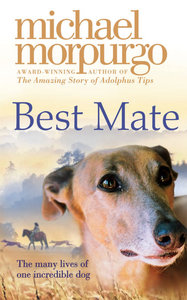
Best Mate is a book for young readers, approximately 10 years of age. I picked up my copy at an outdoor market for just $3 (the book was originally published in 2007). Since I am now the proud owner of a re-homed racing greyhound, it was the greyhound on the cover that caught my eye.
It was, of course, an easy read. But I can highly recommend this book which tells the story of a greyhound pup rescued by a small boy, Patrick, on his way to school. Named ‘Best Mate’, the pup was discarded in a river canal in a sack with his litter mates.
And so begins a story of a dog and a child’s insight into animal cruelty. Best Mate loves Patrick and Patrick loves him. The two are separated when Best Mate is stolen for racing. There he meets a young girl named Becky who names him Brighteyes and he makes a friend with another racing greyhound.
But that is not the end of his story, or the cruelty that the book portrays. Be prepared to support the young reader in your home: Best Mate’s friend is killed when he can no longer win races.
Best Mate will ultimately be re-homed yet again before the end of the book, and this time he ends up with the name Paddywack.
There are a few chapters in this book written from Best Mate’s perspective. The only thing that would strengthen the book is to hear more from Best Mate himself.
This book should be on your child’s reading list. It is a good introduction into animal welfare issues and a good first insight into the greyhound racing industry.
My reading of this book is all the more timely since news has hit the media this week about ‘live baiting’ in Australian greyhound racing…the book doesn’t portray live baiting, but I felt a connection to the story nonetheless because of the headlines.
Kathleen Crisley, specialist in dog massage, rehabilitation and nutrition/food therapy, Canine Catering Ltd, Christchurch, New Zealand
Yale University’s Canine Cognition Center has recruited hundreds of dogs for a study into how the dog’s mind works.
In a puppet show-like performance, dogs watch a rat puppet help a hedgehog up a hill. In another scene, the rat knocks over the hedgehog. And the researchers want to know what the dogs think about that…
“Similar studies have been done with human infants, and what you find is that human infants — they don’t like the guy who was mean. And so we’re doing the same thing with dogs to try to see — do dogs morally evaluate as humans do?” Professor of Psychology Laurie Santos said. Santos is the Director of the Center.
So far, the results show that the dogs are wary of the rat.
In another test, the dog sits and watches as their human sits and reads a book. The human puts the book on the floor behind them and, soon after, the book is taken by someone who comes into the room.
“What we’re really trying to see is whether or not dogs know when they’ve missed some information. Can they realize that, first of all, and when they do realize it, are they motivated to help?” Santos said.
Consistently, the dogs not only realize something is wrong, but they also seem to be trying to alert their companions. Owners regularly give feedback that they believe their dog is observant and knows what they are thinking. This research seems to back up those (amateur and probably biased) observations.
So far, Yale researchers have tested 300 dogs and found that the dog mind is much more complex than they originally thought. There’s more work to be done and thousands of dogs on their waiting list…
Source: CBS News
On 22 February 2015, Hollywood celebrities will gather for the 87th annual Academy Awards. Only a few talented individuals will walk away with the top prize.
But, like last year, those who do not win in the top 5 Oscar categories (Best Director, Best Actress, Best Actor, Best Supporting Actress and Best Supporting Actor) will still be given a gift – a donation of 10,000 meals to the animal rescue of their choice. The donation is made possible by Ellen DeGeneres and her dog food company, Halo, Purely for Pets in partnership with Freekibble.com.

The donations are part of a PR campaign called Everyone Wins at the Oscars® which is organized by a Los Angeles marketing firm specializing in product placement. (The Academy Awards has no affiliation with these gifts – called ‘swag bags.’).
The bag contains many high-end gifts, a value of US$125,000!
Source: News.com.au
Posted in animal welfare
Tagged Academy Awards, dog food, Ellen DeGeneres, Freekibble, Freekibble.com, Halo, Hollywood celebrities, oscars
Animals, including dogs, may need blood donations at critical points in their lives.
The University of Veterinary Medicine, Vienna has operated a blood bank for dogs for more than a decade.
Reasons for a blood transfusion among dogs (and cats) are usually serious accidents, large operations, certain types of cancer, cases of intoxication with rodent poison, serious infectious diseases such as the tick-borne babesiosis, and blood illnesses including haemolytic or inherited bleeding disorders such as haemophilia.
At the University of Veterinary Medicine, Vienna dog owners can bring their animals to donate blood regularly or as needed. Blood donations two to four times a year per dog is the maximum. About 15 minutes are required for a donation. Dogs must have a minimum weight of 25 kilograms and usually donate about 450 millilitres of blood at each session.

Photo by Felizitas Steindl / Vetmeduni Vienna
Animal blood, as well as human blood, is divided into various groups based on different surface proteins found on the red blood cells. More than twelve different blood type systems have been described for dogs, although in practice dogs are only tested for DEA 1.1 positive or DEA 1.1 negative.
Dogs can be registered as blood donors at the Clinical Unit of Internal Medicine Small Animals of the Vetmeduni Vienna. The donors receive a donor card and undergo a thorough examination before each donation. This mandatory health check includes a complete blood count, a test for blood parasites, and a check-up for viral infections.
“Donating blood does not harm the animals. The donated amount can be quickly regenerated by the animal’s organism,” says specialist for small animal internal medicine and blood bank coordinator Nicole Luckschander-Zeller. “We pay special attention to making sure that donor animals feel good during donation. That’s why, after every donation, we give the animals a little snack.”
Dog blood is not only used as a whole. Individual blood components, such as plasma or erythrocyte concentrates, are stored and used when needed.
Source: Vetmeduni Vienna media release
On this Valentine’s Day, I hope you will consider your dog your furry Valentine. Make time for each dog in your life.
And as a little Valentine’s Day lesson, here’s a video of a Labrador helping out his brother so they can get to the dog park:
Kathleen Crisley, specialist in dog massage, rehabilitation and nutrition/food therapy, Canine Catering Ltd, Christchurch, New Zealand
Posted in Dogs
Tagged Canine Catering Ltd, dog park, labrador, Valentine, Valentine's Day, Yellow Labrador, YouTube

I have just finished reading Animals in Emergencies: Learning from the Christchurch earthquakes by Annie Potts and Donelle Gadenne. This was a must-read book for me. Why? I’m in it!
Published in late 2014, this book is largely a compilation of stories about people and animals caught up in the earthquakes of 2010 and 2011. However, since it is also a text produced by university academics, it aims to serve a purpose as “an introduction to the specialised area of animal welfare management during emergencies.”
I found the first 90% of the book the most enjoyable. Filled with stories of rescue, sheltering and individual owner’s tales of the earthquakes, the book serves to document – largely in the first person – the historical accounts of the days, weeks and months following the quakes. And I like the fact that the book doesn’t just focus on companion animal dogs and cats, but also includes stories about horses, fish, hedgehogs and other species.
But the last 10% of the book is rather disappointing (and it hurts me to have to say this). Since New Zealand is a production-based economy, this book had to focus on the fate of production animals. But this is also where the book loses its tone and momentum. Either the authors asked for interviews with farmers and researchers and were rejected, or they simply didn’t ask – we’ll never know.
Perhaps because of the lack of firsthand accounts, the book becomes too formal in its approach to describing the impact on farm animals and animals used in research. The text uses citations from newspaper articles at this point and becomes ‘preachy’ in terms of animal welfare. As someone with a personal interest in animal welfare management, the issues raised in the book are not new but the distinct ‘lessons learned from Christchurch’ is very much lost on the reader.
I’m pleased this book has been produced and I’m very honored to have my story told although I know that I’m a very small contributor to the overall efforts to assist animals following the quakes.
Animals in Emergencies has been distributed to booksellers worldwide and a paperback version is available on Amazon.com.
Kathleen Crisley, specialist in dog massage, rehabilitation and nutrition/food therapy, The Balanced Dog Ltd, Christchurch, New Zealand
I ‘commissioned’ a new toy for Izzy this Christmas – it was not a new or innovative design and there are many videos circulating with dogs using similar ones. It’s made of wood and re-used drink bottles.
And until a couple of days ago, Izzy didn’t understand it was for her. All she managed to do was to chew on the wooden frame and screws that held it together a few times.
But then, Izzy had a play date with her friend, Helga, who is a Bernese Mountain Dog. And Helga showed some interest in the toy with the addition of a little peanut butter at the top of one of the bottles.
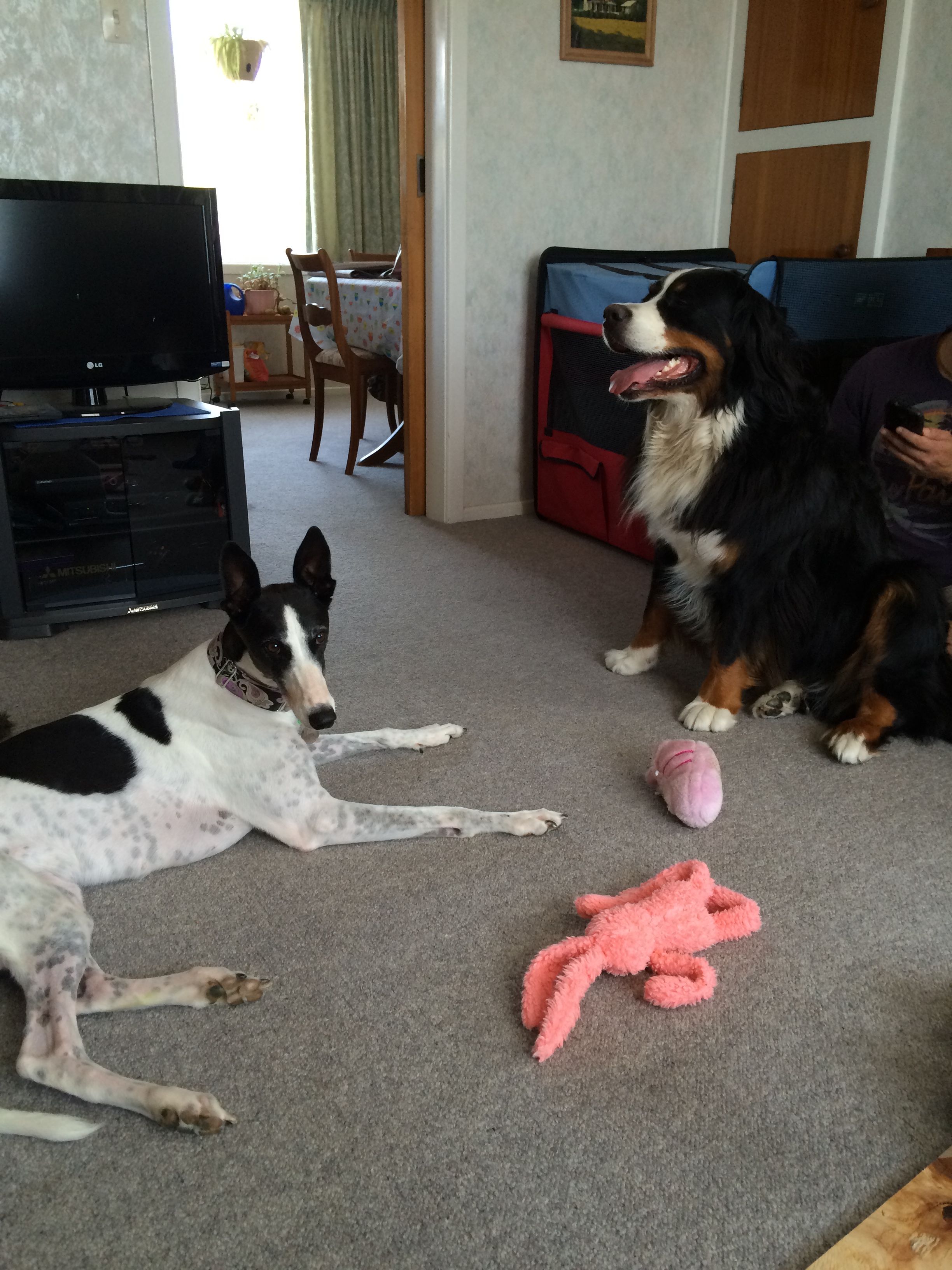
Izzy and Helga take a break from playing together
Helga went home and, within minutes of her leaving, Izzy started to engage with her new toy. Best of all, I caught it on video:
Clever girl, she just needed a little doggy leadership to show her the way!
Kathleen Crisley, specialist in dog massage, rehabilitation and nutrition/food therapy, Canine Catering Ltd, Christchurch, New Zealand
Posted in Dogs
Tagged Bernese Mountain Dog, Greyhound, Helga, Izzy, leadership, play date, toys







 DoggyMom.com