Author Archives: DoggyMom.com

Memories and moving on

This is my first Christmas and holiday season without Daisy and, although I now have Izzy to nurture and care for, there are many memories I have of summer days and holidays with my special girl.

In my garden are now two daisy plants given to me by customers in the days following Daisy’s loss.  On sunny days like today, the daisies are in full bloom:

Daisy's daisies

And then it is clear that people are noticing that the addition of Izzy has changed things.  I received a lovely note in my P O Box from the ladies at the Papanui Post Shop.  It reads:

“Just a short note to say hello!  It’s good to see you smiling.  Daisy was such a kindred spirit, even though we didn’t see her much.  I’m sure she was just as gentle and lovely like you.  Kind regards, Faye and Karen (Papanui Post)

Izzy and Christmas trees are not compatible at this stage in her life; but I’m sure we will find a way of celebrating our first Christmas together.

Kathleen Crisley, specialist in dog massage, rehabilitation and nutrition/food therapy, Canine Catering Ltd, Christchurch, New Zealand

Willow’s surgery for cleft palate

Willow is a beautiful Beagle who was born earlier this year with a cleft lip and palate.  As part of the defect, she has a bottom jaw that is slightly forward and bucked top front teeth – so her top teeth sink into the soft tissue of her lower jaw.

Cleft lip and palate are birth defects that have been traced to genetic factors.  (see my earlier articles on Cleft Palate in Dogs and The Genetics of Cleft Lip and Palate in Dogs)

Willow, before her surgery, showing the cleft lip

Willow, before her surgery, showing the cleft lip

The inside of Willow's mouth, showing the palate deformation more clearly

The inside of Willow’s mouth, showing the palate deformation more clearly

Last week, Willow had surgery to correct her birth defect.  She’s now home but taking strong pain relief medication and sucking on ice cubes for fluids.

Willow's mouth, post-surgery

Willow’s mouth, post-surgery

Willow in her Elizabethan collar (which brother Freddie believes makes her into a scary monster)

Willow in her Elizabethan collar (which brother Freddie believes makes her into a scary monster)

We are all hoping that the surgery was successful; her Elizabeth collar comes off later this week and she’ll be re-examined.  Then her owner will discuss what can be done to help with the mis-alignment of Willow’s jaws and teeth.

Cleft lip and palate are serious defects (Willow had to be hand-fed from birth because she couldn’t nurse like normal pups; many people will ‘look the other way’ when a pup is born with these defects and let it die from malnutrition.  Thankfully, Willow’s owner Gwen Hindmarsh wasn’t willing to do that).

Surgery is expensive and painful for the dog involved.  Dogs with cleft lip and palate in their lines should not be allowed to breed, as the defects don’t always appear in every litter.

Good luck Willow!

Kathleen Crisley, specialist in dog massage, rehabilitation and nutrition/food therapy, Canine Catering Ltd, Christchurch, New Zealand


Within Teddy’s reach

It’s been a while since I had an update on Teddy and this is very much a case of ‘no news is good news.’  Teddy is doing great.

Here’s a photo taken by Jill earlier today.  It’s Teddy in the kitchen demonstrating his reach and food drive.  As Jill says, ‘drive is something they look for in the Beagle standard.’  Jill knew that Teddy was reaching the counter because he stole a bunch of cheese off the top of toasted cheese sandwiches earlier in the week!

Teddy has adjusted well to his life as a tripod and he’s looking fit and trim despite his kitchen antics…

Teddy stretching in kitchen December 2014

Kathleen Crisley, specialist in dog massage, rehabilitation and nutrition/food therapy, Canine Catering Ltd, Christchurch, New Zealand


Dogs and Christmas

Feliz Navidog

Are Christmas and your dog compatible?

Kathleen Crisley, specialist in dog massage, rehabilitation and nutrition/food therapy, Canine Catering Ltd, Christchurch, New Zealand

Another pack member

Today, I had a consult with a new client who also suddenly suffered the loss of her younger dog just a few days ago.  Since I’ve been through my own loss of Daisy in July and I am now co-sponsoring a pet loss support group in my area, I think I was able to provide her with the understanding she needed at this painful time.

We also discussed when it is ‘right’ to bring another dog into the household.  There is no single ‘right’ answer to this question.

For me, I was not doing well in a dog-less household.  I missed the companionship and unconditional love that Daisy gave me willingly for over 10 years.  But, I knew that replacing Daisy was never going to happen – she was unique.   And I don’t believe we ever replace a dog that has passed; we only open our hearts to a new relationship.

I had to find a dog that needed me as much as I needed them.

This is my way of announcing the adoption of Izzy, a greyhound, from the Greyhounds as Pets adoption scheme.

Izzy, with a selection of her toys

Izzy, with a selection of her toys

Initially withdrawn and a bit overwhelmed at being in a pet home after over 5 1/2 years in a kennel environment, Izzy is now experiencing her second puppyhood.  I have had a few household items destroyed (including a tv remote) and I’m learning to schedule play time for us at least twice daily (in addition to our twice-daily walks).

I am finding great joy in giving a home to a dog who didn’t have one.  The time was right for a new pack member;  I think Daisy loved me enough that she would approve.

In the months and years to come, I’ll be sharing stories about Izzy and our adventures together…but I have no plans to change the banner on this blog.  Daisy was my heart dog and soul mate and it is a fitting tribute to keep her image on the advertising for DoggyMom.com.

Kathleen Crisley, specialist in dog massage, rehabilitation and nutrition/food therapy, Canine Catering Ltd, Christchurch, New Zealand

Arson dog joins the Boston Fire Department

The Boston Fire Department has a new recruit – it’s Keegan, an arson dog.

Click on the lick below to watch Keegan demonstrating his skill with Lieutenant Tom Murray…

Arson dog demo

Just another example of how dogs can be trained to work for our benefit!

Kathleen Crisley, specialist in dog massage, rehabilitation and nutrition/food therapy, Canine Catering Ltd, Christchurch, New Zealand

Working with dogs on live tv

King was the ‘pet of the week’ at a local Miami television station last week as part of a regular feature to help profile animals in need of a forever, adoptive home.

King managed to escape and make an entrance early – during the weather report.  Here’s his live tv debut and notice that the weather forecast was completed in a professional manner…

Kathleen Crisley, specialist in dog massage, rehabilitation and nutrition/food therapy, Canine Catering Ltd, Christchurch, New Zealand

A close up look at how our dogs drink…

The field of fluid dynamics explains how our dogs drink and why they splash and slop more than cats…
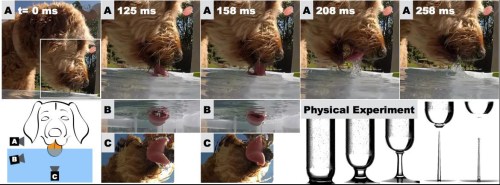
The drinking mechanism of a dog is videotaped from three different angles (A, B, and C). The curved tongue is rapidly withdrawn and a water column is formed underneath. A physical experiment is designed to understand and characterize the underlying fluid mechanics.  Photo by:  Sean Gart and Sunghwan (Sunny) Jung/Virginia Tech

The drinking mechanism of a dog is videotaped from three different angles (A, B, and C). The curved tongue is rapidly withdrawn and a water column is formed underneath. A physical experiment is designed to understand and characterize the underlying fluid mechanics. Photo by: Sean Gart and Sunghwan (Sunny) Jung/Virginia Tech

By studying the drinking habits of various dog breeds and sizes, a group of researchers at Virginia Tech and Purdue University has recently identified and modeled the fluid dynamics at play when dogs drink water.

“Three years ago, we studied how cats drink,” said Sunny Jung, an assistant professor at Virginia Tech. Jung’s research focuses include biofluid mechanics and the nonlinear interactions between soft bodies and surrounding fluids. His current project is sponsored by the National Science Foundation’s Physics of Living Systems program. “I was curious about how dogs drink, because cats and dogs are everywhere.”

As members of the order Carnivora, cats and dogs have incomplete cheeks, which allow them to open their mouths wide to deliver killing blows. But what makes pack hunting possible also makes suction drinking impossible. Unable to seal their cheeks completely, there is no way for a dog to suck up water. Conversely, humans have “complete” cheeks, and we drink by creating negative pressure, allowing us to suck water into our mouths and down our throats.

Cats, too, lack suction, and they compensate by drinking via a two-part “water entry-and-exit” process. This consists of a plunging and a pulling phase, in which a cat gently places its tongue on the water’s surface and then rapidly withdraws it, creating a column of water underneath the cat’s retracting tongue.

“When we started this project, we thought that dogs drink similarly to cats,” Jung said. “But it turns out that it’s different, because dogs smash their tongues on the water surface — they make lots of splashing — but a cat never does that.”

When dogs withdraw their tongue from water, they create a significant amount of acceleration — roughly five times that of gravity — that creates the water columns, which feed up into their mouths. To model this, Jung placed cameras under the surface of a water trough to map the total surface area of the dogs’ tongues that splashed down when drinking.

The researchers found that heavier dogs drink water with the larger wetted area of the tongue. This indicates that an allometric relationship exists between water contact area of the dog’s tongue and body weight – thus the volume of water a dog’s tongue can move increases exponentially relative to their body size.

In order to better understand how the physiology works, Jung and his colleagues could only go so far by watching dogs drink. They had to have the ability to alter the parameters and see how they affected this ability, and since they could not actually alter a dog in any way, they turned to models of the dog’s tongue and mouth. “We needed to make some kind of physical system,” Jung said.

For their model, Jung and his colleagues used glass tubes to simulate a dog’s tongue. This allowed them to mimic the acceleration and column formation during the exit process. They then measured the volume of water withdrawn. They found that the column of water pinches off and detaches from the water bath primarily due to gravity. Dogs are smart enough to close their mouth just before the water column collapses back to the bath.

Source:  Newswise media release

Dogs pay attention to what we are saying

When people hear another person talking to them, they respond not only to what is being said–those consonants and vowels strung together into words and sentences–but also to other features of that speech–the emotional tone and the speaker’s gender, for instance. Now, a report in the Cell Press journal Current Biology on November 26, 2014 provides some of the first evidence of how dogs also differentiate and process those various components of human speech.

I'm listening...new research proves our dogs are paying attention to what we say and how we say it

I’m listening…new research proves our dogs are paying attention to what we say and how we say it

“Although we cannot say how much or in what way dogs understand information in speech from our study, we can say that dogs react to both verbal and speaker-related information and that these components appear to be processed in different areas of the dog’s brain,” says Victoria Ratcliffe of the School of Psychology at the University of Sussex.

Previous studies showed that dogs have hemispheric biases–left brain versus right–when they process the vocalization sounds of other dogs. Ratcliffe and her supervisor David Reby say it was a logical next step to investigate whether dogs show similar biases in response to the information transmitted in human speech. They played speech from either side of the dog so that the sounds entered each of their ears at the same time and with the same amplitude.

The input from each ear is mainly transmitted to the opposite hemisphere of the brain,” Ratcliffe explains. “If one hemisphere is more specialized in processing certain information in the sound, then that information is perceived as coming from the opposite ear.”

If the dog turned to its left, that showed that the information in the sound being played was heard more prominently by the left ear, suggesting that the right hemisphere is more specialized in processing that kind of information.

When presented with familiar spoken commands in which the meaningful components of words were made more obvious, dogs showed a left-hemisphere processing bias, as indicated by turning to the right. When the intonation or speaker-related vocal cues were exaggerated instead, dogs showed a significant right-hemisphere bias.

“This is particularly interesting because our results suggest that the processing of speech components in the dog’s brain is divided between the two hemispheres in a way that is actually very similar to the way it is separated in the human brain,” Reby says.

Of course, it doesn’t mean that dogs actually understand everything that we humans might say or that they have a human-like ability of language.  But, says Ratcliffe, these results support the idea that our canine companions are paying attention “not only to who we are and how we say things, but also to what we say.”

Source:  EurekAlert! media release

Journal reference:  Ratcliffe et al. Orienting asymmetries in dogs’ responses to different communicatory components of human speech. Current Biology, November 2014

Yes. I tend to go a little overboard for my dogs. Am I alone?

I often recommend activity toys, supportive dog beds, and mobility aids like ramps and stairs…is this going over the top? I don’t think so. This lady does some wonderful things for her dogs – it’s about giving them the best life you can afford.
What have you done for your dog lately?

Kathleen Crisley, specialist in dog massage, rehabilitation and nutrition/food therapy, Canine Catering Ltd, Christchurch, New Zealand


Mel's avatarNo Dog About It Blog

If you ask, I am sure many people would tell you that I tend to go a little overboard where my pets are concerned. (I know for sure my family would!) I tend to buy them things that I think will enrich their lives and make them happy.

I think in the case of my dogs, I wanted to make up for the bad lives they had early on. I also want them to have lives that is enriched by a wide variety of fun experiences. (What’s the fun in having a dog if you can’t enjoy the fun they have with you?)

So while I do have a logic behind what I do for my pets, I also know that I am not the norm.

After all, I …

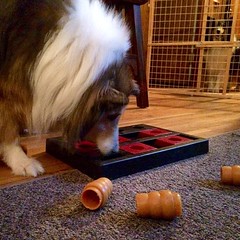
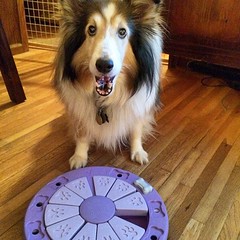
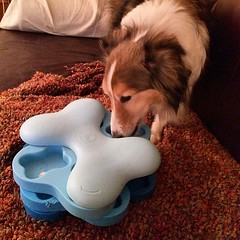
Buy dog games for my dogs, just so they can work their brains on a cold winter’s night.

Waiting his turn

Can you help me mom? This one is hard! #doggames

Game night!

Have at least 20…

View original post 225 more words