Author Archives: DoggyMom.com

VP Nominee Senator Kaine and why I’m writing about him in a dog blog

Today Senator Tim Kaine made news by officially becoming Hillary Clinton’s running mate in the race for the US Presidency.  That’s not why I’m writing about him.

The announcement of his status as candidate for Vice-President has overshadowed something he did earlier this month.  He announced his support for the PAWS Act.

On 15th July he announced his support for new legislation to help veterans suffering from Post-Traumatic Stress Disorder (PTSD). The bill, known as the Puppies Assisting Wounded Service members (PAWS) Act, would help veterans suffering from PTSD to access innovative treatment methods to improve their quality of life.

“We owe each and every veteran a debt of gratitude for the sacrifices they made on and off of the battlefield,” Kaine said.Many come home with injuries that are unseen, such as PTSD which affects a significant percentage of veterans who have returned from the wars in Iraq and Afghanistan. A service dog can provide loyalty and emotional support to help our veterans cope with the scars they return with. I’m proud to join this bipartisan effort.”  

The PAWS Act directs the Veterans Administration to implement a five-year pilot program to provide service dogs from certified providers as well as veterinary health insurance to those veterans who: (1) served on active duty on or after September 11, 2001; and (2) were diagnosed with, and continue to suffer from, PTSD. Veterans paired with dogs would receive follow-up support service from the certified service dog provider for the rest of the dog’s life.
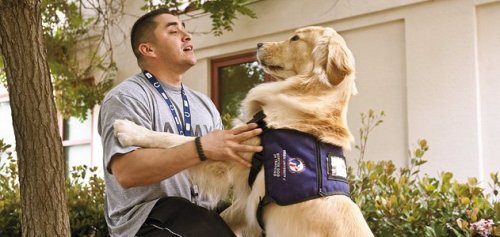
Soldier with PTSD and dog

Pictured in 2012, a soldier in the Paws for Purple Hearts program, one of four experimental programs that paired veterans afflicted by PTSD with Labrador and Golden retrievers. (Joseph Matthews, Veterans Affairs Photo)

The bill authorizes $10 million for each fiscal year from 2017 to 2022 to carry out the pilot program. Following completion of the pilot program, the Government Accountability Office would conduct a program evaluation and submit a report to Congress.

The House version of the PAWS Act, H.R. 4764, was introduced by Congressman Ron DeSantis (R-Fla.) in March 2016. The House bill currently has 97 bipartisan cosponsors and has been referred to the House Committee on Veterans’ Affairs.

I’m pleased to see the support for this Act, although I doubt even $10 million per year will go far enough.  It’s a start.   Thank you Senator Kaine for your support.

Kathleen Crisley, specialist in dog massage, rehabilitation and nutrition/food therapy, The Balanced Dog, Christchurch, New Zealand

In my book review of Reporting for Duty, I referred to these statistics concerning returning soldiers and their needs for support dogs:

  • More that 540,000 veterans of the wars in Iraq and Afghanistan have PTSD or depression (or both)
  • More than 260,000 veterans have been diagnosed with traumatic brain injuries
  • Even if all of the service dog organisations currently operating in the United States increased their annual output by a factor of 100, the mental health challenges of veterans would still not be met
  • The present policy of the Veteran’s Administration is to provide service dogs only to veterans with visual or hearing impairment or some selected mobility challenges – a small sub-set of the range of uses and support that can be given by trained dogs (Assuming the pilot program referred to in the PAWS Act proved successful – then this policy may change)
How shelters can use the Pokemon Go craze to their advantage

I heard a business report recently that local shops can benefit from people using Pokemon Go by promoting themselves to people who are out and about playing the game.  For example, local cafes can offer specials for thirsty players to take a break.

And then the animal shelters got involved…

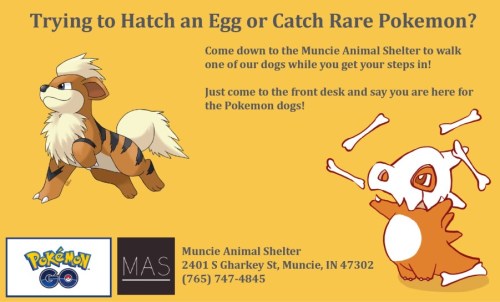
The animal shelter in Muncie, Indiana noticed that a lot of people were  walking around playing Pokemon Go.  Always in need of dog walkers, the shelter staff came up with the idea – play Pokemon and walk a shelter dog at the same time.

Pokemon Go poster

To take a Pokemon Dog, you have to sign a waiver form and you are reminded to watch where you are going for the sake of both you and the dog.

Walking is great exercise for dogs and humans.  If this Pokemon Go craze can help animals in shelters and rescues, I’m all for it.

Kathleen Crisley, specialist in dog massage, rehabilitation and nutrition/food therapy, The Balanced Dog, Christchurch, New Zealand


Research shows dogs de-stress families with autistic children

Owning a pet dog reduces stress and significantly improves functioning in families who have a child with Autism Spectrum Disorder (ASD), new research has shown.

The study, carried out by researchers at the University of Lincoln, UK, and funded by the US-based Human Animal Bond Research Initiative (HABRI) Foundation, also found a reduction in the number of dysfunctional interactions between parent and child among families which owned a dog.

Published in the American Journal of Veterinary Behavior, it is among the first of a number of HABRI-funded research projects which examine the effects of companion animals on human health. This project focused specifically on the effects of pet dogs on families with children with ASD.

Professor Daniel Mills, Professor of Veterinary Behavioural Medicine in the School of Life Sciences at the University of Lincoln, led the research. He said: “While there‭ ‬is‭ ‬growing‭ ‬evidence ‬that ‬animal-assisted‭ ‬therapy‭ ‬can aid in ‬the‭ ‬treatment‭ ‬of‭ children with ‬autism‭ ‬spectrum‭ ‬disorders, this study is one of the first to examine how‭ ‬pet‭ ‬dog‭ ‬ownership‭ ‬can also ‬improve‭ ‬the‭ ‬lives‭ ‬of‭ ‬those‭ ‬more widely affected‭ ‬by‭ ‬autism. Researchers have previously focused on the positive effects that assistance dogs can have on the child’s well-being and have passed over the impact they might also have on close relatives, but our results show that owning a pet dog (rather than a specifically trained assistance dog) can considerably improve the function of the whole family unit.‬‬‬‬‬‬‬‬‬‬‬‬‬‬‬‬‬‬‬‬‬‬‬‬‬‬‬‬‬‬‬‬‬‬‬‬‬‬‬‬‬‬

“We found a significant, positive‭ ‬relationship‭ ‬between‭ ‬parenting‭ ‬stress‭ ‬of‭ ‬the child‭’‬s‭ ‬main‭ ‬caregiver‭ ‬and‭ ‬their‭ ‬attachment‭ ‬to‭ ‬the‭ family dog. This highlights the importance of the bond between the carer and their dog in the benefits they‬‬‬‬‬‬‬‬‬‬‬‬‬‬‬‬‬‬‬‬‬‬‬‬‬‬‬‬‬‬‬‬‬‬‬‬‬‬‬‬‬‬‬‬‬‬‬‬‬‬‬‬‬‬‬‬‬‬‬‬‬‬‬‬‬‬‬‬‬‬‬‬‬‬‬‬‬‬‬‬‬‬‬‬‬‬‬‬‬‬‬‬‬‬‬‬‬‬‬‬‬‬‬‬‬‬‬‬‬‬‬‬‬‬‬‬‬‬‬‬‬‬‬‬‬‬‬‬‬‬‬‬‬‬‬‬‬‬‬‬‬‬‬‬‬‬‬‬‬‬‬‬ gain.”‬‬‬‬‬‬‬‬‬‬‬‬‬‬‬‬‬‬‬‬‬‬‬‬‬‬‬‬‬‬‬‬‬‬‬‬‬‬‬‬‬‬‬‬‬

The research involved families who took part in a previous study, which examined the short-term effect of a pet dog on families of a child with autism. The researchers followed up with the families two and a half years later in order to determine the longevity of the benefits of pet ownership. The study demonstrated that initial results of reduced family difficulties lasted years beyond the early stages of acquiring a dog, and that stress levels continued to experience a steady decline.

“Stress associated with parenting a child with autism continued to decrease among dog owners over time, but we did not see the same reductions in families without a dog,” added Professor Mills. “This long-term follow up study highlights the potential benefits of pet ownership in bringing long-term improvements to the lives of families living with a child with autism.”

HABRI Executive Director Steven Feldman said: “Parents of children with autism can experience increased anxiety and stress, and now we have strong scientific evidence to show that pets can have positive effects on these quality-of-life issues. Families with an autistic child should consider pet ownership as a way to improve family harmony.”

The study at Lincoln is one of a series of research projects from a major body of work carried out at the University of Lincoln’s School of Life Sciences which sheds light on the benefits that pet dogs can bring to children with ASD and their families.

Source:  University of Lincoln media release

Photos from Dog Mountain

It has been two years since my beloved Daisy passed away. So it seemed fitting that on a visit to Vermont this week, my mother and sister stopped at the chapel on Dog Mountain to make a donation in her memory.

Here are their photos:

DSC02308

In loving memory of Daisy (2000 to 2014)

See more at Vermont’s dog chapel

Kathleen Crisley, specialist in dog massage, rehabilitation and nutrition/food therapy, The Balanced Dog, Christchurch, New Zealand


9 special abilities that show how smart dogs really are

I enjoy reading and sharing information about research involving dogs and their cognitive abilities.

Business Insider Malaysia has published a good synopsis of research in the area with references to the relevant studies.

2-dogs-make-eye-contact

The 9 special abilities are:

  1. Dogs feel empathy
  2. Dogs make eye contact
  3. With eye contact, they form a special bond with humans
  4. Dogs see humans as part of their family
  5. And they interact with us as if they were children
  6. Dogs understand gestures, like pointing
  7. Dogs brains react to human voices
  8. Some dogs can learn new words the way children do
  9. And some dogs have the ability to generalize

Kathleen Crisley, specialist in dog massage, rehabilitation and nutrition/food therapy, The Balanced Dog, Christchurch, New Zealand

Before Pokemon Go

The video game Pokemon Go is all the rage at the moment.  I do struggle with the fact that people seem to be willing to walk into traffic or drive their car off the road while playing a game…

Long before Pokemon and video games, there were dexterity puzzles.  These handheld games were a game of skill:  the aim was to roll a ball or other shape into a designated hole/space or through a maze.

The puzzles date back to the 1800s, and were still being manufactured through the 1950s, 60s and 70s. Produced in large numbers, often sold through country fairs and amusement parks, or given as favors at children’s birthday parties, they were manufactured in a wide range of countries including the United State, France, Germany and Japan.

Here are just a few dog-themed examples:


So when you’re ready for a break from Pokemon Go, hop into your local antique/collectible shop, onto Etsy, or visit the weekend garage sales and see if you can find some dog-themed dexterity puzzles of your own.

Kathleen Crisley, specialist in dog massage, rehabilitation and nutrition/food therapy, The Balanced Dog, Christchurch, New Zealand


Flicker of light

This is a lovely thought for a Sunday morning…

The history of canine transmissible venereal cancer

Researchers at the University of Cambridge have produced this interesting YouTube video about how canine transmissible venereal cancer has spread over time.  If you are interested in evolution, genetics or DNA research – this video is for you.

See also my previous posts:

A dog cancer that is 11,000 years old

Global snapshot of infectious canine cancer

Kathleen Crisley, specialist in dog massage, rehabilitation and nutrition/food therapy, The Balanced Dog, Christchurch, New Zealand


Burials with your pet

No one gets out of life alive – not us and not our pets.

But it can be problematic when one wants to be buried with their pet’s remains.  In many locations, this isn’t allowed.

A state Senate bill in New York is making its way through the legislative process that would allow cremated pet remains to be buried in human cemeteries.  In 2014, another regulation allowed pet cemeteries to accept human remains.

Cemetery

Assemblyman James Brennan of Brooklyn, sponsored the measure saying that with increased rates of pet ownership “has come a significant shift in the desire of New Yorkers to have their pets interred in their grave, crypt or niche.”

Source:  New York Post


Pet-friendly companies

This post is inspired by my friend Rachel, who tells me that her husband, Nick, is trying persuade his company that they should become pet-friendly.  Or at least give it a try.

I support the concept of pet-friendly accommodation, workplaces, and shopping because I believe it supports good socialization in our dogs, offers stress relief for owners and workers, and supports good dog ownership because dogs are not left at home for long periods of time.

Autodesk dog at work

Photo by Autodesk

Earlier this year, Fortune magazine profiled the 12 best pet-friendly companies.  They are:

  • Genentech, a biotech company.  While it can’t allow pets in the office because of federal hygiene regulations, it makes up for it by providing its employees with discounts for doggy daycare, pet insurance and a company club for dog lovers called gDogs so they can share information.
  • Kimpton, a hotel chain with a long history of being pet-friendly. The company provides its employees with pet insurance, pet bereavement leave and supports them bringing their dogs to work with bowls, treats, and beds.  Some hotel locations also have a Director of Pet Relations which is usually a dog owned by one of the employees whose job it is to greet guests.
  • Atlantic Health, a hospital chain in New Jersey.  It trains its staff to become part of its Soothing Paws therapy program and even sponsors a pet therapy conference.
  • VMWare, a visualization software company with an open campus policy.  Staff who want to bring their dog to work sign an etiquette agreement and their dog is given a bandana.
  • Salesforce, a cloud-based software company in San Francisco.  It provides its employees with pet insurance discounts, dog walking services, and house calls from a vet.  The company’s pet policy called Puppyforce allows up to six employees to book a special room with water bowls, beds, sound-proofed walls, crates and cleaning materials.
  • Mars, the multi-national providing confectionery and pet food products. 80% of the company’s volunteer projects are about animals; traveling staff are supported with pet feeding and boarding programs, and the offices are pet-friendly.
  • Google, the search engine company.  Dog-friendly offices are combined with a dog-themed cafe and an in-house group of employees who are dog enthusiasts called the Dooglers.
  • Build-A-Bear Workshop, a soft toy retailer.  Once an employee signs a Doggy On-Boarding agreement containing basic rules, their dog can come to work.  Dog birthday parties, treats, and a spa and grooming service are offered.
  • Autodesk, providers of design software for architects.  Dog-friendly offices with rules to protect the human staff who have pet allergies, along with discounted pet insurance.
  • GoDaddy, a web hosting and domain name service.  On-site psychology services using assistance dogs.
  • Workday, makers of finance and human resources software. Dog-friendly offices, an annual Take Your Dog to Work party, and financial assistance to help employees with pet adoptions.
  • Activision Blizzard, a gaming company where approximately 395 dogs come to work every day.  During the annual “Pet Parents Day,” the company brings in pet insurance providers and local vets to provide free health screenings, insurance quotes, and treats for both pets and their humans.

Rachel:  Print out this post and have Nick bring it to work with him!

Kathleen Crisley, specialist in dog massage, rehabilitation and nutrition/food therapy, The Balanced Dog, Christchurch, New Zealand