Today (18th August) is International Homeless Animals’ Day.
On the third Saturday of August each year, organisations band together to raise awareness about pet overpopulation. This year is the 21st year of the initiative!
If you are thinking of adding a dog to your household (or another dog), please adopt from a shelter or rescue organisation. And spay/neuter your pet to avoid adding to the pet population in your area.
Many of us are ‘animal people’ who are concerned about animal welfare in general and not just the health and well-being of our dogs. When it comes to the products we buy, we’d like to choose ethical products – products that haven’t been tested on animals.
Here in New Zealand, you can download a copy of the SAFE Shopping Guide to help you make the right purchasing decisions.
SAFE is a non-profit charitable organisation financed solely through donations. It is dedicated to changing attitudes and nurturing compassionate values by educating the public about the inherent value of animals.
SAFE has been working in New Zealand for 75 years and so they know their stuff. Visit the SAFE website here.
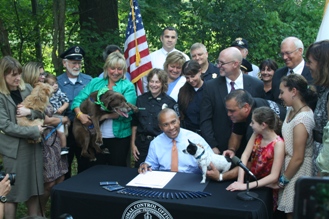
I’m very proud of my home state of Massachusetts. Last week, Governor Patrick signed bill S. 2192 “An Act Further Regulating Animal Control” into law.
The new law:
Creates a statewide spay/neuter program to reduce the number of homeless animals and will, in turn, also reduce the cost to cities and towns for housing and sheltering these animals. This is funded by a voluntary tax check off.
Adds enforcement provisions to section 139A (the spay/neuter deposit law for animals adopted from shelters and animal control facilities) to ensure homeless animals can’t reproduce.
Requires animal control officers to receive training. This is funded by the tax check off.
Prohibits carbon monoxide and carbon dioxide gas as a means to “euthanize” dogs and cats. (Anyone who saw the HBO documentary One Nation Under Dog knows why this important)
Improves the dangerous dog law in a breed neutral manner
Allows pets to be included in domestic violence protection orders
The law will also create some statewide oversight for animal control, which previously did not exist in the state; creates categories for kennel licensing; creates consistency in the holding time for stray dogs and provide other meaningful updates to the state’s antiquated animal control laws. An amendment to the bill also added some restrictions on the tethering of dogs.
This new law will not cost money, it will actually minimize costs to cities and towns by reducing the number of homeless animals and the associated cost to house and take care of them. In addition, ensuring that animal control officers are trained, and improving the dangerous dog law to protect public safety, will provide indirect cost savings.
Best of all, this bill proves that animal welfare agencies can work together. The bill was drafted as a collaboration between the Animal Control Officers Association of Massachusetts (ACOAM), the Massachusetts Society for the Prevention of Cruelty to Animals (MSPCA), the Animal Rescue League of Boston, the state’s Bureau of Animal Health within the Department of Agricultural Resources and the Massachusetts Veterinary Medical Association (MVMA).
His 3-year ban on dog ownership is coming to an end and Michael Vick wants a dog, for his kids, he says.
Let’s not forget the dogs Mr Vick owned in the past – 13 dead, 51 seized from Bad Newz Kennels in 2007, with 47 ultimately surviving after being rehabilitated at places like Best Friends Animal Society (Best Friends took in 22).
Lucas and Mel are just two of the “Vicktory Dogs” seized from Michael Vick and placed with the Best Friends Animal Sanctuary. Photos by Gary Kalpakoff for Best Friends.
When I watched the PBS documentary Shelter Me, I was astounded at the statistics that more returned servicemen are dying by their own hands than are dying in fields of conflict like Afghanistan and Iraq. These men and women are returning from active duty with difficulties such as post traumatic stress disorder and other anxiety-related problems. They have difficulty adjusting to life in peacetime.
Dogs are playing a key role in helping these ex-soldiers to recover and re-enter society. Shelter Me covers the stories of two veterans, for example, who have been paired with service dogs.
Here’s the YouTube trailer for Shelter Me:
The Boston Globe recently covered another story about the value of service dogs. Patriot Rovers is a charity that trains dogs to be service dogs for returned servicemen and women. The charity names the dogs after soldiers who have fallen in the line of duty. The charity’s website is particularly poignant, with photos of the dogs and an explanation of the soldier they are named after.
In the Globe story, Natasha Young-Alicea suffers from migraines and anxiety from the time she served in the Marines and has been paired with Josh who is named after a Navy SEAL, Josh Harris. Josh helps Young-Alicea in many ways. One particular heart-wrenching task is to sit behind her in the checkout line at the supermarket, to avoid people approaching her from behind. This proximity triggers anxiety.
Josh and his handler visit the parents of Josh Harris which also helps in their journey of healing.
These stories reinforce the critical role that service dogs play in our communities. If you have spare time or dollars, please consider supporting service dog charities in your area.
The animal welfare sector is comprised of many volunteer organisations. One special one working in the Oregon and Washington area is Fences for Fido.
This volunteer effort has been working since 2009 to build fences for dogs so they can be released from their chains. Chained dogs rarely have the quality of life of other pets and are vulnerable to aggression from other dogs who are able to roam into their territory and take advantage of the dog’s restrictions. Studies show that dogs who are chained can respond in one of two ways: they become aggressive or they become withdrawn and unresponsive.
More importantly, dogs who are chained are unlikely to have the same bonds and stable relationship with their owners/family. Many are isolated and live a lonely existence and suffer from neglect.
Without prejudice, Fences for Fido assists these dog owners by building fenced sections on weekends. Materials and time are all donated and there is also support for neutering/spaying and veterinary care when needed. The group works to educate families about dog care during the extreme seasons of summer and winter.
This group also follows up with families that have received its assistance twice each year to ensure that the dogs remain unchained and in good condition.
Almost 300 dogs have been helped by Fences for Fido so far.
That’s a special group!
Here’s a video of their first-ever fence building project – for Chopper – in 2009:
An invitation is extended to all interested parties who would like to take part in a forum to share ideas in the review of the Animal Welfare Act planned for later this year (2012).
It is proposed that this open forum will allow each organisation to bring their ideas for improvements to the Act to share and explore as a collective so that their thoughts may be reinforced and enhanced with additional views. In this informal setting much can be achieved and uniformity will result. Bring your ideas and your ideals and emerge with a stronger resolve.
Date: Friday 3rd August 2012
Time: Commences at 11am, concludes around 4pm (with lunch in the middle!)
If you wish to attend the Animal Welfare Act Review workshop please confirm your attendance no later than Thursday 26th July 2012 by emailing Michelle Clay, Secretary of the NZ Companion Animal Council at michelle.clay@xtra.co.nz
Last month, a very special initiative was launched in Los Angeles – NKLA (No-Kill Los Angeles)
This initiative is another to help achieve the goal of the Best Friends Animal Society: No More Homeless Pets.
NKLA’s website says “We are a coalition of animal welfare organizations, city shelters and passionate individuals. Led by Best Friends Animal Society, we’re dedicated to ending the killing of healthy and treatable pets in L.A. shelters. Our plan is straightforward. Provide spay/neuter services where they are needed most so fewer animals go into shelters, and increase adoptions through the combined efforts of the NKLA coalition so more animals come out of the shelters and go into new homes.”
In 2011, over 17,000 adoptable animals were euthanised in the Los Angeles area – so the need is great.
If you live in the Los Angeles area and are an animal lover, perhaps you should consider assisting the NKLA movement by donating money, fostering, or adopting.
As the name suggests, a no kill animal shelter is one where all adoptable animals are allowed to live until they are found a forever, loving home. Only severely ill animals, or those that are truly determined to be dangerous and unadoptable, are euthanised.
The concept of ‘no kill’ has challenged the animal welfare sector as far back as the 1970s. An article by Ed Duvin in 1989 in a publication called animalines is reputed to have been a major turning point. The article characterised the animal welfare sector as a ‘slumbering giant’ and pointed to the need for a coordinated national effort with a greater focus on education and the valuing of each animal’s life. It challenged the sector to stop killing animals in the name of mercy.
I have just had the pleasure of working at the Best Friends Animal Society sanctuary in Kanab, Utah. This is an inspiring leader in the no kill movement and I look forward to bringing you more news about Best Friends and animal welfare in future blog postings.
Daniel looks like an ordinary beagle. But he isn’t. He’s a survivor – quite literally.
In October 2011, Daniel was placed in a gas chamber in Alabama to die with three other unwanted/unclaimed dogs. The miracle is that Daniel survived the gassing (by carbon monoxide). The folks at Eleventh Hour Rescue, a rescue organisation that aims to save dogs from high-kill shelters, heard about Daniel and took him to New Jersey to find a forever home.
After fostering, Daniel was re-homed with Joe and Geralynn Dwyer. Mr Dwyer now is a guest speaker around the country to encourage the banning of gas chambers in the United States and Mr Dwyer is happy to promote Daniel as the face of the anti-gassing law. The law has been called “Daniel’s Law” in honor of Daniel. Pennsylvania is the most recent state to enact it.
Only 19 states in the USA have banned the use of gassing as a means of euthanising unwanted dogs and over 4 million animals are euthanised each year in the country.
Here are a couple of video clips of Daniel’s story, starting with his original fostering arrangement:









 DoggyMom.com