Category Archives: Dogs

If you’re lost…let’s hope your dog is with you

As readers of the blog know, I love to profile new research into topics such as dog health and behaviour.  This story, however, is truly astounding – not only because of the results but because someone chose to research the topic!

It seems that our dogs are sensitive to the Earth’s magnetic field and so they will align themselves in a north/south direction when urinating or defecating – particularly when they are off-leash and allowed freedom.

Photo by Brock Daves

Photo by Brock Daves

A research team of Czech and German scientists studied 70 dogs during 1,893 defecations and 5,582 urinations over the course of two years.  When the Earth’s magnetic field was stable, the dog would align themselves to it when answering the call of nature.  If there was an unstable magnetic field, such as during a solar flare, the dogs seemed to become confused.

So the next time you are lost in the woods (bush for those in the Southern Hemisphere), pray that your dog needs to take a toilet break and watch carefully!  (Or, you could simply help to validate the researchers’ findings by paying more attention to the direction your dog faces when needing to pee or poo – remember your compass!)

The results of this research have been published in the journal Frontiers in Zoology.

Gotta Golden in the Lower 48?

golden-retrievers-fighting-cancer The Morris Animal Foundation is recruiting dogs for its Golden Retriever Lifetime Study.  3,000 Goldens will be followed for life to gather insights that could help prevent and treat cancer in Goldens and all other dog breeds.  In the USA, the Foundation estimates that more than 60 percent of Golden Retrievers die from cancer.

Participants will receive periodic questionnaires about their dog to complete and also be reimbursed $75 towards annual exam costs (owners must agree to bear the remaining costs of participation).  Dogs must be purebreds, with verifiable three-generation pedigree.  Any Golden under the age of two is eligible.

More information can be found in this brochure.

If your Golden resides in the lower 48 states, this may be his/her chance to contribute to the science behind canine health and longevity.

A thought for the new year

Be the Dog

Happy New Year (2014)!

All around me familiar faces…

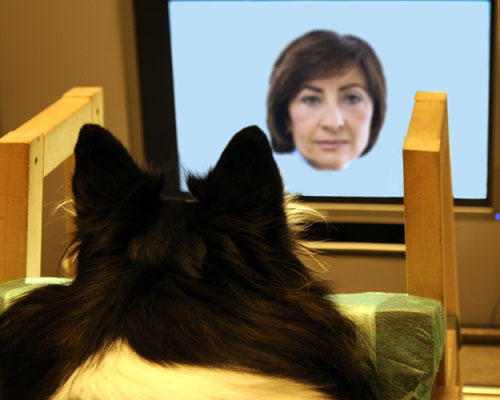
Researchers at the University of Helsinki have been testing dogs to see if they can recognise faces in images and, more specifically, whether the dogs have a different response to the images of strangers vs those people who are familiar to them.

Copyright Sanni Somppi

Copyright Sanni Somppi

The eye movements of the dogs were measured while they watched facial images of familiar humans and dogs (e.g. the dog’s owner and another dog from the same household) being displayed on the computer screen. As a comparison, the dogs were shown facial images from dogs and humans that the dogs had never met.

Dogs preferred the faces of those familiar to them.

The results indicate that dogs were able to perceive faces in the images. Dogs looked at images of dogs longer than images of humans, regardless of the familiarity of the faces presented in the images.  Dogs scanned the images of familiar faces more thoroughly, too.

The research team concludes that dogs are able to see faces in the images and they differentiate familiar and strange faces from each other. These results indicate that dogs might have facial recognition skills which are similar to humans.

Source:  University of Helsinki media release

Virgin Australia’s pet program

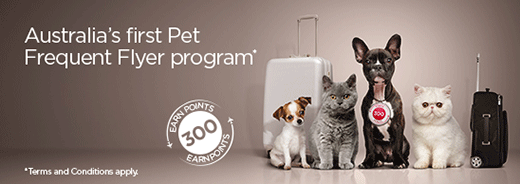
It’s fairly common in the USA to have frequent flyer programs for pets.  But did you know that earlier this year Virgin Australia launched that country’s first pet frequent flyer program?

Photo courtesy of Virgin Australi

Photo courtesy of Virgin Australia

Virgin Australia’s pet program adds bonus points to the air miles that passengers receive when they are members of the Velocity Frequent Flyer program.

Red members (the entry level) earn an extra 300 points each time they fly with one pet carrier. Silver, Gold and Platinum members earn more points per flight.  Platinum members earn 600 points per flight per pet carrier, for example.

Well done to Virgin Australia for recognising travelers who need to travel with their dog!

Colored treats – would you feed these?

Coloured lambs earsHere’s a photo of lambs ears that have been dyed using ‘human grade’ food coloring for Christmas.  I have deep concerns about using coloring agents in dog (and human) foods.

For example, some dogs may be allergic or sensitive to the coloring agents.  We know that the use of these additives can cause excitability since coloring agents have also been linked to hyperactivity in children.

Food colors are chemicals – they are just chemicals that have been tested by the FDA to ensure they are ‘safe’ for human consumption.  Colors are added to make food more appealing and marketable.

Since our dogs have limited color vision and lack photoreceptors in their eyes to ascertain shades of red and green, the color added to dog treats is to appeal to the dog owner and not the dog.  Dogs will decide if something tastes good!

How about some natural alternatives?  Here’s a photo of my Chicken & Cranberry Holiday Crunch (a special for the holiday season).  The red color is totally natural and comes from the whole cranberries that are part of the recipe.

Chicken and Cranberry Holiday Crunch

Chicken and Cranberry Holiday Crunch

I recommend that you feed natural products whenever possible and avoid highly colored dog treats.

And remember that no more than 10% of your dog’s daily caloric intake should come from treats!

Kind regards,

Kathleen Crisley, dog masseuse and nutrition adviser, Canine Catering Ltd

Your dog’s (brain) reward center

Professor Gregory Berns of Emory University is at it again.  He’s expanded on his earlier research using functional MRI (magnetic resonance imaging) to show the brain activity in dogs.

“Now we’ve shown that the initial study wasn’t a fluke: Canine fMRI is reliable and can be done with minimal stress to the dogs. We have laid the foundation for exploring the neural biology and cognitive processes of man’s best, and oldest, friend.”  said Professor Berns.

Tigger, a Boston Terrier, was one of the 13 study subjects

Tigger, a Boston Terrier, was one of the 13 study subjects

The task requires dogs to cooperatively enter the small enclosure of the fMRI scanner and remain completely motionless despite the noise and vibration of the machine.  Only those dogs that willingly cooperated were involved in the experiments.

The canine subjects were given harmless fMRI brain scans while they watched a human giving hand signals that the dogs had been trained to understand. One signal indicated that the dog would receive a hot dog for a treat. The other hand signal meant that the dog would not receive a hot dog.

Most of the dogs showed a response in the caudate region of the brain when seeing the hand signal for a treat.  This area of the brain has the highest concentration of dopamine receptors, which are implicated in motivation and pleasure, among other neurological processes.

“Our goal is to map out canine cognitive processes” said Berns. The research team needs to increase the number of canine subjects that can be trained to stay within the MRI machine so it can validate its research.

See my other blogs about functional MRI and Professor Gregory Berns:

Source:  Emory University media release

A thought for caregivers at Christmas

There's a special place...

As the Christmas holiday is upon us, across the world there are special people who are working in animal shelters and rescues caring for homeless dogs.  Let’s be thankful that these folks exist.  If you are considering adding a dog to your pack, please think adoption first!

This quilt hangs in Old Friends at the Best Friends Animal Sanctuary in Kanab, Utah

This quilt hangs in the kennels at Dogtown in the Best Friends Animal Sanctuary, Kanab, Utah

Dogs are people, too

In this New York Times opinion piece, Professor Gregory Berns discusses the MRI findings of brain activity in dogs, the evidence for ‘sentience’ and the reasons why dogs’ rights should go beyond consideration of animals as property.

For anyone involved in animal welfare advocacy, it is essential to have animal welfare laws that recognise dogs as sentient beings – with the ability to experience emotions like love and grief – because abuse and harm done to sentient beings carries a higher penalty in law than if an item of property is damaged.  (In many areas, dogs are considered nothing more than property.)

Jane Evelyn Atwood/Contact Press Images

Jane Evelyn Atwood/Contact Press Images

The Princess and the Pea

When you own a senior dog, it’s important to understand that they experience discomfort from arthritis, aching joints, and muscle tension.

A supportive dog bed is essential.

In Daisy's case, she now sleeps on a total of four mattresses, one of which is memory foam and acts as the 'boxed spring' layer.  I call this her Princess and the Pea look.

In Daisy’s case, she now sleeps on a total of four mattresses, one of which is memory foam and acts as the ‘boxed spring’ layer. I call this her Princess and the Pea look.