Podcast: Interview with the Integrative Animal Health Collective (May 2025)

The business of dog massage (click to view video)

Greyhound Massage and Stretching Online Course

-
Recent Posts
Categories
- animal welfare (199)
- boarding facilities (4)
- complementary therapies (5)
- dog adoption (43)
- dog books (63)
- dog breeds (140)
- dog care (440)
- dog nutrition and labelling (54)
- dog ownership (151)
- dog quotes (198)
- dog-friendly accommodation (35)
- dog-friendly shops (19)
- dog-friendly workplaces (28)
- Dogs (1,334)
- dogs and families (11)
- dogs and holidays (46)
- dogs and mourning (22)
- dogs in advertising (37)
- ethics and pet rights (6)
- Humor/humour (37)
- lost dogs (2)
- products for dog lovers (15)
- products for dogs (17)
- regulation (5)
- research (490)
- special dogs and awards (225)
- special needs (13)
- statistics and surveys (4)
- Teddy's journey post-amputation (12)
- Uncategorized (49)
-
Join 1,185 other subscribers
-
Copyright
-
Copyright © Kathleen Crisley, The Balanced Dog Ltd and DoggyMom.com, 2010-2026. Unauthorized use and/or duplication of this material without express and written permission from the author is strictly prohibited. Some attributed content, excerpts and links may be used, provided that full and clear credit is given to Kathleen Crisley, DoggyMom.com with specific direction to the original content. Where information has been sourced from a third party, please quote the original source.
‘Like’ us on Facebook
Archives
Rated Top Dog Mom blog by FeedSpot

Read the Canine Corner in NZ Dog World Magazine

Blogorama
RSS Links
OnTopList.com – A directory of blogs
Category Archives: Dogs
ImagePlatty’s Story – A Golden Retriever’s Last Days
On the eve of Valentine’s Day, a story for dog lovers…
Posted in Dogs
A dog cancer that is 11,000 years old
Scientists have sequenced the genome of the world’s oldest continuously surviving cancer, a transmissible genital cancer that affects dogs.
The cancer, which causes grotesque genital tumours in dogs around the world, first arose in a single dog that lived about 11,000 years ago. The cancer survived after the death of this dog by the transfer of its cancer cells to other dogs during mating.
Analysis of the genetic variants in the genome revealed that the dog may have resembled an Alaskan Malamute or Husky. It probably had a short, straight coat that was coloured either grey/brown or black. Its genetic sequence could not determine if this dog was a male or a female, but did indicate that it was a relatively inbred individual.
The genome has over 2 million mutations; the research team used one type of mutation, known to accumulate steadily over time, as a ‘molecular clock.’ This led to the estimate that the cancer first arose 11,000 years ago.
“The genome of this remarkable long-lived cancer has demonstrated that, given the right conditions, cancers can continue to survive for more than 10,000 years despite the accumulation of millions of mutations”, says Dr Elizabeth Murchison, first author from the Wellcome Trust Sanger Institute and the University of Cambridge.
Transmissible cancers are very rare in nature. Apart from the dog transmissible cancer, the only other known naturally occurring transmissible cancer is an aggressive transmissible facial cancer in Tasmanian devils that is spread by biting.
Source: Wellcome Trust media statement
Posted in research
Tagged cancer, cancer cells, genital cancer, genome, transmissible cancer, tumours in dogs
Grounds for dismissal?
Royston Grimstead, owner of an Aston Martin and a Border Collie cross named Luce, came home last week to find that she had chewed the wheel arch of the £80,000 car.
Some people found this story funny, with Grimstead saying that he felt the dog acted out of spite when she heard that he wanted to re-home her. He then reported that the had re-homed Luce without telling her new owners about the destructive chewing incident (although with the coverage this story had in worldwide media, they probably have heard by now).
In my opinion, dogs don’t act out of spite. They do act out of boredom and Border Collies are particularly known for their high intelligence and need of a job (plus other enrichment activities). Luce was likely bored and found the texture and shine of the fibreglass appealing.
I don’t agree with the media coverage of this story for two reasons:
- It reinforces the myth that dogs act from spite
- It spreads the idea that is okay to give away a dog when you don’t want to work with them on behavioural issues
What do you think?
Posted in dog ownership, Dogs
Tagged Aston Martin, Border Collie, chewing, Luce, re-homing, Royston Grimstead
The leader of the pack
Dogs’ paths during group walks could be used to determine leadership roles and through that their social ranks and personality traits, say researchers from Oxford University, Eötvös University, Budapest and the Hungarian Academy of Sciences.
The research team tracked the movements of six Vizsla dogs and their owner using high-resolution GPS harnesses during fourteen 30-40 minute walks off the lead.
The dogs’ movements were measurably influenced by underlying social hierarchies and personality differences.
‘On individual walks it is hard to identify one permanent leader, but over longer timescales it soon becomes clear that some dogs are followed by peers more often than others. Overall, the collective motion of the pack is strongly influenced by an underlying social network.’ said study author Dr Máté Nagy of Oxford University’s Department of Zoology.
Dogs that consistently took the lead were more responsive to training, more controllable, older and more aggressive than the dogs that tended to follow. Dogs that led more often had higher dominance ranks in everyday situations, assessed by a dominance questionnaire.
One possible use of the technology would be to assess search and rescue dogs to see which dogs work best together. The results have been published in the journal PLOS Computational Biology.
Caught on camera
Sometimes when the house goes really quiet, it pays to investigate.
This morning, I found Daisy in the kitchen rubbish bin….
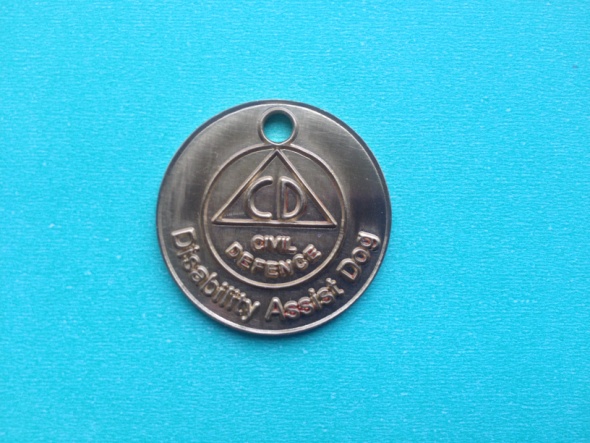
Identification tags for Disability Assist Dogs
In the aftermath of the Christchurch 2011 earthquake, officials had difficulty identifying the status of dogs at civil defence centers. If you were the owner of a disability assistance dog, this made things more difficult in what was already a stressful time.

In December 2013, the Minister of Civil Defence, the Hon Nikki Kaye, announce the production of a Disability Assist Dog tag that will be officially recognised throughout New Zealand. The tags will be entered into the National Dog Database and provide unique identification for each dog, linking it to its owner/handler and the organisation that certified the dog. These tags will be help match lost dogs and owners much faster and ensure that handlers and their dogs are allowed entry to official civil defence centers.
(Dogs are also micro-chipped in New Zealand; this is compulsory)
Seven organisations are authorised under the Dog Control Act 1996 to train and certify disability assist dogs. Only dogs certified through these organisations will qualify to wear the official identification tag:
- Hearing Dogs for Deaf People NZ
- Mobility Assistance Dogs Trust
- New Zealand Epilepsy Assist Dogs Trust
- Royal NZ Foundation for the Blind
- Top Dog Companion Trust (not currently operating)
- Assistance Dogs New Zealand Trust
- Perfect Partners Assistance Dogs Trust
What programs are in place in your country to support owners/handlers and their assistance dogs?
Posted in animal welfare, special dogs and awards
Tagged assistance dogs, assistance dogs New Zealand, Civil Defence, disability assist dogs, disability assistance dog, Dogs Trust, epilipsy assist dogs, hearing dogs, Ministry of Civil Defence, mobility assistance dogs, New Zealand, Nikki Kaye, perfect partners assistance dogs trust, Royal New Zealand Foundation for the Blind
If Sochi’s dogs are biological trash, then I’m not watching the Olympics
Officials in Sochi have hired a private extermination company, Basya Service, to cull stray dogs from the streets in preparation for the Winter Olympics.
For months, animal welfare groups have been protesting against the poisoning of the dogs in the city, which has a large stray dog population. There were promises that the practice would stop, but it appears Russian officials have decided that if they can’t poison the dogs, they’ll simply kill them another way.
The manager of Basya Service, Alexei Sorokin, has told the Associated Press that the dogs are ‘biological trash.’ Justifying the mass killing, he says that it would reflect badly on Russia if someone where attacked or bitten by a stray dog.
Clearly killing dogs is something that he doesn’t think will reflect badly on the country!
Well, if dogs are biological trash then this is one person who won’t be watching or supporting the Olympic Games, which open on Friday. Join me in doing this and don’t support any products that are made or sourced in Russia.
Posted in animal welfare
Tagged Alexei Sorokin, Basya Service, dog cull, dogs in the city, Olympics, Russia, Sochi, stray dog, Winter Olympics