Category Archives: research

The impact of movies on dog breed popularity

The effect of movies featuring dogs on the popularity of dog breeds can last up to ten years and is correlated with the general success of the movies, according to new research from the University of Bristol, the City University of New York, and Western Carolina University.

The researchers used data from the American Kennel Club, which maintains the world’s largest dog registry totaling over 65 million dogs, and analysed a total of 87 movies featuring dogs. They found that the release of movies is often associated to an increase in popularity of featured breeds over periods of one, two, five, and ten years.

The influence of movies was strongest in the early twentieth century and has declined since.

Additionally, they found that these trend changes correlated significantly with the number of viewers during the movie’s opening weekend, considered as a proxy of the movie’s reach among the general public.

This suggests that viewing a movie may cause a long-lasting preference for a breed that can be expressed years later, when the time comes to buy a new dog.

The 1943 hit Lassie Come Home is associated, in the following two years, with a 40 per cent increase of Collie registrations in the American Kennel Club.

Lassie Come Home theater poster

An even more dramatic example is the 100-fold increase in Old English Sheepdog registrations following the 1959 Disney movie The Shaggy Dog.

Photo taken by Harald Urnes, Norway

Photo taken by Harald Urnes, Norway

Professor Stefano Ghirlanda, lead author of the study said: “We focused on changes in trend popularity rather than on popularity itself to avoid attributing to movies trends that were already ongoing before movie release, as up-trending breeds may have been chosen more often for movies.”

Earlier movies are associated with generally larger trend changes than later movies. This might be due to an increased competition with other media, such as television, and more recently, the internet, but also to an increased competition among movies. Movies featuring dogs were released at a rate of less than one per year until about 1940 but a rate of more than seven per year by 2005.

Dr Alberto Acerbi, a Newton Fellow in the Department of Archaeology and Anthropology at the University of Bristol and co-author of the paper said: “If people buy en masse dogs because they appear in movies the consequences can be negative for the dogs themselves. Our previous study found that the most popular breeds had the greatest number of inherited disorders.

“It’s not surprising that we tend to follow social cues and fashions, as this is a quite effective strategy in many situations. However, in particular cases the outcomes can be negative. When choosing a new pet, we may want to act differently.”

Source:  EurekAlert! media release

Using GPS to understand sheep herding

Border collie for herding column

Dr Andrew King of Swansea University has used GPS technology to understand how sheepdogs do their jobs so well.

He  fitted a flock of sheep and a sheepdog with backpacks containing extremely accurate GPS devices designed by colleagues at the Royal Veterinary College, London.  Daniel Strömbom of Uppsala University and colleagues then used data from these devices, together with computer simulations, to develop a mathematical shepherding model.

The team found that sheepdogs likely use just two simple rules: to collect the sheep when they’re dispersed and drive them forward when they’re aggregated. In the model, a single shepherd could herd a flock of more than 100 individuals using these two simple rules.

Andrew King explained,  “If you watch sheepdogs rounding up sheep, the dog weaves back and forth behind the flock in exactly the way that we see in the model. We had to think about what the dog could see to develop our model. It basically sees white, fluffy things in front of it. If the dog sees gaps between the sheep, or the gaps are getting bigger, the dog needs to bring them together.”

Daniel Strömbom said, “At every time step in the model, the dog decides if the herd is cohesive enough or not. If not cohesive, it will make it cohesive, but if it’s already cohesive the dog will push the herd towards the target.”

King believes that the research team’s model will have many applications for tasks like crowd control, herding of livestock, and keeping animals away from sensitive areas.  The algorithm developed could be used to program robots for these tasks.

Source:  Natural Environment Research Council media release

Electronic training collars are a welfare risk

Animal behaviour specialists at the University of Lincoln (UK) have published a study that supports the use of positive reward-based training methods over the use of electronic shock collars.

Shock collar

The immediate effects of training pet dogs with an electronic collar cause behavioural signs of distress, particularly when used at high settings.

The study involved 63 pet dogs referred for poor recall and related problems, including livestock worrying, which are the main reasons for collar use in the UK. The dogs were split into three groups – one using e-collars and two as control groups.

The trainers in the study were industry approved and fully familiar with the guidelines for use of e-collars which are published by collar manufacturers.

Trainers used lower settings with a pre-warning function and behavioural responses were less marked than during a preliminary study (the results of which have since been discounted because the trainers did not follow collar protocols). Despite this, dogs trained with e-collars showed behavioural changes that were consistent with a negative response. These included showing more signs of tension, more yawning and less time engaged in environmental interaction than the control dogs.

Following training most owners reported improvements in their dog’s problem behaviour. Owners of dogs trained using e-collars were, however, less confident of applying the training approach demonstrated.

These findings indicate that there is no consistent benefit to be gained from e-collar training, but greater welfare concerns compared with positive reward-based training.

Lead author Jonathan Cooper, Professor of Animal Behaviour and Welfare at the University of Lincoln’s School of Life Sciences, said: “e-collar training did not result in a substantially superior response to training in comparison to similarly experienced trainers who do not use e-collars to improve recall and control chasing behaviour.

Accordingly, it seems that the routine use of e-collars even in accordance with best practice, as suggested by collar manufacturers, presents a risk to the well-being of pet dogs. The scale of this risk would be expected to be increased when practice falls outside of this ideal.”

The peer-reviewed journal article for this research is:

Jonathan J Cooper, Nina Cracknell, Jessica Hardiman, Hannah Wright, Daniel Mills ‘The welfare consequences and efficacy of training pet dogs with remote electronic training collars in comparison to reward based training’ PLOSone http://dx.plos.org/10.1371/journal.pone.0102722

Source:  University of Lincoln media statement

The benefits of being dog-friendly (Christchurch take note)

Here’s more research that backs up my position on dogs and the Christchurch rebuild.  Hopefully the CCDU and CERA will take note…

A study from the University of Liverpool has recommended investing in dog owner education and facilities as a strategy to target physical inactivity and problems such as obesity in both people and their pets.

The research team reviewed scientific papers published since 1990 (31 studies from the UK, USA, Australia and Japan) and found that access to dog-friendly walking environments and better education about dogs’ physical needs could all motivate people to get out and take more exercise with their pets.

An exercised dog is a healthy one, less likely to be obese, and who is less likely to develop behavioural problems like aggression and excessive barking. 

Among the most common findings of all studies was that dog owners have a varied understanding of how much exercise their dog needs. This affected how much they took their dog for a walk; something that could be addressed with education programs.

People without access to high quality local areas that support dog walking, for example parks where dogs are allowed off-leash and poo-disposal facilities are provided, were less likely to walk with their dog and missed out on the associated health benefits.

There are a large number of reasons why people do or don’t walk their dog and it is worth considering how we can address this when designing strategies for reducing obesity, or when planning urban areas and public open space. Not being able to let their dog off the leash is a particular put-off,” said Dr Carri Westgarth, co-author of the study.

Study authors Dr Carri Westgarth and Dr Hayley Christian take an off-lead walk (photo courtesy of University of Liverpool)

Study authors Dr Carri Westgarth and Dr Hayley Christian take an off-lead walk (photo courtesy of University of Liverpool)

The study also found that some people are worried about their dogs’ behaviour and may be less likely to take it out to the park – potentially out of embarrassment or worry about how it might act – but lack of walks may also be causing this bad behaviour, due to boredom, frustration or lack of socialisation.”

When I submitted to the CCDU in November 2012, I made the point that by having greater accessibility, owners have more opportunity to take dogs out – and that increases opportunity not only for exercise but also socialisation.   We want good ownership to be more visible in our communities – thus making it the norm.  Poor ownership would also be more visible – and subject to peer pressure combined with enforcement approaches.

Let’s have a dog-friendly central city with walking accessibility from one end to the other!

Kathleen Crisley, specialist in dog massage, rehabilitation and nutrition/food therapy, Canine Catering Ltd, Christchurch, New Zealand

Source:  University of Liverpool media release


Skull shape and its implication for animal welfare

Syringomyelia (SM) is a painful condition in dogs that is more common in toy breeds like the Chihuahua and the Cavalier King Charles Spaniel. It involves the formation of fluid-filled cavities, known as syrinxes, in the spinal cord.  In these toy breeds, SM is usually secondary to a specific malformation of the skull called Chiari-like Malformation, CM for short.

Cavalier King Charles Spaniel

New research conducted at the University of Bristol’s School of Veterinary Sciences has identified two significant risk factors associated with these painful neurological conditions.

Identifying a head shape in dogs that is associated with these diseases would allow for selection away from these conditions and could be used to further breeding guidelines. Dogs were measured in several countries using a standardised “bony landmark” measuring system and photo analysis by trained researchers.

The researchers found two significant risk factors associated with CM/SM in the skull shape of the Cavalier King Charles Spaniel.  These were the extent of the broadness of the top of skull relative to its length, also known as brachycephaly, and the distribution of doming of the skull. The study suggests that brachycephaly, with resulting doming towards the front of the head, is associated with both conditions.

Thomas Mitchell, who was the undergraduate involved in the study, says “The study also provides guidance to breed clubs, breeders and judges that have a responsibility to avoid obvious conditions or exaggerations which would be harmful in any way to the health, welfare or soundness of the breed.  It will also provide vets with verified advice to provide to breeders outside the show ring and to occasional hobbyists.”

This research has been published online in the journal Canine Genetics and Epidemiology.

Source:  University of Bristol media release

Please also see my earlier post on Your dog may have a permanent headache, which discusses the Chiari malformation and earlier research on the Griffon Bruxellois.

Kathleen Crisley, specialist in dog massage, rehabilitation and nutrition/food therapy, Canine Catering Ltd, Christchurch, New Zealand

A product for pigs proves useful for dogs

Boar MateThis is Boar Mate, a smelly spray product that helps farmers with swine breeding.

John McGlone, a professor at Texas Tech University, had some of the product at his home at a time when he was looking for ways to stop his Cairn Terrier’s problematic barking.

After a single spray of Boar Mate, Toto stopped barking.

This led the professor of animal welfare and behavior to pursue a new idea and product development.

After extensive testing and publishing of the results, and with funding help from Sergeant’s pet care products, Stop That! was developed and hit store shelves under the Sentry pet products name in 2013. It has been met with tremendous success by pet owners who were on their last legs in trying to curtail bad behavior in dogs.

Stop That!The pheromone ‘secret ingredient’ is a synthetic version of  androstenone.  This pheromone  is secreted by male pigs and is picked up by female pigs in heat. It is a foul-smelling odor for humans and also affects dogs through their olfactory system.

The testing

McGlone had four different groups of barking dogs in separate kennels. The first group of dogs simply had a person with another dog stand in front of the kennels. The second group of dogs was sprayed with a placebo that made the startling, spritz noise. The third group of dogs was sprayed with the noise and a lower concentration (.01µg/mL) of androstenone in isopropyl alcohol. The fourth group was sprayed with a higher concentration (1.0 µg/mL) of androstenone in isopropyl alcohol that also made the spritz sound.

In the first group, 25 percent (3 out of 12 dogs) stopped barking. In the second group, 44 percent (4 of 9 dogs) stopped barking. In the third group, sprayed with the lower concentration of the pheromone, 78 percent (7 of 9 dogs) stopped barking. In the fourth group, sprayed with the higher concentration of androstenone, 100 percent (6 of 6 dogs) stopped barking.

“We sprayed it in their nose or toward their head while they were barking … barking and jumping, running back and forth,” McGlone said. “This whole behavior stopped. You could almost see them thinking, ‘What was that?’”

McGlone and his group also tested the dogs to see if there were any physiological effects from the spray on the dogs, observing them for 10 minutes before and after being sprayed after outfitting the dogs with telemetry jackets and transmitters to monitor heart rate. The androstenone had no effect on the dogs’ heart rates either before or after being sprayed.

Having shown its effectiveness, McGlone was able to classify androstenone not only as a pheromone but also as an intermone, a term developed by him and his team that refers to a product that is a “pheromone in one species and has a behavioral effect in another species, but we do not know if it is a pheromone (naturally produced) in the other species.”

Source:  Newswise media release

Animal-assisted therapy: less pain medication required

Patients recovering from total joint replacement surgery who receive animal-assisted therapy (AAT) require less pain medication than those who do not experience this type of therapy.  AAT has been used in a variety of healthcare settings to improve quality of life and physical, social, emotional and/or cognitive health for patients.

Lazer, a Sheltie, is a Northwest Community Healthcare animal-assisted therapy dog.  He is shown with his handler Dr. Don Lang, DVM.

Lazer, a Sheltie, is a Northwest Community Healthcare animal-assisted therapy dog. He is shown with his handler Dr. Don Lang, DVM.

This retrospective study measured the need for oral pain medication in patients who were exposed to animal-assisted therapy and those who were not. The groups were similar in age, gender, ethnicity, length of stay and type of total joint replacement. The animal-assisted therapy consisted of daily visits from specially trained dogs for an average of five to 15 minutes. The need for oral pain medication was significantly less (28 percent less) in the animal-assisted therapy group (15.32 mg versus 21.16 mg).

This study offers interesting observations about the healing potential of animals,” said Fran Vlasses, PhD, RN, NEA-BC, ANEF, FAAN, co-author and associate professor and chair, Health Systems, Leadership and Policy Department, Loyola University Chicago Marcella Niehoff School of Nursing. “The efficacy of animal-assisted therapy in decreasing the need for pain medication and its effect on patient well-being after surgery deserves further study.”

These data were published in the August/September issue of Anthrozoos by researchers from Loyola University Chicago Marcella Niehoff School of Nursing and Loyola University Health System. Anthrozoos is the official journal of the International Society for Anthrozoology.

Source:  Loyola Medicine media release

Journal details:

Julia Havey, Frances R. Vlasses, Peter H. Vlasses, Patti Ludwig-Beymer, Diana Hackbarth. The Effect of Animal-Assisted Therapy on Pain Medication Use After Joint Replacement. Anthrozoos: A Multidisciplinary Journal of The Interactions of People & Animals, 2014; 27 (3): 361 DOI: 10.2752/175303714X13903827487962

Making cadaver dogs more efficient

A PhD student at the University of Huddersfield (UK) is conducting research to make cadaver and victim recovery (VR) dogs more efficient in their work.

These special dogs are probably not as well known as other working and assistance dogs, because the work they are associated with isn’t pleasant.  They are used to recover dead bodies (victims of suicide or murder), plus to find body parts and fluids that can help police track down the perpetrators of crime.  VR dogs were used to identify body parts from victims of the 7/7 bombings in London, for example.

Kip, a victim recovery dog from the South Yorkshire Police department, has been helping in the research (photo courtesy of University of Huddersfield)

Kip, a victim recovery dog from the South Yorkshire Police Department, has been helping in the research (photo courtesy of University of Huddersfield)

In her experiments using Kip, researcher Lorna Irish set out a sequence of vials containing different odours that she had prepared in the lab.  These chemicals are known to be produced from the body decomposition process.  Alongside these test chemicals were “positive controls” associated with human cadavers, such as human bone – from archaeological sources – and pork at various stages of decomposition.  Pork meat is used for training such dogs due to the ethical and legal problems associated with obtaining human material.  It is thought to be the closest analogue for human flesh for decomposition studies.  There were also “negative controls” – smelly chemicals not associated with decomposition, such as clove oil.

Kip correctly identified the odours derived from decomposition and was not distracted by the “negative control” smells.  It was a successful demonstration. In the field, VR dogs can sometimes be distracted by “false positives”, such as dead animals, or even mushrooms, explained Lorna.  If she can arrive at a greater understanding of the chemistry of odours from human cadavers, then VR dogs can be extra efficient.

“If you train a dog with a chemical that is specific to human decomposition, you can enhance its ability.  It is not about changing the way the dogs do it, but improving it,” she added.

Irish is approximately half-way through the research for her degree; she is traveling widely across the UK to observe dog training methods.

Source: University of Huddersfield media statement


Treating canine cancer with nanotechnology

An 11-year-old Labradoodle named Grayton  is the first patient at the Virginia-Maryland College of Veterinary Medicine in a new clinical trial that is testing the use of gold nanoparticles and a targeted laser treatment for solid tumors in dogs and cats.

Grayton is suffering from a return of nasal adenocarcinoma, a cancer of the nasal passages that typically has a short life expectancy.  (Grayton’s tumor was originally treated with high dose radiation which extended his life by three years.)

Dr. Shawna Klahn, assistant professor of oncology in the Department of Small Animal Clinical Sciences, performs a checkup on Grayton four weeks after his experimental cancer treatment involving gold nanoparticles and a targeted laser therapy. (photo courtesy of Virginia Tech News)

Dr. Shawna Klahn, assistant professor of oncology in the Department of Small Animal Clinical Sciences, performs a checkup on Grayton four weeks after his experimental cancer treatment involving gold nanoparticles and a targeted laser therapy. (photo courtesy of Virginia Tech News)

“This (nanotechnology) treatment involves two phases,” Dr. Nick Dervisis, assistant professor of oncology in the Department of Small Animal Clinical Sciences, said. “First, we infuse the patient with the gold nanoparticles. Although the nanoparticles distribute throughout the body, they tend to concentrate around blood vessels associated with tumors. Within 36 hours, they have cleared the bloodstream except for tumors. The gold nanoparticles are small enough to circulate freely in the bloodstream and become temporarily captured within the incomplete blood vessel walls common in solid tumors. Then, we use a non-ablative laser on the patient.”

Dervisis explained that a non-ablative laser is not strong enough to harm the skin or normal tissue, but “it does cause the remaining nanoparticles to absorb the laser energy and convert it into heat so that they damage the tumor cells.”

Like all clinical trials, the study involves many unknowns, including the treatment’s usefulness and effectiveness. One month after the AuroLase treatment, the nosebleeds that initially brought Grayton back to the Veterinary Teaching Hospital had stopped and Grayton has no other side effects.

Grayton’s owners report that he recently enjoyed the family’s summer vacation at the beach.

Grayton may be the first companion animal in the study at the veterinary college, but he certainly won’t be the last. Dervisis is continuing to enroll patients in the study and is seeking dogs and cats of a certain size with solid tumors who have not recently received radiation therapy or chemotherapy. For more information about the trial and eligibility requirements, owners should visit the Veterinary Clinical Research Office website.

Source:  Media release, Virginia Tech News

Jealousy in dogs is real

Dogs can act jealous (is this really news to most dog owners?).  Well, researchers have taken steps to scientifically prove that jealousy exists.  They undertook this research because researchers studying emotion have argued for years whether jealousy requires complex cognition or that jealousy is a social construct not linked to physiology and psychology the way emotions like fear and anger are…

Emotion researcher Christine Harris, professor of psychology at UC San Diego, with Samwise, one of three border collies to inspire the study on dog jealousy. Photo by Steve Harris.

Emotion researcher Christine Harris, professor of psychology at UC San Diego, with Samwise, one of three border collies to inspire the study on dog jealousy. Photo by Steve Harris.

The research, published in the journal PLoS ONE, by University of California San Diego psychology professor Christine Harris and former honors student Caroline Prouvost is the first experimental test of jealous behaviors in dogs.

The findings support the view that there may be a more basic form of jealousy, which evolved to protect social bonds from interlopers.

Harris and Prouvost show that dogs exhibit more jealous behaviors, like snapping and pushing at their owner or the rival, when the owner showed affection to what appeared to be another dog (actually a stuffed dog that barked, whined and wagged its tail). Dogs exhibited these behaviors more than if the same affection was showered on a novel object and much more than when the owner’s attention was simply diverted by reading a book.

“Our study suggests not only that dogs do engage in what appear to be jealous behaviors but also that they were seeking to break up the connection between the owner and a seeming rival,” Harris said. “We can’t really speak to the dogs’ subjective experiences, of course, but it looks as though they were motivated to protect an important social relationship.”

Since there had been no prior experiments on dog jealousy, the researchers adapted a test used with 6-month-old human infants. They worked with 36 dogs in their own homes and videotaped the owners ignoring them in favor of a stuffed, animated dog or a jack-o-lantern pail. In both these conditions, the owners were instructed to treat the objects as though they were real dogs – petting them, talking to them sweetly, etc. In the third scenario, the owners were asked to read aloud a pop-up book that played melodies. Two independent raters then coded the videos for a variety of aggressive, disruptive and attention-seeking behaviors.

Dogs were about twice as likely to push or touch the owner when the owner was interacting with the faux dog (78 percent) as when the owner was attending to the pail (42 percent). Even fewer (22 percent) did this in the book condition. About 30 percent of the dogs also tried to get between their owner and the stuffed animal. And while 25 percent snapped at the “other dog,” only one did so at the pail and book.
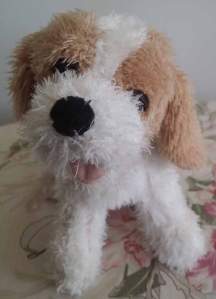
The “other dog” – the stuffed, animated pooch used in the experiment. Photo by Caroline Prouvost.

The “other dog” – the stuffed, animated pooch used in the experiment. Photo by Caroline Prouvost.

Did the dogs believe the stuffed animal was a real rival? Harris and Prouvost write that their aggression suggests they did. They also cite as additional evidence that 86 percent of the dogs sniffed the toy dog’s rear end during the experiment or post-experiment phase.

“Many people have assumed that jealousy is a social construction of human beings – or that it’s an emotion specifically tied to sexual and romantic relationships,” Harris said. “Our results challenge these ideas, showing that animals besides ourselves display strong distress whenever a rival usurps a loved one’s affection.”

Source:  UCSD media release


