Category Archives: special dogs and awards

Outfitting Smokey

In Tennessee, college football is a religion. When I studied in Knoxville in 2023, I was told that on Fridays the staff have to clear their car parks by a certain time (no overtime on Fridays!) because all of the car parking is needed for football fans who descend with their vans, campers and gear to make a weekend of it.

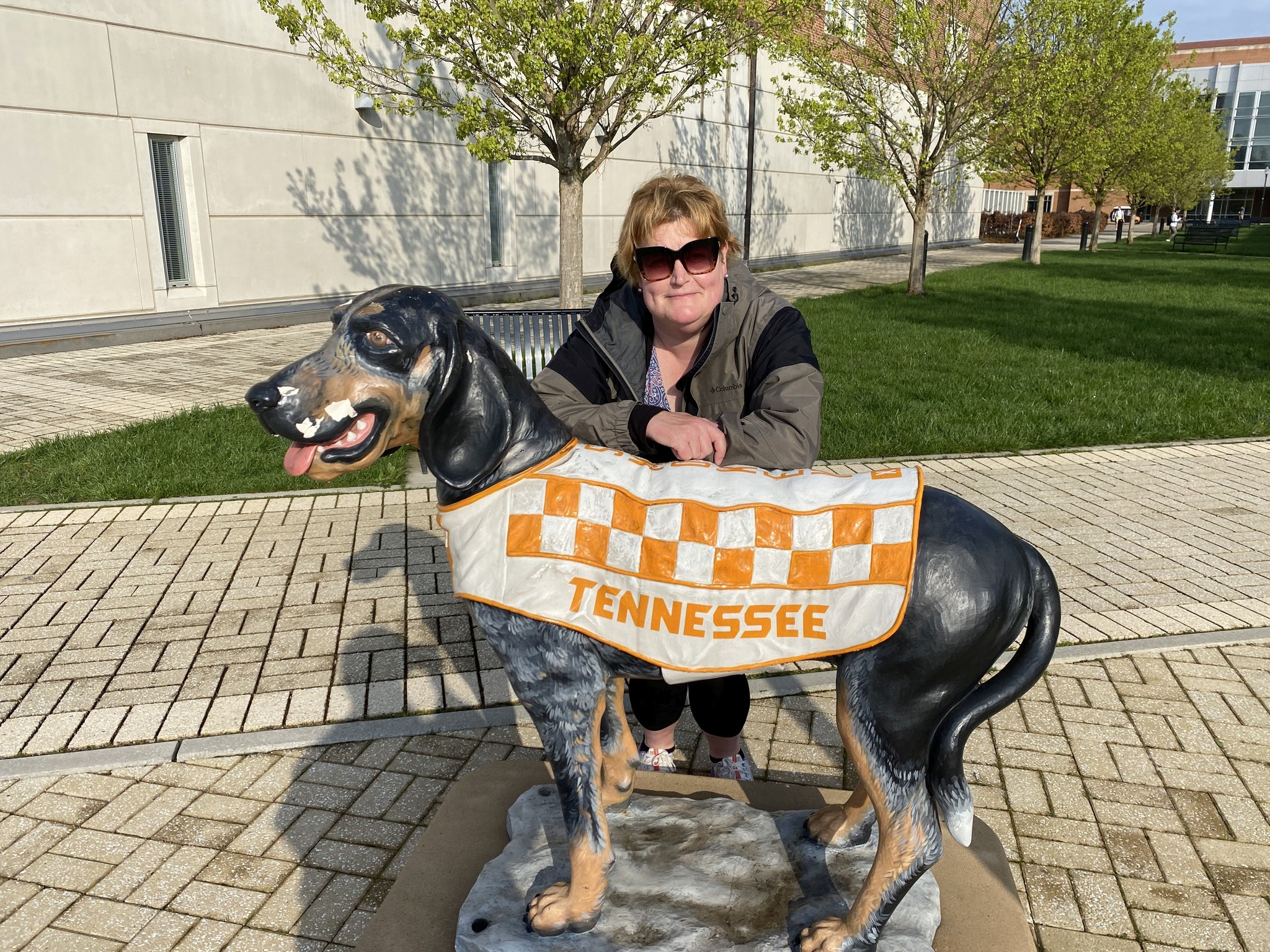
Smokey, a Bluetick Coonhound, is the team mascot and the Knoxville campus is dotted with Smokey statues:

There have been a succession of real-life Smokeys; below is a story about the woman who outfits the current mascot, Smokey X…

Kathleen Crisley is Fear-Free certified dog massage therapist and canine fitness trainer. She has a particular passion for working with dogs and their families to ensure injury prevention and quality of life. She specialises in working with anxious and emotionally damaged dogs. Her mobile practice, The Balanced Dog, is based in Christchurch, New Zealand

________________________

There’s nothing quite like sitting in the stands of Neyland Stadium on a fall Saturday as the T opens and Smokey leads the football team out to the field of battle.

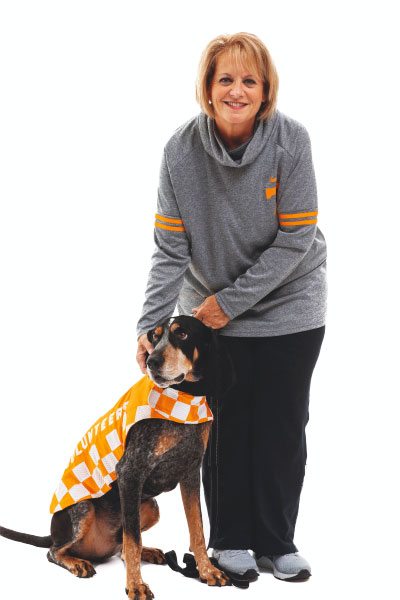
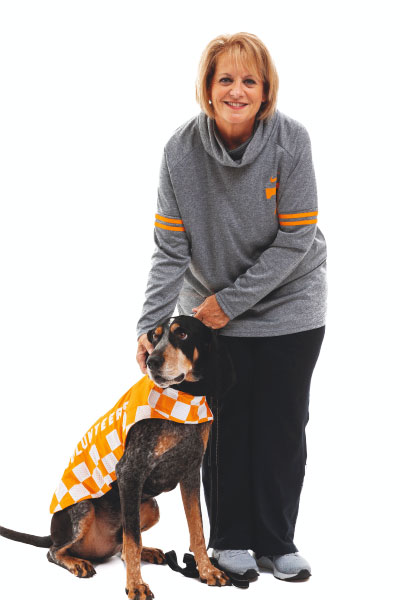
Jill Mayfield with Smokey X

For more than 70 years, Smokey has been an icon in college sports, and his game day gear, made by Tennessee Athletics’ own Jill Mayfield, is just as iconic.

Mayfield, a facility operations and support specialist for UT Athletics, has dedicated a prodigious amount of time brainstorming, stitching, and sewing for the beloved canine.

And it all began with some cheerleaders and a paint mishap.

Before Mayfield began working at UT, she had a friend whose son was on the cheer team. One game day morning, the team was painting the Rock, and without thinking they threw the paint cans in the back of their truck.

“Paint got all over the big flag they had back there for the football game that night,” Mayfield says. Knowing she was a seamstress, they called her in a panic.

The cheerleaders brought the flag to Mayfield’s house, giving her the opportunity to fashion a pattern of the Power T. Half of the team went to find white material, and the other half went to find orange, and they made a temporary flag for the night.

The Cedar Rapids, Iowa, native attributes her love for sewing to her maternal grandmother, who ran a drapery business out of her home. 

“My mom would help her at the shop, and to keep me entertained they would have me pick up pins they dropped on the floor,” Mayfield recalls. “Just being around it led me to want to sew.” 

In 2000, Mayfield began working for the UT ticket office and reconnected with the head of the cheer team. Shortly afterward, she was asked to try her hand at crafting the outfits worn by the costume mascot. 

Though she doesn’t sew much for the costume mascot currently, Mayfield was responsible for the fan favorite Big Orange tuxedo.

It was in 2014 that she was asked if she was interested in making the live mascot’s vest—and she jumped at the opportunity.

Her first task was figuring out the timing. Smokey’s senior handler, a member of the Alpha Gamma Rho fraternity, designs the vests for each football season. Depending on how intricate the design is, the garment may take up to two days to make. 

After the design is approved by the spirit program director, Mayfield will tweak it, measure Smokey, and then gather the orange and white fabric to pull the design together.

“I start at the back section first, then the side sections to finish. I’ll put them together and send a picture to the team. Once it looks good, I’ll start assembling and bring Smokey in for a final fitting.”

Mayfield is on the sidelines for each game and loves to see Smokey on duty and interacting with fans.

“I always want to make the handler’s vision come through just like he wanted it,” she says. “I’ve seen Smokey run through the T a million times, but each time feels like the first.”

Source: Torchbearer, the magazine of the University of Tennessee

With a nuzzle, paw and kiss, dogs offer a potent antidote to human loneliness

Loneliness has become an increased concern nationally since the pandemic. However, studies have shown companionship with dogs can greatly reduce the effects. (VCU Center of Human-Animal Interaction)

By Mia Stephens

Framed by the isolation of the pandemic, loneliness has become a huge concern across the world in recent years. Loneliness is considered as harmful as smoking 15 cigarettes a day and may be a greater public health threat than obesity

Long known as man’s best friend, dogs are being embraced even more now as a means of combatting loneliness. In one study, frequent interactions with dogs, either through ownerships or through long-term interventions, have been associated with positive psychological outcomes across the human lifespan.  

“They are skilled at socializing with humans, sensitive to our emotional states and gestures – they can communicate using complex cues and form complex attachment relationships with humans,” said Nancy Gee, Ph.D., C-AISS, professor of psychiatry and the director of Virginia Commonwealth University’s Center for Human-Animal Interaction and Bill Balaban Chair in Human-Animal Interaction. “Their attachment to their human owners mirrors that of human babies to their mothers.”  

Gee, whose been studying the relationship between therapy dogs and humans for more than two decades, spoke with VCU Health News about how interactions with dogs can relieve loneliness and increase connection with others.   

How can dogs combat human loneliness?  

Dogs are thought to fulfill the four roles of an attachment figure: They are enjoyable, comforting, missed when absent and sought in times of distress. Adults and children alike confide in their pets because they relieve us from the worry of confidentiality, judgments, or meeting expectations.  

Dogs are known as wonderful “social icebreakers” and referred to as the “great leveler” – people will risk directly engaging with unfamiliar people when there is a dog present. Additionally, research shows that pet owners have made friends through their companion animals, which have helped them engage more in the community.  

When humans interact with a dog in a calm way – where they are stroking the dog and making eye contact, or even talking to the dog – we see that both species release oxytocin (bonding/feel-good hormone), and their cortisol (stress hormone) levels drop. Additionally, their blood pressure and muscle tension lower, and their mood elevates.  

When you combine these responses together, it indicates the interactions are relaxing and enjoyable, which helps to reduce a person’s overall experience of loneliness. 

Is there a difference from other animals?  

Probably, yes, but there is not enough research on the subject to know for certain. We do know that dogs are unique in the animal kingdom. Through domestication and selection, dogs emerged from the grey wolf over a period of at least 35,000 years, and there is probably no other species on the planet as well-matched to human social needs as dogs.  

What are common types of service dogs, and do they differ in addressing human loneliness?  

There are three prominent classifications: 

  • A Service Dog (also called an Assistance Dog) has one handler who has a medically recognized disability. The dog is specially trained to assist that one person (their handler) with some aspect of that disability. For example, some dogs are trained to alert a person with a seizure disorder that a seizure is about to occur. This will allow the person to take medicine, call for assistance and/or get into a safe place/position so that they are not harmed during the actual seizure.  Service Dogs are covered under the American’s with Disabilities Act and are granted access to public facilities and housing that otherwise excludes pets. 
  • An Emotional Support Animal can be any animal species and requires no specific training. An ESA supports one person with a mental disability by comforting that person in a way that reduces symptoms. ESA status is determined by a mental health professional who writes a letter attesting to the animal’s role and housing status if pets are otherwise not allowed. However, ESAs are not permitted any other public access. 
  • A Therapy Dog is handled by one person, but the dog’s job is to interact with many people who may benefit from the interaction. Therapy dogs, like those in our center’s Dogs on Call program, are granted access to facilities and transportation based on the permission of the administration of the facility or transportation provider, and the requirements of the program in which the dogs participate. 

Currently, there is very little research that compares the three classifications of animals and the effects of SDs or ESAs in reducing loneliness. However, Dogs on Call specifically, and other therapy dogs in general, have been found to significantly reduce loneliness in the people they visit. 

Does human age matter in regard to loneliness and the benefits of interacting with dogs?  

We have results back from our own randomized clinical trials showing that for older adults and for adults with mental illness, interacting with Dogs on Call dogs and handlers is effective at reducing loneliness.  

We’ve just completed data collection on our pediatric study, so we don’t know the answer just yet, but we have reason to believe that across the human lifespan, interacting with a therapy dog can reduce loneliness. Additionally, one study showed that adolescents derive more satisfaction from, and engage in less conflict with, their pets than with their human siblings.

Source: VCU Health (Virginia Commonwealth University)

Canines trained to detect clubroot in the fields of Alberta

Note from DoggyMom: I published a post in November 2024 about scent detection dogs trained to identify tubers of an endangered orchid in New South Wales (Australia). Bill Grimmer, who is featured in this article, reached out to me to make me aware of the use of dogs in Alberta. “We had similar success with the tuber “Clubroot” affecting a $12 billion operation for canola oil.” Bill also says that training of the detector dogs has become a service business for dog trainers in the area. Another success story on using the natural abilities of dogs to benefit humans and the environment.


Any dog lover knows that dogs can do amazing things. Add to that list the ability to detect clubroot in canola.

“The idea behind using dogs as detectors has been around for quite a long time. Using them to detect crop diseases has been around for the last five years or so,” said Michael Harding, plant pathologist with Alberta Agriculture and Forestry.

Last spring, Harding got a cold call from a dog trainer in New Brunswick wanting to connect with a plant pathologist to see if dogs could be trained to detect crop diseases.

After some discussion, he and two trainers from Grimmer’s Canine College in Shediac, New Brunswick, Bill Grimmer and Mario Bourque, agreed to conduct a trial on clubroot. Four dogs — all young with high energy and eager-to-please dispositions — were selected and trained using clubroot galls.

Bill Grimmer, a dog trainer from New Brunswick, walks with Adi while the Goldendoodle sniffs out clubroot in a canola field. Photo: Morton Molyneux

“They started doing the clinical training to teach the dogs to alert them when and where they detected the clubroot gall,” said Harding. “The dogs are smelling these things all the time anyway. The trick is just getting them to alert you when they smell what it is you want to detect.”

Once the dogs were trained to the scent indoors, the training moved outdoors, a much more challenging environment because of all the visual, auditory and scent distractions.

“After a couple of months of clinical training indoors and outdoors, they were ready to be field tested,” said Harding.

Funding was an issue but was resolved when Harding connected with Ken Coles, general manager of Lethbridge’s Farming Smarter, who secured a Canadian Agricultural Partnership grant.

In October, the trainers and dogs landed in Alberta and visited four canola fields — two in the southern Alberta brown soil zone, and a pair in the black soil zone near Edmonton. The dogs selected for the project were two-year-old Josie, a German shepherd, and Adi, an eight-month-old Goldendoodle rescued from the humane society.

“When the trainers were here, they showed us using their clinical training aids that the dogs were able to detect clubroot,” said Harding. “They have trained the first two dogs in the world that can detect clubroot by scent.”

Dogs will alert by barking, putting their nose on the infected canola plant, or by digging. It was surprising how quickly the dogs were able to master the task, said Harding.

“The dogs came from New Brunswick, and had never set foot in a canola field before and there were a few distractions, like gophers.”

While Adi and Josie are good examples of “working dogs,” almost any breed could be trained to do this, said Harding.

“Some dogs have some advantages when it comes to scent detection,” he said. “All dogs have the capacity to do this. It’s just a matter of rewarding the behaviour that you want.

“You could as easily train a Chihuahua or a Great Dane but we’re looking for dogs that can move through fields easily and be easy to transport.”

The trainers put GPS collars on the dogs, so they could map the fields and see where the dogs stopped. The results can then be mapped and shown on an iPad.

There are several advantages to using dogs to sniff out clubroot. First, it’s quicker than having a person walk a field looking for stunted or damaged plants, and then digging them up to see if they have galls. It might also be a way to detect the presence of the disease when an infestation is at a very early stage.

Then there’s the cost factor.

“Once you’ve borne the upfront cost of the dog, it’s not that expensive to keep a dog around, compared to what it costs to provide salaries and benefits for employees who are doing scouting,” noted Harding. “You could add multiple inspectors to your inspection crew and not have it be as financially onerous if you were going to add human inspectors.”

While some canola producers might like to train their dogs to do early identification of clubroot, another option is for individual counties to train dogs in order to beef up their level of scouting. Dog trainers might also want to add clubroot detection to their roster of services.

“This was a research project to determine feasibility and so our part in it is done,” said Harding. “If there is something valuable that the industry is going to run with, we hope that this is the case.”

There are skeptics who don’t believe the industry will be keen to adopt sniffer dogs, but Harding has ideas for additional studies to build on this first successful trial.

“We’re wondering if it’s possible to teach dogs to detect resting spores in the soil,” he said. “What if we could train them to detect spores above a certain threshold in the soil and then they could scout equipment to determine whether it was clean or needed to be washed?”


Source: Alberta Farmer Express, November 2019

Scent detection dogs sniffing out a critically endangered orchid

Three spaniels, an orchid in hiding, and an innovative technique that could change how Saving our Species monitors elusive species.

Trying to save a species that’s hard to find is a problem many conservationists face. Imagine the challenge when a species spends most of its time lying dormant beneath the earth’s surface.

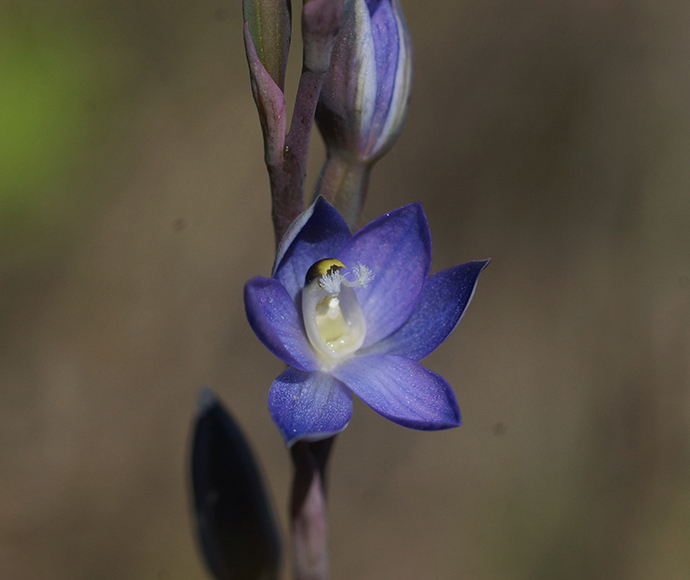
The critically endangered Wyong sun orchid (Thelymitra adorata) is one of these hidden species. It is hard to see unless it’s flowering, which makes monitoring a difficult task.

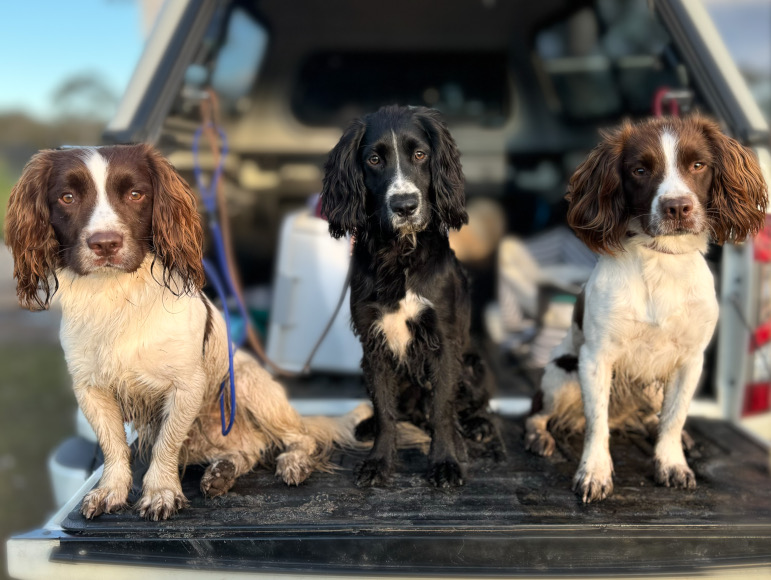
Three clever canines (Paddy, Sully and Vera) are being trained to use their strong sense of smell to help find this orchid. While the use of scent detection dogs is not new to conservation, this is the first time they have been used for Wyong sun orchid monitoring. It’s a trial that could mark the start of a game-changing method.

Hard-to-detect tubers

A tuber is a specialised plant stem that occurs underground, storing a lot of a plant’s nutrients. It exists in a type of hibernation mode. During this ‘resting’ phase, you could walk right over a tuber and never know it. When conditions above ground are favourable, a tuber will sprout and push through the soil, producing a plant that conservationists can finally see.

However, for the Wyong sun orchid’s tubers, the right conditions for emerging include the presence of fire (much like humans in winter). Imagine how much easier monitoring would be if conservationists could detect this plant without having to wait for these conditions.

A less invasive, innovative method

Thanks to a partnership between Saving our Species and dog training organisations On the Scent and The Good Dog, the team are one ‘sniff’ closer to detecting this species while it is sleeping.

‘If successful, this method may enable a year-round survey window, give greater certainty of survey results and assist in planning conservation actions, such as targeting areas for controlled burns’, said Paul Hillier, a senior regional conservation officer for Saving our Species.

‘Until now, the only way to find the Wyong sun orchid is by identifying the flower or leaf, whereas the dogs will attempt to find the plant by scenting the tubers under the ground in a minimally invasive way’, said Mel, owner and dog trainer, The Good Dog.

This unique partnership is expanding opportunities to conserve this critically endangered species, and if successful, may provide the basis for detecting other cryptic species in the future.

‘Both The Good Dog and On the Scent believe that supporting threatened species conservation is important to ensure they remain and repopulate in their habitat for years to come and don’t become just another item added to the extinction list’, said Philly, owner and dog trainer, On the Scent Canine Detection.

The project is also in collaboration with Australian Botanic Garden Mount Annan and Central Coast Council.

Source: NSW Environment and Heritage

Therapy Dogs Ease Stress for Nurses, Doctors, Too

Therapy dogs can help boost the spirits of healthcare workers in the same way they brighten the moods of hospital patients, a new study shows.

Photo: Ohio State University Wexner Medical Center

 The furry, four-legged friends reduced emotional exhaustion and job stress among a small group of workers at two surgical and two intensive care units in the Midwest, researchers report.

“We brought the dogs to the units and many times we had staff in tears sitting with the dogs, telling them about their day,” said lead investigator Beth Steinberg, a senior researcher with Ohio State University’s Center for Integrative Health.

“For the most part, people have an affinity to a non-judgmental, warm, furry animal that can come and just sit with them and listen,” Steinberg said in a university news release. “Dogs don’t care what you look like, how you’re feeling that day; they just know that when you need them, they’re there.”

Steinberg is co-founder of Buckeye Paws, a therapy dog program initially aimed at improving the mental and emotional health of staff at the Ohio State University Wexner Medical Center.

Buckeye Paws launched in March 2020, shortly before the pandemic began taking its toll on overtaxed health professionals.

To see whether the program is making a difference, researchers focused therapy dog sessions with a group of 64 health care workers. The group included doctors, nurses, nurse practitioners, respiratory and rehabilitation therapists, patient care associates and unit clerks.

“The recruitment for this study was incredibly easy because as soon as you said, ‘We’re going to do a study assessing your response to therapy dog interaction,’ people were like, ‘I’m in!’” Steinberg said. “Even before COVID-19 hit hospitals so hard, the staff were already struggling with stress, burnout, lack of work engagement.”

Buckeye Paws handlers — all hospital employees who volunteered their time — brought in seven certified therapy dogs three times a week for eight weeks. The study ran from October 2021 to March 2022.

“There was free interaction with the dogs that people could spend as much or as little time as they wanted with the dogs,” Steinberg said. “Prior to their interactions, we asked them to fill out a basic 1 to 10 mood scale. And then, after the interaction, they did that again.”

Most interactions were brief, just a few minutes between a dog and a health care worker at a clinical workstation or in a team room or break room.

But results showed the brief sessions made a big impact.

Many study participants reported an immediate decrease in feelings of stress, emotional exhaustion, depersonalization and burnout.

“Our findings suggest that an animal-assisted activity, available for healthcare workers within busy inpatient settings, may offer immediate benefits through improved mood,” researchers concluded in their report, which was published recently in the International Journal of Complementary & Alternative Medicine.

Buckeye Paws expanded in March 2022, and now provides therapy dog assistance to students, faculty and staff at Ohio State University. There are now 29 dog-handler teams in the program, with another 11 teams going under training and eight more beginning the process, researchers said.

Source: Newsmax

An emotional support animal for the NBA

Dallas Mavericks assistant athletic trainer Heather Mau has noticed a trend of players grabbing extra breakfast. It’s not that their appetite has grown, but they need the extra food to lure in their favorite coworker.  

Mavericks team emotional support dog Bailey. Photo courtesy of Dallas Mavericks

Bailey, a two-year old mini Bernedoodle, is the team’s emotional support animal — the only one known to exist among NBA teams. She was “hired” in April of 2022 for a job that requires her to be her adorable self and get spoiled by professional basketball players. 

While Mau is proud to say the Mavericks are the first NBA team to do this, she hopes to inspire other organizations to get emotional support animals. She said that even with the team’s busy schedule, having Bailey has added a lot of benefits.

“We are trying to be progressive when it comes to that as an organization,” Mau said. “Being the first to have an emotional support animal, and really putting our mental health — players, staff and coaches’ mental health — in the forefront and the focus on what we do.”

Naturally, of course, the team loves to spoil her. 

Dwight Powell, Tim Hardaway, Josh Green and Maxi Kleber are usually the ones that fall victim in that category,” Mau told CBS Sports. “But there are a few staff members who spoil her even more than the players.”

Head coach Jason Kidd and other Mavericks higher-ups approved the decision to get Bailey, and Mau couldn’t volunteer fast enough to take care of her full-time. 

“I like to say I quite frankly tricked everybody here to get me a dog,” Mau joked. “She is awesome. She brings a lot of light not only into my life but a lot of light into the building.”

Mau is Bailey’s mom and the players are her “uncles.” The cuddly staffer has a busy schedule because she attends all practices, home games, shoot arounds and treatments with Mau. Fortunately, she gets plenty of treats to help her maintain her energy.

“This dog is too smart sometimes,” Mau said. “She doesn’t like to eat all her breakfast at home before we leave for work because she knows she is going to go to work and have more breakfast.”

Players do not apologize for such behavior.

“Do I feed Bailey too much? I don’t think so,” Green told The Dallas Morning News. “She does a lot for the team. She’s one of our teammates. She’s always there for me, so I bring extra breakfast every morning.”

Sure, Bailey sometimes gets the zoomies and runs around the entire facility going “absolutely bananas.” And, yes, she occasionally forgets she is not supposed to play with her mom’s equipment, but she brings a lot of joy to everyone in the organization. 

“That’s what Bailey brings, something different but also happiness,” Kidd told WFAA.

She stays at home for road games but still shares her support for her uncles on her Instagram account, which her mom finally let her get in December. 

Bailey gets lots of cuddles from the team, an endless amount of kisses, and Powell has gone as far as wearing matching outfits with her. In December, she had a birthday party and her favorite uncles did not miss out. 

The San Francisco 49ers appear to be the only other professional sports organization doing something similar. They have Zoe, an adorable French bulldog who has captured the hearts of the entire roster. She had a brother, Rookie, but he passed away last year. Zoe belongs to the team’s director of player engagement, but others in the organization also help take care of her.

Her instagram is filled with photos with her teammates proudly posing with her. 

Bailey and Zoe don’t just make workdays more fun, mental health professionals agree that animals have real mood-boosting benefits.

Ed Chavez, mental performance clinician for the 49ers, thinks every team should consider adding a pet to their roster. 

“I’m a huge advocate for having therapy dogs. Studies have shown that they reduce stress, anxiety and depression,” Chavez said. “Having them around is so beneficial to our mental health. When interacting with dogs, it lowers stress hormones and it releases calming and feeling good biochemicals in the brain. They generally make us feel better.”

Source: CBS Sports

The induction

National air carrier Air New Zealand has recently announced that it is expanding its efforts in conservation by becoming the principal sponsor for the Conservation Dogs Programme. This programme helps mentor, certify and manage over 120 detection dogs to support conservation outcomes. 

Conservation is a big deal in New Zealand and dogs make great conservation workers!

The dogs and their handlers will receive free travel on Air New Zealand to get them to where they are most needed.

Enjoy this indogtion (induction) video:

Kathleen Crisley, Fear-Free certified professional and specialist in dog massage, rehabilitation and canine fitness,  The Balanced Dog, Christchurch, New Zealand

Dogs enlisted for pest-free Banks Peninsula success

Dog versus hedgehog. In a suburban garden, victory would go to the one with the prickled armour. On the dunes of Kaitōrete, the 25km spit of windswept land separating Te Waihora/Lake Ellesmere from the Pacific Ocean on Banks Peninsula, the hedgehog doesn’t stand a chance. Minutes after being tracked down in the long grass by Nightshade the border terrier, it has been removed and shot.

“Hedgehogs seem very cute but they are in the wrong country and they eat anything here on Kaitōrete,” says Karin Bos, dog handler for Pest Free Banks Peninsula. “Insects, lizards, eggs, tiny birds – they just hoover everything up they can find.”

Nightshade is part of an arsenal of dogs, traps, poison bait stations and cameras used by Pest Free Banks Peninsula to protect the biodiversity of Banks Peninsula Te Pātaka o Rākaihautū through the eradication of all animal pests by 2050.

For a piece of land without the water border of an island sanctuary or the predator-proof fence of a land sanctuary, it is a bold goal, first laid out in 2016 in the 2050 Ecological Vision for Banks Peninsula developed by the Banks Peninsula Conservation Trust in conjunction with the local community. Two years later, Pest Free Banks Peninsula was formerly established by 14 founding signatories, including local councils, rūnanga and the Department of Conservation.

“We are amongst some others trying to do it for the first time, so we are all learning together,” PFBP project manager Sarah Wilson tells Frank Film. “Nobody knows how to do this.”

Banks Peninsula Te Pātaka o Rākaihautū is an ancient volcanic landscape, covering around 115,000 hectares of farmland, pockets of native bush, plantation forests, cliffs and beaches encroaching on the edges of Ōtautahi Christchurch. It is a unique landscape rich with native flora and fauna including tūī, ruru (morepork), pīwakawaka (fantail), kororā (white flippered little blue penguin), hoiho (yellow-eyed penguin, tītī (sooty shearwater), waterfowl, jewelled geckos and spotted skinks. At least six plant species and more than 60 invertebrate species, including the rare beaked moss moth, Gadira leucophthalma, do not exist anywhere else in the world.

Threatening this biodiversity are invasive populations of rats, mice, stoats, ferrets, weasels, hedgehogs, feral cats and an estimated 460,000 possums.

“When you look at possums and rats and stoats and everything else put together, the damage they do to the whole ecosystem is pretty significant,” says PFBP operations manager Tim Sjoberg. “If you start reducing one native species versus another then you are really throwing the balance of the whole ecosystem out of whack.”

But the peninsula’s near-island topography is an advantage, allowing the eradication programme to move steadily from the coastal edges on the east and south towards the west, hopefully without losing advances to reinfestation.

To work within available funds, half of which comes from Government company Predator Free 2050 Ltd, it is beginning in two elimination sites.

The appropriately named Wildside Project covers 23,000 hectares of steep gullies and towering sea cliffs on the south eastern corner of the peninsula. While aimed at feral cats, ferrets, stoats and weasels, its primary target is possums. Sjoberg takes Frank Film through the stunning beauty of the DOC-managed Nikau Palm Gully, pointing out trees etched with claw marks and saplings stripped of foliage. “The damage they do to the forest structure by eating the most palatable species, the absolute appetite for invertebrates and everything else – these guys have an impact on every cycle of the ecosystem.”

The eradication programme here relies on self-resetting battery powered traps in more inaccessible areas, over 90 live capture traps laid on roadsides and in public parks and backyards and poison bait stations using encapsulated cyanide.

Unlike more remote eco-sanctuaries around the country, care is required around private dwellings, public walking tracks and water-take areas but in setting traps, checking trap lines and monitoring the area for reinvasion, community support, says Sjoberg, is vital.

“We are working in people’s backyards, on their farms – there is some public land but the bulk is private land so having that buy-in from the community is absolutely critical. In this country if you walk away from it without doing any control, you’ve lost all that work, all that mahi, you’ve done – they’ll be back.”

Sjoberg estimates the programme has already killed around 4000 possums over the past two years; cameras in 20 sites around this remote area show a dramatic decrease in possum numbers in the past six months alone.

“A few more to go but we are learning every day and we are accelerating every day.”

The other site is the 5000ha Kaitōrete Spit, where a programme of dogs (including Nightshade and Terry, the cat-sleuthing springer spaniel), cameras and self-reporting traps, which send a signal back to PFBP HQ in Tai Tapu when a trap is sprung, are being used to clear this wild finger of land from hedgehogs, feral cats, possums, ferrets, stoats and, most commonly, weasels, accustomed to dining out on the rich diet of birds, invertebrates, lizards and geckos.

Already about 45ha has been cleared of hedgehogs as the programme moves steadily eastward without reinvasion behind.

“Two years ago walking down the sand dunes you would never see anything,” says Sjoberg. “This last summer when we walked through there were lizards, geckos everywhere. We were able to see a change that quickly. It was quite phenomenal.”

The goal now, he says, is to bed in these gains and to extend further across Banks Peninsula Te Pātaka o Rākaihautū.

“If we are valued by the community, and we undertake this safely and professionally, then I am confident funding will come and we will be able to scale up and work across that landscape.”

Source: Sally Blundell for Frank Film

Purina Dog Chow honors PTSD service dogs

In honor of Service Dog Awareness Month, Purina Dog Chow is joining forces with actor and singer Anthony Ramos to celebrate the finalists of this year’s Dog Chow Visible Impact Award, which recognizes the remarkable impact service dogs have on the lives of military veterans experiencing post-traumatic stress disorder (PTSD). Ongoing research shows most veterans with trained service dogs show lower symptoms of PTSD and reduced depression compared to more traditional clinical care for PTSD alone.

From now through October 13, 2023, dog lovers are invited to help select the 2023 Visible Impact Award winner by voting on the selected finalists at DogChow.com/service. For every vote, Dog Chow will donate $5 to the Association of Service Dog Providers for Military Veterans (ASDPMV), up to $75,000, to help train more PTSD service dogs. The winning service dog’s veteran will receive a $10,000 cash prize and $25,000 for the organization that trained the service dog.

“Partnering with Dog Chow for this year’s Service Dog Salute program is a privilege beyond words. The unwavering loyalty and support that service dogs provide to our military veterans is nothing short of remarkable,” said Ramos. “I am honored to help shine a light on the powerful impact service dogs have on the lives of those who served our country.”

Visible Impact Award Finalists This year’s Visible Impact Award Finalists include:

  • Huey/Operation Freedom Paws–helps U.S. Army veteran Ramon by detecting migraines and dizzy spells before they happen
  • Eagle/K9s for Warriors–helps U.S. Navy veteran Joe by providing standing pressure therapy “hugs” to reduce anxiety and create a sense of security
  • Phelan/Tails of Valor, Paws of Honor–helps stop U.S. Army veteran Harold’s night terrors and can detect and de-escalate when Harold begins to feel anxious or angry
  • Maverick/K9 Partners for Patriots–helps U.S. Air Force veteran Wendy by jumping on her lap when she starts to get anxious and helps prevent panic episodes
  • Bobby/Pawsitive Teams–helps U.S. Navy veteran Sondra mitigate her anxiety and hyper vigilance by walking lightly in front of her and scanning the environment to ease Sondra’s mind

A PTSD service dog’s Impact

Roughly 3.5 million military veterans suffer from PTSD, and while service dogs have been demonstrated to reduce the severity of PTSD, only 1% of those in need who seek a service dog receive one each year. Dog Chow has been on a mission to help, donating more than $1M to service dog organizations since the start of the Service Dog Salute in 2018. These donations help support the care and training of more service dogs for veterans with PTSD at no cost to the veterans.

To vote for the Visible Impact Award winner and for more information about Dog Chow’s support of our nation’s veterans, visit DogChow.com/service.

Source: Petfoodindustry.com

Subaru Supports Pet Organizations Through Adoption Events

Subaru of America announced the return of Subaru Loves Pets Month, a time dedicated to supporting and celebrating shelter pets through the Subaru Loves Pets initiative. Together with its nationwide network of retailers, Subaru is doubling down on efforts to unite animals with loving homes, with a special focus on the older, physically challenged and “different” dogs Subaru lovingly calls “Underdogs,” often the last to be adopted.

According to the ASPCA (The American Society for the Prevention and Cruelty of Animals), nearly 6.3 million companion animals enter shelters nationwide annually. To help find loving homes for these animals, more than 600 Subaru retailers will partner with local shelters, rescues and animal welfare organizations throughout October to host in-person and virtual adoption events. Participating retailers will donate $100 to the organizations for every pet adopted in October, up to $3,100. In addition, Subaru will donate $20 to the ASPCA with every purchase of select pet-friendly accessories, including pet harnesses, seat protectors and travel bowls, through Subaru Parts Online and $1 for each “Animal” badge ordered through Subaru Badge of Ownership throughout October.

“We advocate for adopting from pet organizations year-round, but October is particularly special as we devote the entire month to uniting pets across the country with the loving homes they deserve,” said Alan Bethke, senior vice president of marketing, Subaru of America, Inc. “Our Subaru community is incredibly passionate about animal welfare, and together with our retailers, we’re proud to help make the world a better place for pets everywhere.”

Subaru Loves Pets Month will culminate in the fourth annual National Make A Dog’s Day on Oct. 22, a Subaru holiday that invites dog-lovers everywhere to go the extra mile for their pup. To celebrate, Subaru invites dog owners to do something special for the furry friends in their lives and share on social media using #MakeADogsDay. For those who are yet to be pet parents, Subaru invites Americans to consider adopting a shelter pet or “Underdog.”   

Subaru has a long history of supporting pets in need and the Subaru Loves Pets initiative has helped support the adoption of nearly 60,000 animals from local animal welfare organizations. Since 2008, Subaru has donated more than $42 million to national and local organizations to support the rescue, transport, and adoption of nearly 350,000 pets.

Source: Pet Business