Category Archives: special dogs and awards

Haus the rescue dog returns the favour

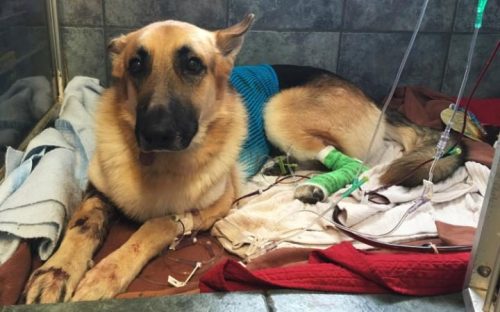
The DeLuca family of Tampa, Florida are very happy they chose to adopt Haus, a German Shepherd two months ago.

Last week, Haus stepped in to keep their 7-year old daughter from being attacked by a rattlesnake, an Eastern Diamondback to be precise.

Haus

Haus suffered several snake bites and it was touch-and-go for a while when he was admitted to the local veterinary hospital and put on an anti-venom drip and given pain relief.

The family appealed for funds for his care and were amazed at how quickly the funds added up to over $50,000.  They then issued a statement “PLEASE — we feel we have plenty to care for Haus’ needs” and encouraged people to donate to other worthwhile charities – where the excess funds will also be donated.

At last report, Haus’ condition is improving.

And it makes me very glad that New Zealand is a land without snakes!

Kathleen Crisley, specialist in dog massage, rehabilitation and nutrition/food therapy, The Balanced Dog, Christchurch, New Zealand

Teaching dogs to fly

Mark Vette, New Zealand-based animal training and behaviorist, has done it again.

Known for his achievement in teaching dogs to drive (See the Driving Dogs of New Zealand), Mark and his team have now taught three rescue dogs to fly…

Rescue dogs are great dogs with depths of intelligence and emotion that we have only begun to explore.

Kathleen Crisley, specialist in dog massage, rehabilitation and nutrition/food therapy, The Balanced Dog, Christchurch, New Zealand

Words we say to our dogs and other things

Yet more research on the human-animal bond.  This time the research was based at Barnard College’s Dog Cognition Lab.

Researchers Alexandra Horowitz and Julie Hecht asked members of the public to send them videos of playtime with their dogs.

Dog with frisbee

They received 187 videos from dog owners in 19 different countries and watched them all, looking for patterns in human behaviour and the dog’s responses.

For example, they created a list of the top 35 words owners used with their dogs:

List of words dog owners use

The research team also noticed gender differences.  Female owners touch their dogs more when at play; half of male owners didn’t touch their dogs at all.

There is a practical application for this research (although I do agree that it sounds like a fun job).  There is a growing interest in helping to train dogs as assistance dogs and understanding how humans and dog interact may help to refine training techniques.

The research has been published in the journal Animal Cognition.

Source:  Discover magazine

Obituary: Fidele of Bruges


Fidele of Bruges

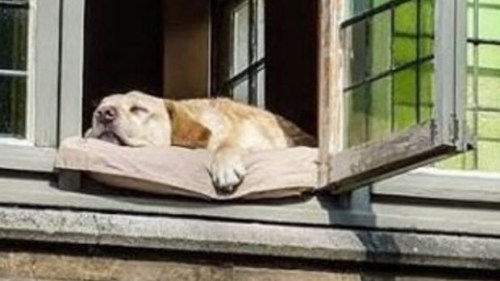
Fidele, the Golden Labrador who lived at the Bed and Breakfast Coté Canal and made a small appearance in the film In Bruges, passed away in early February at the age of 12.

His owner, Caroline Van Langeraert, has said that Fidele became an icon, with tourist boats along the canals stopping so tourists could take photos of him in his regular resting space at the window of the bed and breakfast.  He is irreplaceable.

Many tourists will have photos and videos of Fidele in his spot at the window, as seen here in YouTube.

It is always sad to see our dog friends leave; particularly so when they share our businesses and our customers know them well.  (Apparently, one US tourist asked to book into the bed and breakfast specifically because she had heard about Fidele.)


Kathleen Crisley, specialist in dog massage, rehabilitation and nutrition/food therapy, The Balanced Dog, Christchurch, New Zealand


Reading to dogs

Reading to dogs programs, more formally known as animal-assisted reading programs, are on the rise.

In this Boston Globe article, it is reported that one volunteer organisation – Dog B.O.N.E.S. (Dog Building Opportunities for Nurturing and Support) – has certified more than 200 Reading Partner teams.  And that’s working in the state of Massachusetts alone.

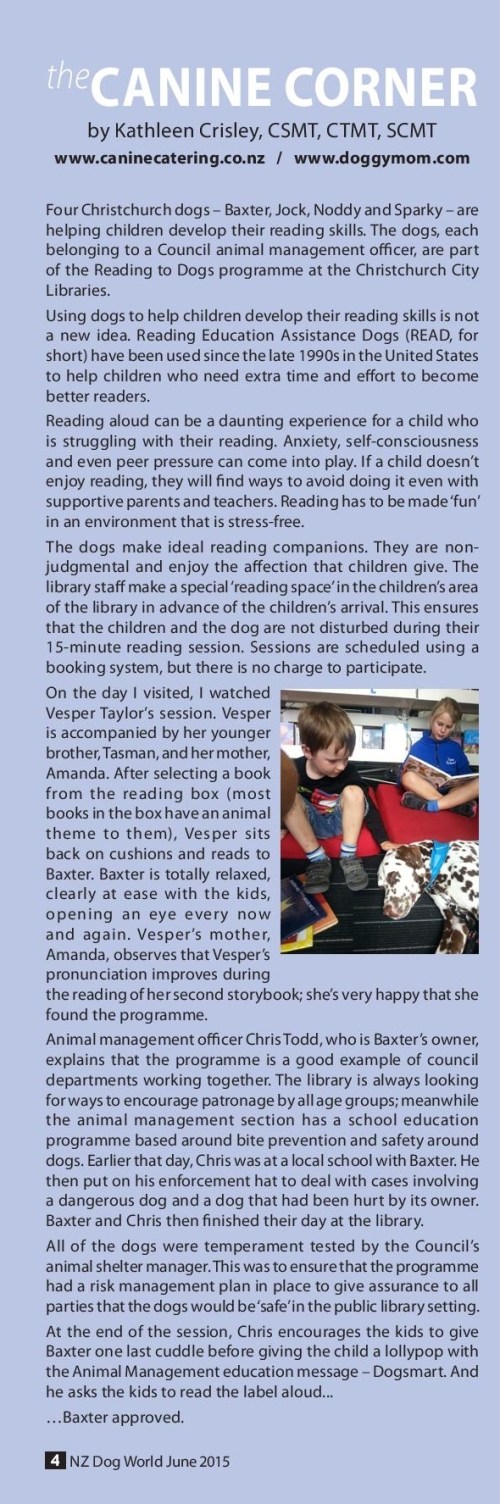
In Christchurch, we have a Reading to Dogs program which I wrote about in my column in NZ Dog World magazine (see below).

The big difference is that the Council was so worried about risk that it only accepted temperament testing by the Council’s shelter manager on the pet dogs of the animal control officers before allowing the program to proceed.  Since we have testing such as the Canine Good Citizen test, sponsored by the NZ Kennel Club, I think it’s a shame that volunteers are not resourcing this program.

This would allow the animal control officers to work in enforcement areas that are so badly needed and always under-resourced.

Reading to Dogs

See also Can your dog R.E.A.D?

Kathleen Crisley, specialist in dog massage, rehabilitation and nutrition/food therapy, The Balanced Dog, Christchurch, New Zealand

Whizz, a remarkable Newfoundland

Whizz

Photo: © PDSA / SWNS.com

A black and white Newfoundland and marine rescue dog, Whizz, has been awarded the PDSA Order of Merit.  This is the animal equivalent of the Victoria Cross and recognises animals that display outstanding devotion to their owner or wider society, above and beyond normal companionship.

His trainer told The Telegraph that he trained Whizz as a rescuer when the dog was only one year old. “I am bursting with pride for Whizz.”

“He was a dog in a million and I am truly heartbroken that he isn’t here to receive his medal. Whizz loved working and had an extraordinary talent. Not only was he strong and gentle – he was also so emotionally intuitive. This made him the perfect rescue and therapy dog and a beloved companion to the hundreds of sick children and adults he met along the way.”

During his rescue career, Whizz saved many people including two little girls who had floated out to sea on an inflatable raft and then got into trouble.  He also was a regular at Newfoundland Water Rescue Days, a fundraising event where people would enter the water and then be ‘saved’ by the rescue Newfoundlands.

Whizz also visited the sick and injured in hospital as a therapy dog.

Joey and the Pit Bull


People who have autism are often misunderstood.  So are Pit Bulls.  These two make a great pair.

Kathleen Crisley, specialist in dog massage, rehabilitation and nutrition/food therapy, The Balanced Dog, Christchurch, New Zealand


Odorology – the science behind training scent dogs

Dog training for scent tracking

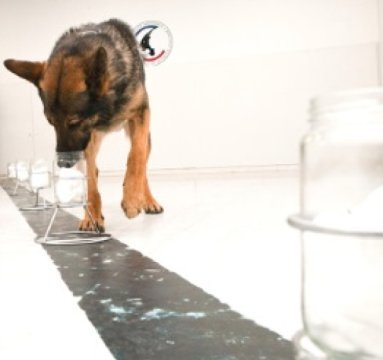
Cisko, one of the police dogs, during a scent detection test. The dog sniffs the reference scent and then smells a series of five jars containing human scents, one of which corresponds to the reference. If the dog recognizes the reference scent it lies down in front of the relevant jar; if the dog does not find a match, then it does not stop or lie down. Credit: © DGPN – SICOP

Odorology is a technique that uses specially-trained dogs to identify human scent. It is used in police investigations to establish that an individual has been at the scene of a crime. However, there is no international norm on how these dogs are trained. At the Centre de recherche en neurosciences de Lyon (CNRS/Université Claude Bernard Lyon 1/Inserm), researchers specializing in scents and their memorization have analyzed data, provided since 2003 by the Division of the Technical and Scientific Police (DTSP, Ecully) on dog performances in scent identification tasks.

Their results show that, at the end of a 24-month training program, the dogs are able to recognize the smell of an individual in 80-90% of cases and never mistake it for that of another. These findings validate the procedures that are currently in use and should convince the international community of the reliability of this method.

Odorology, or the science of smells, is a method of identifying human scents. It has been used in France since 2003 in police investigations to establish that an individual has been present at a crime scene. The method is based on the fact that each person has their own scent and relies on the powerful canine sense of smell (which can be 200 to 10,000 times more sensitive than that of a human being1). It involves a long period of dog training.

This technique consists in using a specially-trained dog to compare a human scent collected from an object found at a crime scene with scents from several people, including that of a suspect or victim. As the results of these tests are of critical importance for investigators, they need to be obtained through viable and reproducible methods. However, there are no internationally recognized norms for the training of these dogs or for their inclusion in investigations—hence the occasional reluctance to treat their evidence as proof. By analyzing results collected since 2003 at the Division of the Technical and Scientific Police (DTSP, Ecully), researchers from the Centre de recherche en neurosciences de Lyon have succeeded in demonstrating the viability of the technique used.

During basic training, the German and Belgian shepherd police dogs must learn to make the link between two scents from the same individual through the completion of increasingly complex tasks. By the end of this training, the dogs are able to carry out identification exercises during which they sniff a reference human scent and then compare it with five different human odors, one of which is the reference scent. When a dog matches the scent in the jar to the reference one (which it shows by lying down in front of the correct jar) it is rewarded with a treat or a game. The human odors may consist of traces collected from an object that someone has touched or of a scent collected directly from a person.

The analysis of the data obtained with the 13 DTSP dogs since 2003 shows that after they have learned the task’s principles, 24 months of regular training is necessary for stable and optimal performances. At the end of the first twelve months, the dogs no longer made any recognition errors, i.e., they did not confuse the scent of one person with that of another. Furthermore, their olfactory sensitivity increased significantly over the training period: on average, after two years, the dogs managed to recognize two scents from the same person in 85% of cases. The remaining 15% of cases in which no match was obtained, were mostly the result of poor scent sampling rather than poor recognition.

The researchers also found that German shepherds were better than Belgian shepherds.

At the end of their basic training, the dogs are able to participate in criminal cases and receive continuing training throughout their lives. In practice, each identification test is carried out by at least two dogs. Additionally, each dog performs at least two tests with the same panel of scents: the collected scent is presented either as a sample to be sniffed at the start of the task, or in one of the jars that the dog sniffs successively. Between 2003 and 2016, odorology was used in 522 cases at the SDPTS and helped to resolve 162 cases.

In these criminal cases, the sampled scents were only a few hours or days old. The researchers now want to study how the dogs perform on older scents. Scent samples can in fact be stored in scent libraries over several years.

Bear’s best friends

Detection dog for bears

Camas, of Working Dogs for Conservation, on the job in the Centennial Mountains.  Photo credit:  Julie Larsen Maher

A recently released study from WCS (Wildlife Conservation Society) details a new method using  “detection dogs,” genetic analysis, and scientific models to assess habitat suitability for bears in an area linking the Greater Yellowstone Ecosystem (GYE) to the northern U.S. Rockies.

The method, according to the authors, offers an effective, non-invasive approach to the collection of data that could play a vital role in the further recovery of grizzly bears during the coming decades.

“The use of detection dogs allowed us to quantify and map key areas of habitat for black bears in the Centennial Mountains located along the Idaho-Montana border west of Yellowstone National Park,” said Jon Beckmann, WCS Scientist and lead author of the study. “Black bears are a proxy species useful for predicting likely grizzly bear habitat. With recovery, a larger grizzly bear population needs room to roam and to reconnect with other populations. The Centennial Mountains region of the U.S. northern Rockies can provide room and safe linkages— critical to connecting the bear population in the GYE area to others further north and west”. 

During the study, two Labrador retrievers and two German shepherds owned and trained by Working Dogs for Conservation, located 616 scat samples of black bears and 24 of grizzly bears (identified by DNA extraction and analysis) in the 2500 square kilometer (965 square mile) study area.

“Dogs excel at searching for multiple scents at once, even if one is far more common than the other,” according to Aimee Hurt, Working Dogs for Conservation co-founder. “In this case, the dogs easily alerted us to a multitude of black bear scat, while also readily locating the rare grizzly bear scat, resulting in a multitude of data points and a robust model.”

“We recognize that black bears do not always utilize the landscape in precisely the same manner as grizzly bears,” said Beckmann. “But given the paucity of grizzly bears in the study area—especially  during the years of our study—our  approach, data, and model have value to grizzly bear conservation and management. This is especially true given that black bears and grizzly bears in the GYE are known to utilize very similar habitats spatially, but at different times.” 

Plugging the scat sample location data into their scientific model, the scientists examined the landscape with respect to habitat parameters, private lands, public land management and human activity in the area. Results of modeling provided insight into bear habitat use and resource selection patterns.

Among the findings it was determined that distance to roads matters; bears use habitat that is farther from roads, and when road density increased within 4 kilometers of a location bears used that habitat less. Bears also used a habitat less if it were high elevation, or privately owned. With this information land managers, land trusts, and others will be better informed to make bear habitat management and conservation decisions. This study may also inform human-bear conflict avoidance, and so help people and bears better co-exist.

“Using Detection Dogs and RSPF Models to Assess Habitat Suitability for Bears in Greater Yellowstone,” appears in the current edition of Western North American Naturalist. Co-authors include: Jon P. Beckmann of WCS; Lisette P. Waits of the Department of Fish and Wildlife, University of Idaho; Aimee Hurt and Alice Whitelaw of Working Dogs for Conservation; and Scott Bergen of Idaho Department of Fish and Game.

WCS’s work in this region is supported by the Turner Foundation, Wilburforce Foundation, Brainerd Foundation, The New York Community Trust, and the Bureau of Land Management–Dillon, Montana office.

Source:  Wildlife Conservation Society media release


When Dogs Heal

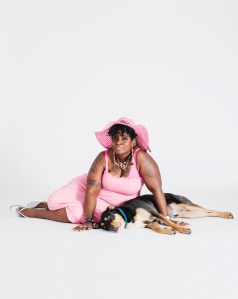
When Dogs Heal is a photographic exhibition supported by the charity Fred Says, which helps people diagnosed with HIV.

The photographs tell the stories of the dogs who helped their HIV-positive owners through tough times.

When Dogs Heal photograph

Paolo and Stud

The photographs have been shown in Chicago and New York, and through the When Dogs Heal website, galleries can express interest in hosting an exhibit.

When Dogs Heal photograph

Sharon and Dulk

The stories behind the photographs are pretty hard-hitting, but then again so is HIV and the impact of an HIV diagnosis.  Just another example of the human-animal bond and the connection between dogs and good health.

Kathleen Crisley, specialist in dog massage, rehabilitation and nutrition/food therapy, The Balanced Dog, Christchurch, New Zealand