I love you to bits: kibbles and bits and bits and bits…

I was thinking today about how dog nutrition has changed over the years.  Today, there are more dog foods than ever before.  There are organic products and even products that aim to attain the values of the raw food diet – but offering a more prepared formulation for busy dog owners.

So now I’m going to show my age and also the power of a good jingle.  I still remember this commercial from the 1980s for Kibbles and Bits.  This was one of the first commercial dog foods to offer a hard kibble combined with softer texture pieces.  But it’s the jingle I remember and I’ve found it for you here on YouTube.  Enjoy it.

And now my friends will understand when I tell Daisy that I love her to bits…kibbles and bits and bits and bits!

We Bought a Zoo – look for the beagle!

Over the holidays, my mother and I went to see We Bought A Zoo starring Matt Damon and Scarlett Johansson.  The movie is based on the true story (and book by) Benjamin Mee, who purchased the rundown Dartmoor Wildlife  Park (now known as Dartmoor Zoo) and re-opened it in 2007.

I’m an animal lover and so movies like this appeal to me.  Even better, the family in the story owns a beagle named Leon.  He’s not a main character but as with all beagles – he’s adorable.  Behind the scenes, it sounds like the beagle playing Leon was being a true beagle – with a mind of his own despite his training.    According to Cameron Crowe, the Director of the film, “it was really the beagle who was hard to work with (laughs).”  (Interview on azcentral.com)

My advice:  go to the film and enjoy it and look for the beagle!

Loose Leashes – the photography of Ron Schmidt

As my readers know, I don’t make product endorsements very often.  But, I had to share the great dog photography of Ron Schmidt with my readers.

I discovered Ron’s work last year when I purchased a calendar, Dogma – A Dog’s Guide to Life.  I loved the combination of dog photos and dog-inspired proverbs.  I have purchased another Dogma calendar for this year!

Ron trained in photography and worked with fashion and celebrity photographers for years before branching out into commercial photography on his own in 1999.  A holiday card developed for friends and relatives that featured the family dog carrying a Christmas tree quickly morphed into a career in dog photography.  Ron and his wife launched Loose Leashes in 2005 and they donate a portion of the proceeds from sales of prints to animal welfare causes (another reason to like them!)

I won’t break any of Ron’s copyright by attempting to copy his photography on this blog – but check out Loose Leashes today!

The alpha roll myth

When scientists studied captive wolves (and I’m talking about research that dates back to the 1960s), they observed fighting for dominance within the group and extrapolated that information as relevant to domesticated dog behaviour.  Unfortunately, by studying captive wolves, the scientists were observing an artificial pack – wolves that were placed together in very unnatural circumstances.

Over the years and ‘informed’ by this research, the theory of being the Alpha Dog developed.  The alpha dog is the top dog of the pack, the dog who eats first (as an example).

Trainers who picked up on the alpha dog theory taught their clients to ‘alpha roll’ their dog.  That is when you force your dog to roll over on its back to signal your dominance.

It is true that wolves roll over as a submissive behaviour, but nothing in the record suggests that wolves force other wolves to roll over.   Wolves will roll over on their backs as a submissive gesture – they do it willingly and not by force.

This YouTube video shows a wolf rolling over as a sign of submission:

There are many trainers today who are adopting reward-based techniques, but others still adhere to a rigid interpretation of dominance theory including alpha rolls.  I’m saddened to say that when I first adopted Daisy eight years ago, I went to a local dog training club in Christchurch where the teacher believed in alpha rolls.  When Daisy didn’t go ‘down’ on my command, he took both of her legs on the right side and flipped her over.  I can still remember the frightened look in her eyes and I was almost in tears myself over the incident.

My advice is to stay away from any dog trainer that doesn’t use reward based techniques.  Make sure any trainer you use doesn’t have outdated ideas of what is true canine behaviour.

Dogs on the Hollywood Walk of Fame

Along a stretch of about 15 blocks of Hollywood Boulevard in Hollywood, California is the Hollywood Walk of Fame.   Stars are embedded in the pavement to honor achievements in the entertainment industry and are a major tourist attraction for anyone visiting Hollywood.

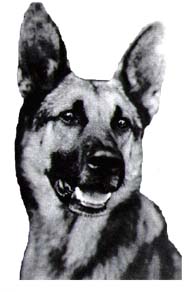
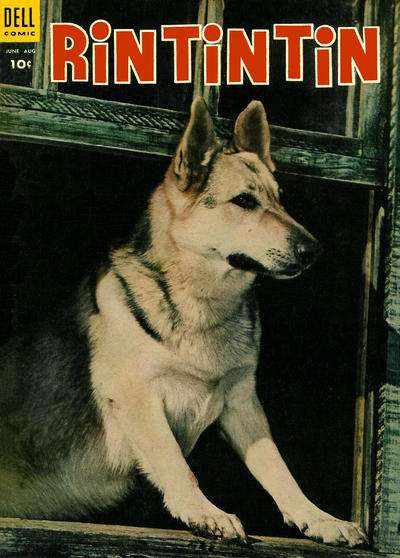
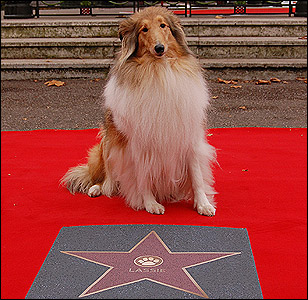
Three members of the Walk of Fame are canines:  Rin Tin Tin, Lassie and Strongheart (a canine star of silent films).

Strongheart was a German Shepherd that was born in 1917 and lived until 1929.  He starred in a number of films including White Fang and was sadly injured on a movie set when he was burned by a studio light.  The burn became tumorous and was responsible for his death.

Strongheart, an early canine star in Hollywood

Rin Tin Tin, another German Shepherd, is probably more well known.  The first Rin Tin Tin was born in 1918 and featured in 26 films for Warner Brothers studios.  There have been many successors to the first Rin Tin Tin and the dog has featured in comic books and other memorabilia.  You can learn lots more by visiting his official web site.

Most dog lovers will know about Lassie, a Collie dog who starred in Lassie Come Home in 1943.  The film was based on a novel that was published several years earlier.    Lassie was played by a dog named Pal.  Lassie went on to feature in a television programme, comic books, animated films, radio and other children’s books.  Like Rin Tin Tin, there have been a number of Lassies over the years.  Lassie also has an official web site.

Lassie on the Hollywood Walk of Fame

If you are visiting California, why not honour the dog stars of Hollywood by visiting them on the Walk of Fame?

Resolve to be a great dog owner this year

There are lots of jokes that circulate at this time of year about a dog’s resolutions for the new year (e.g., kitty-box crunchies are not junk food, etc.).  But what about your resolutions for your role as a Doggy Mom or Doggy Dad?

Here are my suggestions for new year resolutions:

1.  Resolve to feed your dog the highest quality dog food you can afford.  Not sure what to feed or even if you are feeding the right amount?  That’s where a nutritional assessment comes in.  People like me are trained in reading the labels of your existing dog food and with some information about your dog’s condition and lifestyle, we can tell you a lot about whether you are feeding the right amount and make un-biased suggestions about your core dog food.

In my case, I’m not affiliated with any veterinary practice or brand of dog food (many professionals take their nutrition training from a programme offered by dog food manufacturer – ask about this when selecting a provider for nutritional advice!)

2.  Exercise more – for your dog and yourself!  Exercise is important mental and physical stimulation for both you and your dog.  Discover new walks, link up with walking partners and doggy buddies for more variety, and manage your exercise according to the temperatures of the day (your dog doesn’t have the heat regulation system that you do in the summer; and their paw pads can be irritated by road salt and ice during the winter).

3.  Groom your dog – regularly.   If you don’t know what to do, then take your dog to a professional groomer and get advice on maintenance that you can do at home.  It breaks my heart to hear about veterinary nurses and groomers that have to work on severely matted dogs because their owner has neglected their grooming responsibilities.

4.  Make time for your dog.  I signed off last month’s newsletter to my Canine Catering customers saying “remember that the best thing you give your dog this holiday season is your time.”  It goes for the rest of the year, too.  Your dog is a social animal and needs your love and attention throughout the year.

5.  Keep a watchful eye on your dog’s health, ensuring they are not overweight (or underweight) and that they receive regular veterinary care.  (For a dog to be accepted into my dog massage and rehabilitation practice, the owner must certify for me that their dog is under regular veterinary care.)

6.  Have fun together – play time is essential.  Dog walks are not the only stimulation for your dog.  Choose an activity that suits both you your dog.  It could be agility or obedience training, rally-o, fetch, cross-country skiing, hiking/tramping, or the use of interactive dog toys.

I wish you and your dog a wonderful 2012.  Contact me through this blog or my website for information on any topic I cover in this blog.

Happy New Year for Arizona dog

As we start a new year, great news out of Montana.

According to the Salt Lake Tribune, Buddy has been missing near Butte since November 28th.  He has been reunited with Phil Nichols, his owner, this week.

Read more here.

Doggy quote of the month for January

“I’ve caught more ills from people sneezing over me and giving me virus infections than from kissing dogs.”

– Barbara Woodhouse


Cool Collars for summertime heat

In Christchurch, we are starting to get some hot summer days.  I walk Daisy twice each day and our early morning walks ensure that we escape the summer heat.  However, the pavement heats up during the afternoons and even when we walk in the evening, it can be hot for Daisy.

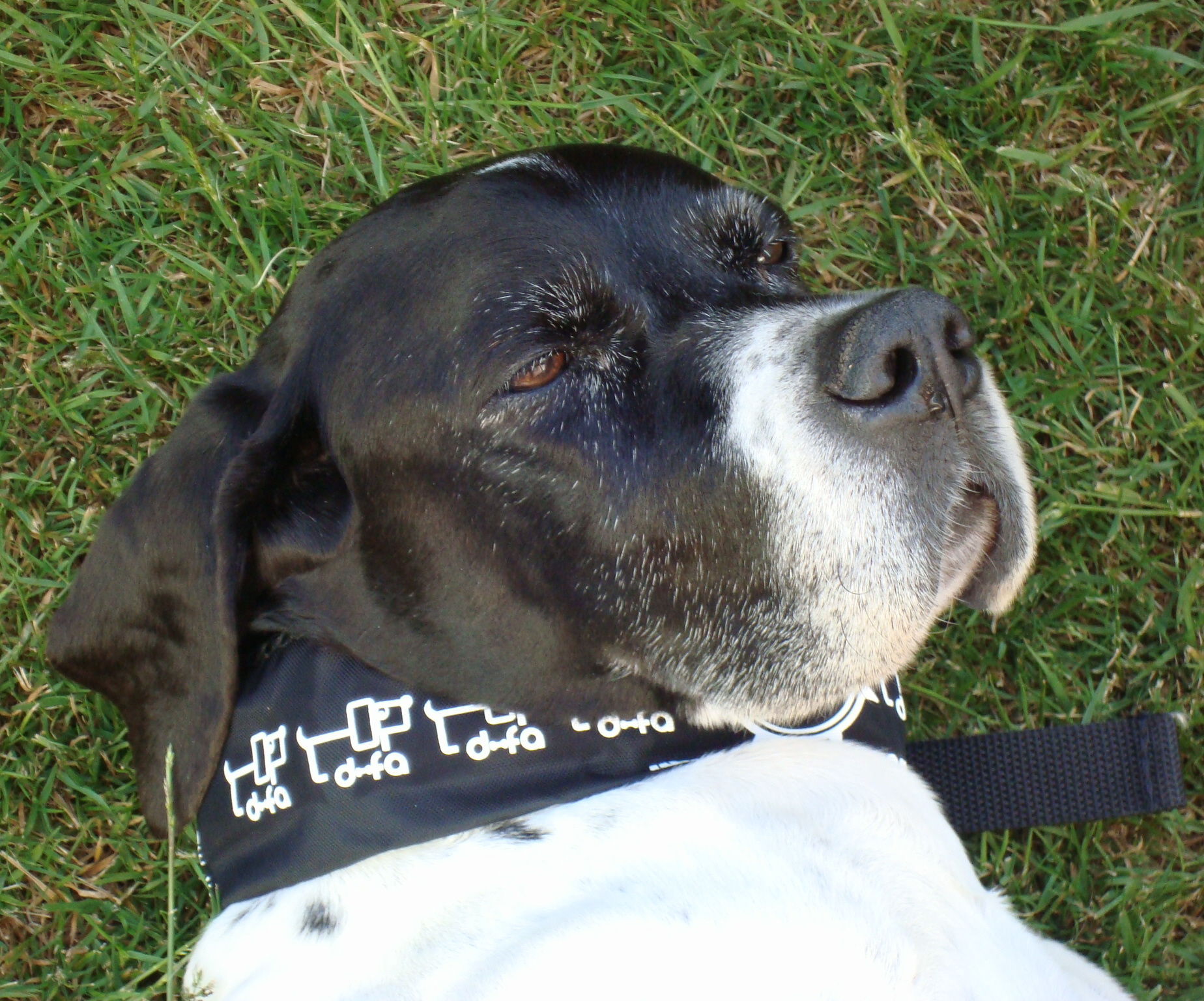
That’s where the Cool-Collar comes in.  Made by D-Fa based in beautiful Wanaka, New Zealand, this collar features a reusable chill strip insert.  As the insert (or ice, if you use it instead) melts, it cools your dog’s neck and chest.  This helps them to manage the summer heat better as panting is really the only other option for them to cool down.

Daisy in her Cool-Collar - ready for walkkies!

Daisy poses for her close up, wearing a D-Fa Cool-Collar

I don’t recommend products often, but this is one that I definitely support.

Canine PTSD: Dogs Suffer Like Soldiers

The notion of canine post-traumatic stress disorder (PTSD) is still somewhat new, although those of us living in the Christchurch region of Canterbury (New Zealand) have witnessed first-hand how dogs cope with extraordinary stress caused by our ongoing earthquakes.

I have one dog in my massage therapy practice who is undergoing treatment for post-earthquake stress.   She shows signs of self-mutilation (excessive licking) and her owner reports that she is a happy dog when taken on trips away from home but she shows worry and anxiety when she returns.  She’s getting better, though, through love, attention, and massage therapy to work on acupressure points that help with the stress response.   It’s all about desensitization and it takes time.

Earlier this month, the New York Times published this article:  After Duty, Dogs Suffer Like Soldiers.  In this article, you’ll read that there is a specialist military veterinary hospital called the Daniel E. Holland Military Working Dog Hospital at Lackland Air Force Base in Texas.  There’s even a chart being used to show the acupressure points of the dog!   The hospital was named after Lieutenant Colonel Daniel Holland, who died in 2006 when a roadside bomb exploded in Iraq.

Some military dogs are being retired from service and re-homed:  For War Dogs, Life with PTSD Requires Patient Owners talks about one adoptive family’s approach to caring for their dog, Buck.