9 out of 10 nurses believe animals can improve patient health

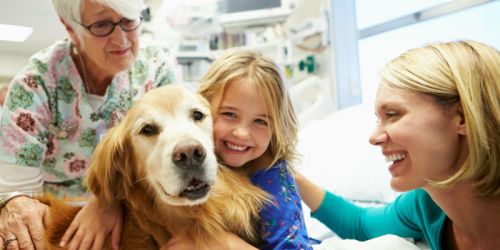
Nine out of ten (90%) nurses believe animals can improve the health of patients with depression and other mental health problems, according to a survey of members of the Royal College of Nursing (RCN).

animal-therapy

The survey of more than 750 nursing staff also found that more than 80% think animals can improve communication difficulties such as for people with autism. In addition, 82% said that animals, dogs in particular, encouraged patients to be more physically active, while nearly 60% said just the presence of animals seemed to speed physical recovery.

Nearly half of those surveyed have worked with animals in their career, from dogs and cats to ponies and chipmunks, and of those 98% said it benefited the patient.

However, almost a quarter of staff questioned said no animals were allowed where they worked.

Amanda Cheesley, RCN Professional Lead for Long-term Conditions and End-of-life care, said: “I’ve seen patients with animals in hospitals and in their homes – the difference it makes is remarkable. I used to take my Great Dane with me when I was a district nurse and he could put a smile on any patient’s face.”

“The RCN is calling for better, more consistent access to animals for all patients who can benefit, as the evidence is clear that as well as bringing joyful moments to people when they are unwell, the clinical benefits are tangible. Nurses have told us of patients with reduced anxiety, better interaction and a whole reason to live – and we should listen to these experiences.”

Source:  Royal College of Nursing

Building a dog wheelchair

During the fall semester, three College of Engineering students working as on-campus co-ops at New Mexico State University designed and built a wheelchair device to assist a dog who had his right hind leg amputated due to cancer.

“When I started to research mobility options to help Kita after his amputation to remove bone cancer, there were a lot of ideas online about using 3-D printers to create custom dog wheelchairs or walkers,” owner Michelle Lebsock said. “Even in his old age, Kita is the type of dog who absolutely loves walks, and although he healed well and adjusted to getting around on three legs, he would get tired very quickly and I could tell he really missed his long walks.”

After realizing regular pet wheelchairs wouldn’t work for Kita, Lebsock contacted the Aggie Innovation Space for advice on do-it-yourself dog wheelchair instructions she had found online.

“I first spoke to Natalia, and instead of just offering advice she took on the project as her own,” Lebsock said. “The talented engineering students at the AIS including Natalia, Abdiel and Arturo worked all semester to create a functional and ergonomic device that was custom-built for Kita. Even though the idea of 3-D printing brought me to the lab, the final product used traditional materials, and the students worked tirelessly to make sure each piece was exactly right. Their work has made one little three-legged dog and his owner very happy.”

Kita dog with wheelchair and students who designed it

New Mexico State University College of Engineering students and Aggie Innovation Space mentors (from left to right) Natalia Perez, Abdiel Jimenez and Arturo Dominguez designed and developed a wheelchair for Kita and his owner Michelle Lebsock. Kita’s right hind leg was amputated due to cancer in spring 2016.

“The AIS team became very passionate about this project sharing ideas, collaborating to assess specific constraints and requirements, and evaluating ideas for build-out materials. Collectively, we were able to design a device that was cost effective, functional, comfortable, strong enough to support the weight of the dog, and ultimately, easy to use,” Jimenez said. “We selected specific materials and specific design features to meet the unique needs of Kita. Michelle was kind enough to give us feedback, which allowed us to further refine the design.”

Throughout the fall, Perez, Jimenez and Dominguez met with Kita and Lebsock many times to determine the correct height, comfort, and restraint requirements of the device. Ease of assembly and disassembly were also important factors the Aggie Innovators had to consider to ensure the device was portable and easy to use.

“We were excited to have met a functional level of comfort for Kita with our first design, as he realized he could move around freely,” Dominguez said. “From there, we studied and evaluated Kita’s movement in the device, which allowed us to adjust the design to make it more comfortable and functional. With each iteration, Kita became more and more comfortable. During our final test, Kita was able to run for the first time since surgery and was able to move much more naturally. We then spent a week enhancing a few aesthetic features and branded it NMSU, including a specialized 3-D printed name plate.”
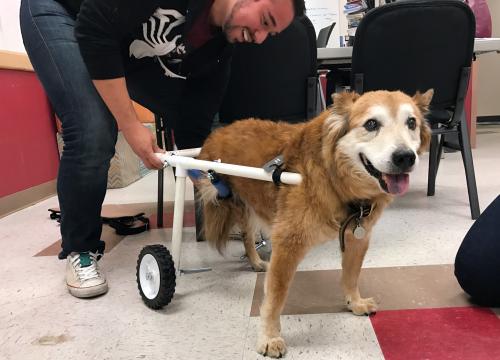
Kita dog in special wheelchair

Arturo Dominguez, a New Mexico State University College of Engineering student, fits nearly 17-year-old Kita with a wheelchair that was designed and built in the Aggie Innovation Space.

Dominguez said the group faced many design challenges throughout the duration of this project.

“Some of our initial design considerations required us to adjust the height of the device while ensuring that we provided adequate support of the shoulders and hips so as to minimize weight on pressure points,” Dominguez said. “As we adjusted the saddle mechanism in the device, we had to be sure not to pinch or irritate the underbelly and other sensitive areas of the dog.”

Perez said the challenges and hours spent working on this project was worth it when she and her fellow Aggie Innovators saw Kita run freely in the device and saw the happiness expressed in Lebsock’s reaction.

“This project reminded us how engineers can enhance quality of life, and made us realize that our duty as engineers is not just for people and the environment but for our furry friends that make our lives happier,” Perez said.

Source:  New Mexico State University media release

Favorite Video Friday – Doodad the Greyhound

Happy weekend, everyone. I hope you enjoy this greyhound video as much as we (Izzy and I) did.

Mel's avatarNo Dog About It Blog

I don’t know if I have ever shared this before, but in addition to being a lover of Shelties and Labs, I am a big lover of Greyhounds.

The first greyhound I ever met was Tater. He was owned by a couple I used to walk with at the dog park. He was elegant and graceful and so very funny. He played that deadpan look so well. (Is that a greyhound thing?)

Tater might have been an older greyhound, but he could still run like the wind. He and his sister, Nadya, who is a Borzoi, made running look like art. I loved watching them. Such beauty and grace.

There is just something about this breed that makes me smile.

I think that is why I fell in love with today’s Favorite Friday video featuring Doodad the Greyhound. If ever there was a dog who inspired smiles it is Doodad…

View original post 39 more words

The sign I love to see

They did it.  Local shop LifestyleLS has officially become dog-friendly.

I saw this sign on our morning walk.

dogs-welcome

The shop sells outdoor furniture, barbeque and cooking accessories and gas and wood burners.  It encourages people with their dogs to shop indoors and to enjoy the display furniture outside.

What’s even better is that there is a cafe, The Rose Cafe, just a few doors down.  One of you needs to hold the dog while the other goes inside to buy coffee and people treats.  You can then sit outside at LifestyleLS.

This is great advertising for LifestyleLS.  What better way to sell outdoor furniture than to show real people and pets using it?

P.S.  This is the sign I don’t like to see.

Kathleen Crisley, specialist in dog massage, rehabilitation and nutrition/food therapy, The Balanced Dog Ltd, Christchurch, New Zealand

Spreading the word about dog massage

Dog massage??? What???!!!!

I get this fairly often; it doesn’t bother me.

One of the best ways I have found to give dog owners (and their d0gs) a bit of a taste for what I can do for them is to attend public events.  This weekend, I participated in the first annual Bark in the Park at Ferrymead Heritage Park.  The historic park was opened to dogs and their families to enjoy for the day.

Dogs rodethe trams, had posters printed for them on the authentic printing press, attended a blessing of the animals ceremony and were treated to frozen slushies made with chicken stock.  There was a series of guest speakers, including me.

I was consistently busy throughout the day at my stall as dog after dog came to see me for massage.  Dogs of all sizes, too!

Here are a few snaps from the day:

Every dog enjoyed their massage and owners were surprised at how quickly their dog relaxed and got into ‘the zone’ (as I call it).

Lesson for the day:  don’t knock it until you’ve tried it.  If you are a local Canterbury resident who missed out on Bark in the Park, the event is likely to become an annual one.  And you can always reach me here at The Balanced Dog to discuss your dog and how massage, laser, trigger point and food therapies can help your dog.

Kathleen Crisley, specialist in dog massage, rehabilitation and nutrition/food therapy, The Balanced Dog, Christchurch, New Zealand

Dog-directed speech is more effective with puppies

 A small team of researchers from the U.S., the U.K. and France has found that puppies are more receptive to dog-directed speech than are adult dogs.
In their paper published in the journal Proceedings of the Royal Society B, the researchers describe experiments they conducted recording human voices and playing them back to dogs, what they found, and what it might mean for human communications.
dog

Credit: CC0 Public Domain

Most everyone has heard dog-directed speech, which is similar to speech patterns some use when talking to infants—the voice gets higher, the words come out slower and there is a sort of sing-song phrasing.  (i.e. baby talk) Some of the phrases are familiar as well, such as “Who’s a good boy?” In this new effort, the researchers looked into the use of dog-directed speech seeking to learn if there might be any modulating factors in its use.

The experiments consisted of asking 30 female human volunteers to look at pictures of dogs while reading a script consisting of typical dog-directed speech phrases into a microphone to make recordings. The recordings were then played to 10 puppies and 10 adult dogs at an animal shelter as the researchers watched and recorded their reactions.

The researchers report that the volunteers tended to raise their voices in ways similar to people speaking to human infants regardless of the age of the dog they were looking at, though it was noted that the voices were raised slightly higher for puppies than for adult dogs. They also report that at the animal shelter, the puppies responded very clearly to the voices coming from the speakers, acting as if they wanted to play. The adult dogs, on the other hand, after a quick investigation, ignored the recordings altogether.

The researchers were not able to explain why the humans spoke in dog-directed speech or why the puppies responded to it while the adult dogs did not, but suggest that humans likely respond to puppies in much the same way they respond to babies—and babies have been shown to respond more to baby-directed speech. As for why the older dogs were not interested, it might have been the case that they were simply older and wiser—they could see very clearly there was no human present speaking to them, so they chose to ignore whatever was being said.

(DoggyMom’s comment:  Smart dogs!)

Source:  Phys.org

Full journal reference:

  1. Tobey Ben-Aderet, Mario Gallego-Abenza, David Reby, Nicolas Mathevon. Dog-directed speech: why do we use it and do dogs pay attention to it? Proceedings of the Royal Society B: Biological Sciences, 2017; 284 (1846): 20162429 DOI: 10.1098/rspb.2016.2429

Francis of Cooking with Dog

I’m still learning about all the content I can watch on YouTube.  I have only recently found the Cooking with Dog series – which features an unnamed Japanese female chef  (only referred to as Chef) and Francis,  a Poodle.  The series started filming in 2009 with a new video listed every Friday.

Francis narrates each video in English (with a Japanese accent), while Chef speaks in Japanese.

Sadly, Francis the Poodle passed away in November 2016 at the advanced age of 14 years, 9 months.  In one of the last of the videos, we are told that Francis was feeling unwell and so his stand-ins are some soft toy Poodles.  And then there is a message on the final videos telling us they were filmed before his passing.

What a novel idea – a Poodle narrating a Japanese cooking program!  I only wish I had found Francis and Chef sooner.

Rest easy, Francis.  And thanks for your cooking legacy!

Kathleen Crisley, specialist in dog massage, rehabilitation and nutrition/food therapy, The Balanced Dog, Christchurch, New Zealand

Colloidal silver

colloidal-silver

I recommend keeping a bottle of colloidal silver at home for all minor skin scratches and wounds.  As it turns out, so does my vet!

Izzy is a greyhound and they are known for their thin skin which is easily damaged.  She had a run of wounds in November and December, thanks in part to doing zoomies in our yard and running into branches.

I cleaned these wounds twice a day using colloidal silver solution. I took her to the vet about 3 days in to ensure that she was happy with the healing.  She was and told me that vets (like human doctors) are starting to be more cautious when prescribing antibiotics because of the proven problems associated with over-use (in particular, the development of antibiotic-resistant superbugs).

Colloidal silver is a natural antibacterial and also has antiviral and anti-inflammatory properties.  This makes it a great addition to your pet first aid kit.  And, your dog thinks that you are simply using water on their sore spots!

Kathleen Crisley, specialist in dog massage, rehabilitation and nutrition/food therapy, The Balanced Dog, Christchurch, New Zealand


Pets offer valuable support for owners with mental health problems

The body of research studying the value of pets in supporting mental health continues to grow.  A research team based at the University of Manchester published its results before Christmas, a study that involved 54 participants.

Said Helen Brooks, the lead researcher,

The people we spoke to through the course of this study felt their pet played a range of positive roles such as helping them to manage stigma associated with their mental health by providing acceptance without judgement

This YouTube video explains the research:

Prescription diets – what’s the truth?

Prescription diet foods, both canned and dry, are often recommended to match a specific health condition in an animal.  Most owners know how expensive these foods can be, and yet they want to feed something that will help their pet’s health.

There is lots of information written by holistic veterinarians about the quality of ingredients in these foods and whether they are truly biologically appropriate for animals.  In my massage workshops for owners, we go through a module on label reading as an introduction to understanding what is in commercially-made pet foods and what makes one food ‘better’ than another…

Recently, a class action lawsuit was filed in the U.S. District Court of Northern California listing these companies as defendants:

  • Mars PetCare
  • Hill’s Pet Nutrition
  • Nestlé Purina Petcare
  • Banfield Pet Hospital
  • Blue Pearl Pet Hospital
  • PetSmart
The plaintiffs are pet owners who had purchased prescription diets from one or more of the above companies and they argue that the companies conspired with each other to falsely promote prescription pet foods and, more importantly, that none of the ingredients in the foods are drugs or medications that would be subject to a prescription under the food and drug regulations.  The plaintiffs argue that this is false marketing; some of the plaintiffs appear to say that veterinarians in some of the pet hospitals ‘prescribed’ the foods without even examining their animal.

The main brands involved in the case are:
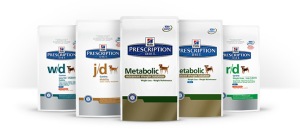
  • Hill’s Prescription Diet hills-prescription-diets
  • Purina Pro Plan Veterinary Diets
  • Royal Canin Veterinary Diet
  • Iams Veterinary Formula
pro-plan-veterinary-dietsAs pet parents are a large group of consumers, it’s important that we understand nutrition and ask questions of professionals that recommend diets.  This is everyone who tries to sell you pet food – not just vets, may I add.  In our local market in New Zealand, there are dog trainers and pet shops that sell food and have a vested interest in recommending certain products to owners.

royal-canin-veterinary-dietiams-veterinary-formula

For me, the question to ask is how any food or supplement may help to nutritionally support your pet’s health condition.  It’s also worth asking what feeding or clinical trials were done on foods professing to be specifically for treatment of a health condition.

The grounds for the lawsuit make very interesting reading You can read a copy of the lawsuit filed in the court here.

And if you are based in the USA, have purchased prescription diet foods within the last four years,  and may wish to consider joining the class action, this is the website of the law firm representing the plaintiffs.

There will be more to come on this case; the plaintiffs are seeking a trial by jury.  I can’t even say at this point that the jury is out…
Kathleen Crisley, specialist in dog massage, rehabilitation and nutrition/food therapy, The Balanced Dog, Christchurch, New Zealand