Tag Archives: therapy dog

With a nuzzle, paw and kiss, dogs offer a potent antidote to human loneliness

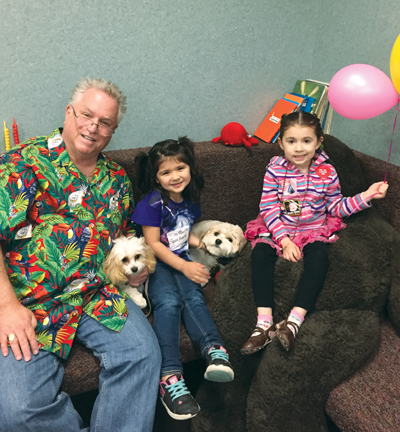
Loneliness has become an increased concern nationally since the pandemic. However, studies have shown companionship with dogs can greatly reduce the effects. (VCU Center of Human-Animal Interaction)

By Mia Stephens

Framed by the isolation of the pandemic, loneliness has become a huge concern across the world in recent years. Loneliness is considered as harmful as smoking 15 cigarettes a day and may be a greater public health threat than obesity

Long known as man’s best friend, dogs are being embraced even more now as a means of combatting loneliness. In one study, frequent interactions with dogs, either through ownerships or through long-term interventions, have been associated with positive psychological outcomes across the human lifespan.  

“They are skilled at socializing with humans, sensitive to our emotional states and gestures – they can communicate using complex cues and form complex attachment relationships with humans,” said Nancy Gee, Ph.D., C-AISS, professor of psychiatry and the director of Virginia Commonwealth University’s Center for Human-Animal Interaction and Bill Balaban Chair in Human-Animal Interaction. “Their attachment to their human owners mirrors that of human babies to their mothers.”  

Gee, whose been studying the relationship between therapy dogs and humans for more than two decades, spoke with VCU Health News about how interactions with dogs can relieve loneliness and increase connection with others.   

How can dogs combat human loneliness?  

Dogs are thought to fulfill the four roles of an attachment figure: They are enjoyable, comforting, missed when absent and sought in times of distress. Adults and children alike confide in their pets because they relieve us from the worry of confidentiality, judgments, or meeting expectations.  

Dogs are known as wonderful “social icebreakers” and referred to as the “great leveler” – people will risk directly engaging with unfamiliar people when there is a dog present. Additionally, research shows that pet owners have made friends through their companion animals, which have helped them engage more in the community.  

When humans interact with a dog in a calm way – where they are stroking the dog and making eye contact, or even talking to the dog – we see that both species release oxytocin (bonding/feel-good hormone), and their cortisol (stress hormone) levels drop. Additionally, their blood pressure and muscle tension lower, and their mood elevates.  

When you combine these responses together, it indicates the interactions are relaxing and enjoyable, which helps to reduce a person’s overall experience of loneliness. 

Is there a difference from other animals?  

Probably, yes, but there is not enough research on the subject to know for certain. We do know that dogs are unique in the animal kingdom. Through domestication and selection, dogs emerged from the grey wolf over a period of at least 35,000 years, and there is probably no other species on the planet as well-matched to human social needs as dogs.  

What are common types of service dogs, and do they differ in addressing human loneliness?  

There are three prominent classifications: 

  • A Service Dog (also called an Assistance Dog) has one handler who has a medically recognized disability. The dog is specially trained to assist that one person (their handler) with some aspect of that disability. For example, some dogs are trained to alert a person with a seizure disorder that a seizure is about to occur. This will allow the person to take medicine, call for assistance and/or get into a safe place/position so that they are not harmed during the actual seizure.  Service Dogs are covered under the American’s with Disabilities Act and are granted access to public facilities and housing that otherwise excludes pets. 
  • An Emotional Support Animal can be any animal species and requires no specific training. An ESA supports one person with a mental disability by comforting that person in a way that reduces symptoms. ESA status is determined by a mental health professional who writes a letter attesting to the animal’s role and housing status if pets are otherwise not allowed. However, ESAs are not permitted any other public access. 
  • A Therapy Dog is handled by one person, but the dog’s job is to interact with many people who may benefit from the interaction. Therapy dogs, like those in our center’s Dogs on Call program, are granted access to facilities and transportation based on the permission of the administration of the facility or transportation provider, and the requirements of the program in which the dogs participate. 

Currently, there is very little research that compares the three classifications of animals and the effects of SDs or ESAs in reducing loneliness. However, Dogs on Call specifically, and other therapy dogs in general, have been found to significantly reduce loneliness in the people they visit. 

Does human age matter in regard to loneliness and the benefits of interacting with dogs?  

We have results back from our own randomized clinical trials showing that for older adults and for adults with mental illness, interacting with Dogs on Call dogs and handlers is effective at reducing loneliness.  

We’ve just completed data collection on our pediatric study, so we don’t know the answer just yet, but we have reason to believe that across the human lifespan, interacting with a therapy dog can reduce loneliness. Additionally, one study showed that adolescents derive more satisfaction from, and engage in less conflict with, their pets than with their human siblings.

Source: VCU Health (Virginia Commonwealth University)
An emotional support animal for the NBA

Dallas Mavericks assistant athletic trainer Heather Mau has noticed a trend of players grabbing extra breakfast. It’s not that their appetite has grown, but they need the extra food to lure in their favorite coworker.  

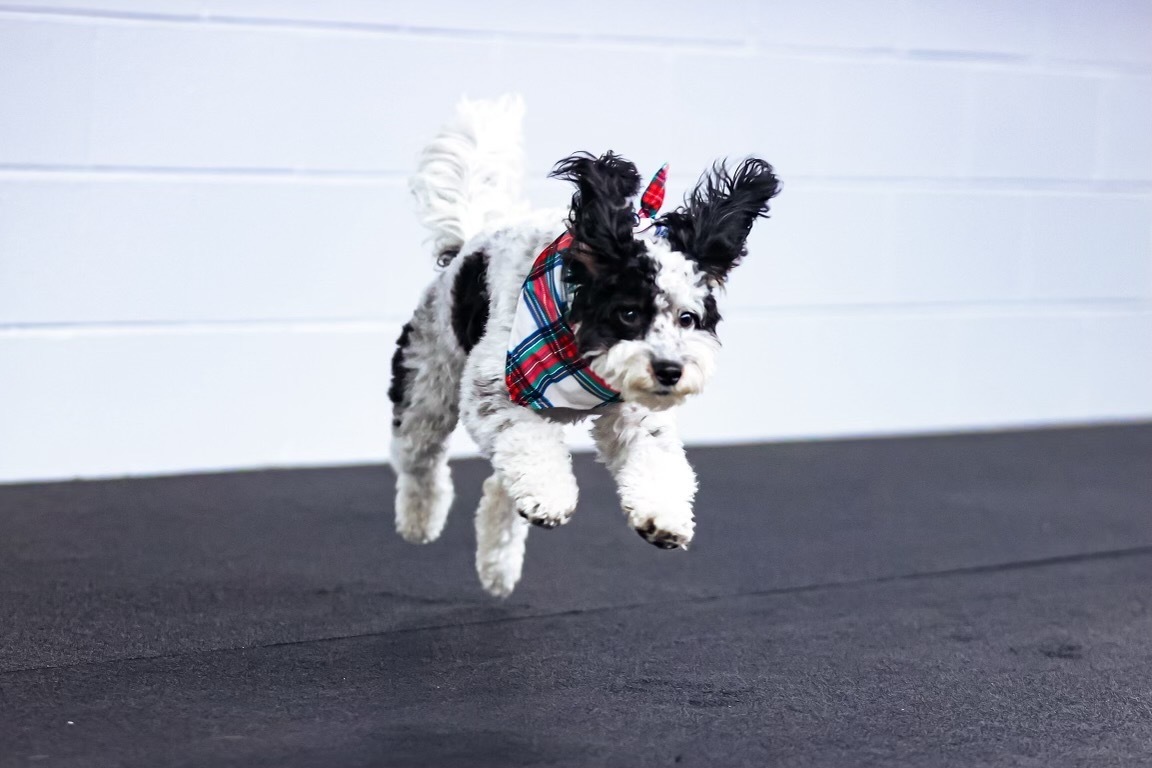
Mavericks team emotional support dog Bailey. Photo courtesy of Dallas Mavericks

Bailey, a two-year old mini Bernedoodle, is the team’s emotional support animal — the only one known to exist among NBA teams. She was “hired” in April of 2022 for a job that requires her to be her adorable self and get spoiled by professional basketball players. 

While Mau is proud to say the Mavericks are the first NBA team to do this, she hopes to inspire other organizations to get emotional support animals. She said that even with the team’s busy schedule, having Bailey has added a lot of benefits.

“We are trying to be progressive when it comes to that as an organization,” Mau said. “Being the first to have an emotional support animal, and really putting our mental health — players, staff and coaches’ mental health — in the forefront and the focus on what we do.”

Naturally, of course, the team loves to spoil her. 

Dwight Powell, Tim Hardaway, Josh Green and Maxi Kleber are usually the ones that fall victim in that category,” Mau told CBS Sports. “But there are a few staff members who spoil her even more than the players.”

Head coach Jason Kidd and other Mavericks higher-ups approved the decision to get Bailey, and Mau couldn’t volunteer fast enough to take care of her full-time. 

“I like to say I quite frankly tricked everybody here to get me a dog,” Mau joked. “She is awesome. She brings a lot of light not only into my life but a lot of light into the building.”

Mau is Bailey’s mom and the players are her “uncles.” The cuddly staffer has a busy schedule because she attends all practices, home games, shoot arounds and treatments with Mau. Fortunately, she gets plenty of treats to help her maintain her energy.

“This dog is too smart sometimes,” Mau said. “She doesn’t like to eat all her breakfast at home before we leave for work because she knows she is going to go to work and have more breakfast.”

Players do not apologize for such behavior.

“Do I feed Bailey too much? I don’t think so,” Green told The Dallas Morning News. “She does a lot for the team. She’s one of our teammates. She’s always there for me, so I bring extra breakfast every morning.”

Sure, Bailey sometimes gets the zoomies and runs around the entire facility going “absolutely bananas.” And, yes, she occasionally forgets she is not supposed to play with her mom’s equipment, but she brings a lot of joy to everyone in the organization. 

“That’s what Bailey brings, something different but also happiness,” Kidd told WFAA.

She stays at home for road games but still shares her support for her uncles on her Instagram account, which her mom finally let her get in December. 

Bailey gets lots of cuddles from the team, an endless amount of kisses, and Powell has gone as far as wearing matching outfits with her. In December, she had a birthday party and her favorite uncles did not miss out. 

The San Francisco 49ers appear to be the only other professional sports organization doing something similar. They have Zoe, an adorable French bulldog who has captured the hearts of the entire roster. She had a brother, Rookie, but he passed away last year. Zoe belongs to the team’s director of player engagement, but others in the organization also help take care of her.

Her instagram is filled with photos with her teammates proudly posing with her. 

Bailey and Zoe don’t just make workdays more fun, mental health professionals agree that animals have real mood-boosting benefits.

Ed Chavez, mental performance clinician for the 49ers, thinks every team should consider adding a pet to their roster. 

“I’m a huge advocate for having therapy dogs. Studies have shown that they reduce stress, anxiety and depression,” Chavez said. “Having them around is so beneficial to our mental health. When interacting with dogs, it lowers stress hormones and it releases calming and feeling good biochemicals in the brain. They generally make us feel better.”

Source: CBS Sports

San Diego therapy dog detects water contamination

It’s just a small news item in the Los Angeles and San Diego newspapers…but it’s another story of how special dogs are – and how they use their detection skills to help humans.

On 26 January 2017, a therapy dog at San Diego Cooperative Charter School in Mountain View wouldn’t drink the water a teacher had poured for it from the classroom sink.

The teacher noticed a sheen on the water, which was tested and initially revealed the substance vinyl chloride.  Subsequent testing has revealed levels of lead some of which exceed health standards.

A district-wide water testing program is underway in all City of San Diego schools.

All because of one keen-nosed therapy dog with discerning tastes!

Source:  LA Times; Voice of San Diego

Norbert: the little therapy dog with a series of books

Norbert

Norbert shows his High Five (photo courtesy of Norberthood.com)

Norbert is a special therapy dog.  He’s a very tiny (3-pound) cross-breed who was the only puppy born to his dog mother in California.  His owners believe he is a Chihuahua, Cairn Terrier  and Lhasa Apso cross.  Adopted in 2009 from PetFinder.com, Norbert was his human mother’s first-ever dog and he traveled to Boston to live with her.

At the age of one, he passed his therapy dog tests and began working with children and the elderly. Along the way he learned new tricks like High Five, Namaste (stay) and Zen (lie down).

Then his mom decided to write a book, and then another, and (soon) another….

Book 1: Norbert - What can little me do?

Book 1: Norbert – What can little me do?

Book 2: Norbert - What can little you do?

Book 2: Norbert – What can little you do?

Book 3 (due out in November 2015): Norbert & Lil Bub - What can little we do?

Book 3 (due out in November 2015): Norbert & Lil Bub – What can little we do?

Therapy dogs are special dogs providing important emotional support services to those in need.  I like the fact that there are children’s books featuring Norbert – if we tell children about dogs and their personalities, and teach them lessons along the way, we set them up to be compassionate adults who are prepared to be responsible pet owners.

Kathleen Crisley, specialist in dog massage, rehabilitation and nutrition/food therapy, Canine Catering Ltd, Christchurch, New Zealand

The dental therapy dog

Just when you think I’ve run out of ways to report on new ways dogs are working as assistance/therapy dogs…I introduce you to Flossie.

Appropriately named, Flossie is a dental therapy dog.

Lexa and Flossie: (From left) Dr. Alan Golden, Elysia Yriarte and Natalia Caraballo smile for the camera while petting Flossie, a dental therapy dog, and her half-sister Lexa, a dental therapy dog-in-training.  (photo courtesy of American Dental Association)

Lexa and Flossie: (From left) Dr. Alan Golden, Elysia Yriarte and Natalia Caraballo smile for the camera while petting Flossie, a dental therapy dog, and her half-sister Lexa, a dental therapy dog-in-training. (photo courtesy of American Dental Association)

At the 10,000-square-foot Virginia facility, Golden Pediatric Dentistry & Orthodontics, Flossie is free to run around with one job: to make people comfortable wherever they are. Flossie has been coming to the office since she was 8 weeks old in 2012.

“I would say, ‘Back to work,’ and she goes out and finds a lap to sit on, or sometimes she cuddles with the kids,” Dr. Golden said. “She’s good at it.”

With the success of Flossie, Dr. Golden said he’s been considering creating a resource for dentists who are interested in using therapy dogs in their practice.

Flossie, a Cavachon (Bichon Frise/Cavalier King Charles Spaniel cross), received her therapy dog certification from the Alliance of Therapy Dogs.  New patients are informed that Flossie works at the practice so they are ready for her presence in the office when they arrive.

For patients that are particularly frightened of dogs, or who have severe allergies, Flossie is sent to her official resting area, which is fenced off and has a dog bed.

Dr Golden’s partner in practice is so impressed by what Flossie brings to the practice that he has his own dental therapy dog in training, Lexa.

Source:  American Dental Association

A therapy dog to help mourners

Say ‘therapy dog’ and most people will think of hospitals, rest homes, and mental health services.  Some may also think about dogs supporting witnesses when they have their day in court….but now there’s a growing use of therapy dogs in funeral homes.

This video, from the Ballard-Durand funeral home in New York, promotes Lulu, a Goldendoodle, who can be booked on request for funeral services.

The loss of a loved one and funerals, in general, are times of great emotional stress.  How nice it is that dogs are offering comfort in these situations and that they are being accepted by professional funeral directors.

Kathleen Crisley, specialist in dog massage, rehabilitation and nutrition/food therapy, Canine Catering Ltd, Christchurch, New Zealand

Infection control guidelines for animal visitation

The use of dogs in hospitals and other therapy institutions is on the rise, as more medical professionals acknowledge the positive effects of dogs on human patients.

New expert guidance by the Society for Healthcare Epidemiology of America (SHEA) outlines recommendations for developing policies regarding the use of animals in healthcare facilities, including animal-assisted activities, service animals, research animals and personal pet visitation in acute care hospitals.

The guidance was published online in Infection Control & Hospital Epidemiology, the journal of SHEA.

“Animals have had an increasing presence in healthcare facilities,” said David Weber, MD, MPH, a lead author of the recommendations. “While there may be benefits to patient care, the role of animals in the spread of bacteria is not well understood. We have developed standard infection prevention and control guidance to help protect patients and healthcare providers via animal-to-human transmission in healthcare settings.”

Guidance is grouped by the role of animals – animal-assisted activities (i.e., pet therapy and volunteer programs), service animals, research animals and personal pet visitation. Select recommendations include:

Animal-Assisted Activities

  • Facilities should develop a written policy for animal-assisted activities. An animal-assisted activity visit liaison should be designated.
  • Allow only dogs to serve in animal-assisted activities, such as pet therapy.
  • Animals and handlers should be formally trained and evaluated.
  • Animal interaction areas should be determined in collaboration with the Infection Prevention and Control team and clinical staff should be educated about the program.
  • Animal handlers must have all required immunizations, restrict contact of their animal to patient(s) visited and prevent the animal from having contact with invasive devices, and require that everyone who touches the animal to practice hand hygiene before and after contact.
  • The hospital should maintain a log of all animal-assisted activities visits including rooms and persons visited for potential contact tracing.

Service Animals

  • The policy allowing service animals of patients and visitors into the facility should be compliant with the Federal Americans for Disability Act (ADA), other applicable state and local regulations and include a statement that only dogs and miniature horses are recognized as Service Animals under federal law.
  • If an inpatient has a service animal, notification should be made to the Infection Prevention and Control Team, followed by discussion with the patient to make sure the owner of the service animal complies with institutional policies.
  • Healthcare providers or staff may ask the patient or visitor to describe what work/tasks the dog performs for the patient, but may not ask for a “certification” or “papers.”

Personal Pet Visitation

  • Pets should, in general, be prohibited from entering the healthcare facility.
  • Exceptions can be considered if the healthcare team determines that visitation with a pet would be of benefit to the patient and can be performed with limited risk. Even then, visitation should be restricted to dogs.
  • The patient must perform hand hygiene immediately before and after contact with the animal.

The authors of the guidance also note that as the role of animals in healthcare evolves, there is a need for stronger research to establish evidence-based guidelines to manage the risk to patients and healthcare providers.

This guidance on animals in healthcare facilities has been endorsed by the Association for Professionals in Infection Control and Epidemiology (APIC), the leading professional association for infection preventionists with more than 15,000 members.

Source:  EurekAlert! media release

Previous blogs about therapy dogs include:

A day in the life of a therapy dog

I love it when we hear about dogs who are able to use their instincts, talents and charm for good.  There is a growing body of knowledge about how the company of dogs can assist with human therapies.

In this video, the pet therapy program at HCA Virginia’s Chippenham and Johnston-Willis hospitals is featured.  Meet Fraser, a Black Labrador/Golden Retriever mix.  Fraser’s canine colleague, Schaffer, doesn’t feature in this video.  But, as full-time employees of HCA Virginia, the dogs receive benefits which include supplies and paid veterinary care.

Kathleen Crisley, specialist in dog massage, rehabilitation and nutrition/food therapy, Canine Catering Ltd, Christchurch, New Zealand

Can your dog R.E.A.D?

In today’s world, literacy is an essential life skill.   Did you know that dogs are being specially trained to help children learn how to read?

A Canadian R.E.A.D. dog in action (photo courtesy of TherapyAnimals.org)

The Reading Education Assistance Dogs (R.E.A.D.) programme operates in the United States, United Kingdom and Canada and aims to improve reading and communication skills by allowing children to read to a dog.  Dogs are non judgmental companions who allow the children to read aloud and gain self esteem, while practising their reading skills.

R.E.A.D. dogs are registered therapy animals who volunteer with their owner/handlers and they visit  schools and libraries and other venues.    In tracking the effectiveness of the programme, schools are asked to report back on reading test scores of the children involved.  Libraries schedule the R.E.A.D. visits as special events, and watch the children flock in to participate.  Attendance numbers are also tracked.

Patrick Barkham of The Guardian Weekly recently published an article about Danny, a greyhound R.E.A.D. dog in the UK.  Read The dogs who listen to children reading.

R.E.A.D. chapters have various requirements for dogs and their handlers.  All dogs must achieve therapy dog qualifications which test their obedience, temperament, and sociability.  Most dog handlers are required to attend training courses and this is augmented by on-the-job mentoring and coaching.

Kathleen Crisley, specialist in dog massage, rehabilitation and nutrition/food therapy, The Balanced Dog, Christchurch, New Zealand

Faith the dog

I’m very interested in special needs dogs.  These dogs often have physical limitations that can be assisted with massage, acupressure and laser treatments (which I can provide).

In my research on special needs dogs, I have come across the story of Faith – a biped dog who was born with her front legs so deformed that she was unable to walk on them.  (of added interest, my sister’s name is Faith)

Faith the dog

Faith the Dog’s website isn’t the most professional I’ve seen, but it certainly tells a heartwarming story of a dog that was going to be killed by its mother and was saved by a young man.  Despite recommendations that Faith be put down, her adoptive family persisted and trained her to walk on her hind legs using treats like peanut butter.  Faith is now a loyal family pet who also serves as a therapy dog.

Faith’s story has been told on the Oprah Winfrey Show.  Watch the Oprah segment here.

So now you know why Faith’s story carries the byline Hope and Love on Two Legs!

Kathleen Crisley, specialist in dog massage, rehabilitation and nutrition/food therapy, The Balanced Dog, Christchurch, New Zealand