Category Archives: dog ownership

Deaf pet awareness week

The week of 23 – 29 September is Deaf Pet Awareness Week.

In many cases, when a dog is found to be deaf, it is put to sleep.   However, more frequently there are pet owners willing to take on these special needs animals.  These dogs can be trained using sign language and are just as intelligent as ‘normal’ dogs.

Deafness in animals can be inherited or acquired through trauma, drug reactions, or simply old age.   Dalmatians and Boxers are more prone to deafness than others. Thirty percent of all Dalmatians born are either deaf in one ear or  bilaterally deaf.   Some deaf dogs also have albinism, meaning that they lack normal melanin pigment in their eyes, nose, or skin.  Owners of these dogs have to pay special attention to sun protection.

The Deaf Dog Education Action Fund has a wonderful website with answers to questions involving the ownership and care of deaf dogs.

Use this special week to contact animal shelters in your area to find out if there is a special deaf dog waiting for you!

A university where your dog can come too

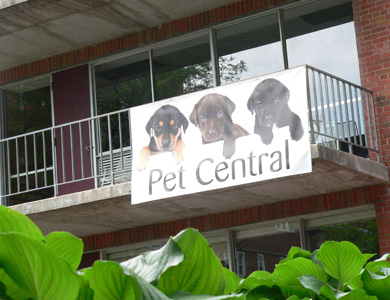
It’s autumn in the northern hemisphere and the time of year when students are going to colleges and universities for the first time.   If they are enrolled at Stephens College in Columbia, Missouri – there’s a high chance that their dog can come too!

Searcy Hall at the college is better known as Pet Central and houses 40 students and their pets.  Pets have been accepted at the college since 2004.  The college also has a pet fostering program.  They’ve partnered with a local no-kill shelter and students can foster a dog during their time at college and train and socialise them in preparation for adoption.

A scholarship, room discount, paid food and medications, and pet deposit waiver are just a few of the benefits available to freshmen and transfer students who apply to participate in the pet fostering program.

Sadly,  the college’s insurance policy excludes these breeds from staying at Pet Central:  Pit Bull, Rottweiler, Chow, Akita and German Shepherd.  I’m not a supporter of breed-specific legislation and so it’s hard to accept these types of restrictions but that’s the influence of the underwriters, unfortunately.

Oogy – the dog only a family could love

I’ve just finished reading Oogy:  the dog only a family could love by Larry Levin.  This New York Times bestseller tells the story of Oogy, a puppy that had been used for bait in dog fighting, and the Levin family who adopted him.

In many ways, this is a story about fate.  Fate in how a badly injured Oogy was brought to an animal hospital offering after-hours treatment.  Fate because a woman who worked at the hospital (later called ‘Saint Diane’)  recognised Oogy’s special character and intervened to ensure Oogy got life-saving treatment and care.     Fate because the Levin family met him when they had brought their sick cat to be put to sleep and decided to adopt him.

Oogy lost his left ear and and a good portion of his jaw and face to dog fighting.  It appears that he was used as bait because he wasn’t a good fighter and then left in an abandoned house to die without care or attention.

The Levins named him Oogy because it was a derivation of ‘Ugly.’  Mr Levin is the first to admit that when he first met Oogy, his appearance was grotesque.  (The dog had a lot of scar tissue which was operated on later.)  In fact, Oogy was so disfigured that, because of the connection to dog fighting, everyone assumed Oogy was a pit bull.

As he matured, it was agreed that Oogy was a Dogo Argentino, one of the breeds that is often discriminated against and termed ‘dangerous.’

Read this book and enjoy the Levin’s journey with Oogy.  Read about how his charm wins over residents who were scared of him; read about the care the Levins provided for Oogy, seeing him through corrective surgeries as well as rehabilitation from cruciate ligament ruptures.

Finally, I think one of the best parts of this book is how Levin describes the responsibility of the pet owner:

‘It has always been my belief that a pet owner has a special responsibility to do everything that can be done to make the pet’s life as fulfilling and peaceful as possible.  That responsibility is yours the moment you make the choice to take an animal into your life.’

The public relations nightmare of unscooped poop

Every sector has an issue that, if not managed, becomes its downfall.  In the dog world, I think this issue is poo.  More specifically, it is poo that is not cleaned up.

A woman complained in our newspaper recently about the amount of dog poo that had not been picked up at a local dog park. I have been at our dog park and watched as dog owners conveniently ‘don’t see’ their dog do a poop.  Even less common (and perhaps something to do with kiwi culture?), are the other dog owners who see it but do not bring it to the dog owner’s attention.   I have found that most dog owners are embarrassed and very willing to clean up when the fact of the dog’s neglected poo is mentioned.

In Poole (UK), the local council has resorted to more overt tactics to get dog owners to recognise the errors of their ways.  They spray paint piles of poo green to highlight the scale of the problem.  It was reported that 200 piles of poo were found in one street alone.[1]  The painting campaign augmented other initiatives such as a crackdown by council officers in issuing fines.

In New Zealand, we have the benefit of a lower population density but that should not make us complacent about this problem.  Cities such as Auckland and Christchurch are actively encouraging infill housing and more urban development to stop urban sprawl.  Over time, people and dogs will be living much closer together.

We need to find ways to peacefully co-exist with one another; and leaving faeces for people to step in is not one of them.  There are also indications that dog waste contributes to water pollution through runoff.

Since August 2009 (when most supermarkets began charging for carry bags) free bags are harder to come by.  Our dog park has posted at least one plea for urgent bag donations.  However, is the lack of a plastic bag an adequate excuse for not cleaning up after your dog? 

There are plenty of other sources of bags and responsible dog owners always have a supply, even in the glove box of the car. Ask your non-dog-owning friends and co-workers to save bags for you.  Bread bags and produce bags work just as well as carry bags.  As a last resort, a roll of freezer bags will set you back a couple of dollars at the supermarket.  The last roll I purchased allowed me to pick up no less than 60 piles of poo!

It is very concerning to see the evidence of dog owners who are not cleaning up after their dog.  It gives all of us a bad name.  If your dog could talk, I wonder if they would say, “I poop.  You pick it up.  Any questions?”[2]


[1] BBC News, August 2010

[2] Puget Sound Starts Here campaign poster (Washington, USA)

Kathleen Crisley, specialist in dog massage, rehabilitation and nutrition/food therapy, The Balanced Dog, Christchurch, New Zealand

Of dogs, house dust and asthma…

This is a tale of how owning a dog can help protect your child from asthma.  Strange, but true.

Researcher Dr Kei Fujimura used mice to test the impact of house dust from homes where a dog lived and from those that didn’t.  She found (and her study was presented at a recent meeting of the American Society for Microbiology) that the dust from households with dogs seemed to have a beneficial effect.

Mice who were fed dust from these households developed an immune response to RSV(respiratory syncytial virus).  Infants who contract this virus have a marked increase in their risk of developing asthma.  RSV affects 90% of children worldwide.  That makes this study significant.

Dr Fujimura says these results support the hypothesis that exposure to animals in early childhood stimulates the immune system to resist the development of asthma and other allergies.

Another reason to introduce your children to the wonders of dog ownership at an early age!

Source:  Discovery News

If your dog voted for President

The philosopher Immanuel Kant once said, “We can judge the heart of a man by his treatment of animals.”  If dogs were allowed to vote in the upcoming US presidential election, I believe that this would be their main criteria for voting.

US President Barack Obama kept his promise to his daughters when he was elected to the US presidency and the family adopted Bo, a Portuguese Water Dog.  Bo currently features in the President’s commemorative photo issued by the Democratic National Committee:

The official photo issued by the Democratic National Committee

In stark contrast is presidential candidate Mitt Romney’s reputation for caring for the family’s dog, Seamus.  Romney placed Seamus into a dog crate on top of the family’s car in 1983 for a long car trip from Boston to Ontario, Canada.  Romney defended his actions by saying that he outfitted the crate with a ‘modified’ windshield.   When Seamus soiled the crate and the rear window of the car, Romney calmly stopped the car and used a hose on Seamus.  (Romney’s team has commended his approach, citing it as an example of his emotion-free crisis management.)  (You can read more about Romney’s treatment of Seamus and others in this Vanity Fair article.)

When interviewed by ABC’s Diane Sawyer, she asked Romney if he would do it again.  He replied, “Certainly not with the attention it’s received.”  (No comment about the appropriateness of his actions, just the attention).

This act of cruelty has been described by Scott Crider as a ‘deal-breaker’ for Romney’s candidacy.  Crider has started the Dogs Against Romney movement which includes a Facebook page.

Supporters can also buy various Dogs Against Romney merchandise from the movement’s website.  For example, your dog can wear a bandana that says “I ride inside” or you can use a coffee mug at the office “Dogs aren’t luggage”

So, who would your dog vote for?  Romney or Obama?

I leave you with the words of Mahatma Gandhi:

“The greatness of a nation and its moral progress can be judged by the way in which its animals are treated.”


Nelson City responds to dog owners

Here’s an example of democracy in action in the city of Nelson on the South Island of New Zealand.

The Council consulted on revisions to its dog bylaws and dog owners responded about the unnecessary restrictions.

On 3 May, the Council announced “Nelson City Council has responded to submissions on its Dog Control Policy and Bylaw Review by developing a new proposal based on feedback from submitters.”

Deputy Mayor Ali Boswijk said, “Ultimately, the dog bylaw we are proposing will take a default position where dogs can be off-leash everywhere, except areas which are identified as prohibited or on-lead.

“Hindsight is a wonderful thing and perhaps we should have spent more time talking with the wider community before we drafted the original Statement of Proposal. This is a good learning for us and something we will take on board in future.”

The new summary of Council’s preferred direction for the Dog Control Policy and Bylaw:

  • Dogs to be prohibited from the part of Marsden Valley Reserve to the east of the Barnicoat Walkway
  • Retain Girlies Hole and Black Hole as swimming holes for dogs during summer (December to March) and allow dogs in all holes during the remainder of the year
  • Add Sand Island to the list of dog prohibited areas
  • Dogs to be prohibited from the Maitai Cricket Ground during the cricket season but they can exercise there from April to September.
  • The shared pathways (Railway Reserve and Atawhai Shared Pathway) will become off-leash areas
  • The Maitai Walkway to remain an off-leash area for dogs
  • Seventeen neighbourhood reserves will remain on-lead areas for dogs as requested by submitters
  • The Good Dog Owner Policy will be amended with input from the Dog Owner’s Group and other interested parties.

In addition, Council is looking at establishing a dedicated dog park at Saxton Field where dogs can exercise off-lead.

Well done to the Nelson City Council for recognising that its constituents wanted something else for dogs and their owners and well done to all who submitted on the dog control bylaw.

If you don’t participate in your local community to represent your interests and the interests of dog owners in general, be prepared for restrictions that will inhibit your ability to socialise your dog and enjoy their company in public places.

Perhaps a lesson for dog owners elsewhere in NZ and overseas?

Hug me, I need the oxytocin

Oxytocin is a mammalian hormone that is released during the act of touching and hugging.   For these reasons, the hormone is often referred to as ‘the cuddle hormone’ or ‘the love hormone.’  (The hormone is also released during childbirth, by the way).

As a dog owner, your relationship with your dog is likely to involve you and your dog triggering the release of oxytocin in one another.  Temple Grandin, animal behaviourist and autism researcher, has found that ‘A dog’s oxytocin levels rise when his owners pet him and petting his dog raises the owner’s oxytocin too.’    In other words, this hormone plays a role in the human-animal bond.

In 2003, J.S.J. Odendaal and R.A. Meintjes of the  Life Sciences Institute at Pretoria published research into the blood levels of endorphins, oxytocin, prolactin, B-phenylethylamine and dopamine (all associated with pleasure response or relaxation) and cortisol (a known stress hormone) in people and dogs both before and after they interacted with each other.  The researchers compared levels of the neurochemicals under three scenarios:   1) after people petted their own dogs 2)  after they petted unfamiliar dogs and 3) after they sat quietly and read a book.

In both humans and dogs, the levels of the pleasure-response chemicals  rose after 5 to 24 minutes.  At the same time, cortisol levels in humans fell as they spent time with their pets.   The increase in oxytocin was highest in the group where people interacted with their own dogs, as opposed to dogs that were unfamiliar to them.

In 2008, Miho Nagasawa’s research team in Japan showed that only eye contact was necessary between dogs and their humans to increase oxytocin levels.  After 30 minutes of contact with their dog, owners showed an increase in oxytocin levels.

Dr Kerstin Uvnäs-Moberg from Uppsala University, studies oxytocin and its effects.  Her 2010 study showed that women and their dogs experienced increases in their oxytocin levels after only 10 minutes of contact.  When compared to a survey of the women, their oxytocin response was in direct correlation with the quality of the bond they felt for their pet.

For those of us who have experienced this bond during our lives, it is probably not surprising that there is a scientific reason for our feelings and that it is hormone-related.  But it’s nice to have science on our side.

For those of you raising puppies, these studies show that there  is a good scientific reason to ensure your  puppy is socialised.  It is not surprising  that dogs involved in hoarding cases or puppy mills are withdrawn and in many cases frightened of humans.  They aren’t accustomed to the positive effects of oxytocin release and in many cases have suffered other traumas.

Hey Daisy, give me a hug…I need the oxytocin.

Have you hugged your dog today?

Kathleen Crisley, specialist in dog massage, rehabilitation and nutrition/food therapy, The Balanced Dog, Christchurch, New Zealand

Daisy, this is Louie (and he’s not staying)

Several weeks ago, Daisy and I met a little dog  when we were out for our afternoon walk.   From his tag, I knew his name was Louie.  He was obviously lost and happy to follow us, but also lacked car sense (running across roads without stopping to look for traffic).   So, I encouraged him to come along with us and picked him up when we were approaching streets to cross.

I think together Daisy and I have ‘rescued’ three dogs in the last year who have lost their way from their homes.  In Louie’s case, matching him with his owner was not difficult because Louie’s owner had secured a name tag with her phone number to Louie’s collar (a move which I applaud and endorse).

Louie

Now, Daisy is an older girl and she is very congenial to all dogs and humans.  But, she prefers her routine and very young Louie was a little too much for her.  On arrival at home, she went to bed.  I went for the phone to call Louie’s owner who, as it turns out, was out of town.  She’d left Louie with a friend and he’d escaped.  Help was on the way within the next hour or so….

Daisy couldn’t help herself.  She had to come out and see what was happening in her house.  Louie wanted to play; Daisy wasn’t so sure.  Here’s a video of their encounter (latin dance music courtesy of the film that was playing on the tv at the time)…

Louie was picked up by his owner’s flatmate.

Today, my doorbell rang and Anna (owner) was there to thank me.  Louie, a Bichon/Poodle cross, decided to jump out of the car and say hello too, to both Daisy and I.  We were given a bottle of wine for our efforts (Daisy won’t indulge).  All’s well that ends well.

But Daisy is still glad we are a one-dog household…

Dog friendly shopping in Colorado

****This is a re-print of my column that appeared in the December 2010 issue of NZ Dog World magazine.  Since that magazine is currently available to NZ Kennel Club members only, I’m re-publishing it here because it is a topic I’m passionate about.****

_________________________________________________________

I thought I’d share my experience of dog-friendly shopping in the state of Colorado, where I recently traveled for my business.

Colorado is a state that clearly values the companionship of dogs.  They were everywhere:  in trucks, cars and – unlike New Zealand – they were welcomed in many shops and public shopping areas.   On my flight from San Francisco to Denver, there was even a passenger who had a small dog in a carrier.  (Many U.S. airlines now allow small dogs into the cabin as carry-on luggage.)[1]

I wished my Daisy could have traveled with me to enjoy the sites (but she wouldn’t have appreciated the long flight or the required three-month quarantine on our return to New Zealand).

Dogs welcome

Dog owners could easily identify shops where their dog would be allowed to enter.  These shops displayed a Dogs Welcome logo in their window.  Interestingly, these shops sold clothing and footwear for people and were not just pet stores.  An outdoor mall in Castle Rock went a step further by providing grassed park areas and dispensers of plastic bags for dogs to have a ‘comfort stop.’

Other shops made up their own signs, such as one retailer whose sign proclaimed, “Four Legged Friends Welcome.”

I asked a shop attendant if they get many shoppers accompanied by their dogs.  She replied, “Yes.  Lots.  Particularly on weekends when people who work all week want to be out with their pet.”

Dog rest stops

I noticed that many communities welcomed dogs in their shopping areas by providing bowls of water for passing dogs to drink from.  I quickly became accustomed to seeing these ‘dog rest stops’ in virtually every town that we visited.

Rest stops varied in style and offerings.  Some were simply a single water bowl or raised water bowls.   Pet shops would often include extras, such as a bench for owners to sit in.  In Manitou Springs, a popular tourist destination at the foot of Pike’s Peak (elevation 4,800 m), a sweet shop provided vending machines with dog treats.  For 25 cents, a passing dog owner could purchase a handful of treats.

Good behaviour required

In all of the communities I visited, dogs and owners acted responsibly.  There was never a pile of poo left on the footpath and dogs didn’t jump on passers-by.  Responsible dog ownership is clearly essential for communities to embrace dog-friendly shopping.

And so, I leave you with good wishes for the summer holiday season and encourage you to think:  Is dog-friendly shopping appropriate for New Zealand and, if so, what will it take to get dog-friendly shopping established here?


[1] The dog carrier is considered the single piece of carry-on luggage for the owner; the dog must have current vaccinations and is not allowed out of the carrier during the flight.

Additional photos of my trip can be found in this blog post.

Kathleen Crisley, specialist in dog massage, rehabilitation and nutrition/food therapy, The Balanced Dog, Christchurch, New Zealand