Category Archives: research

Dogs pay attention to what we are saying

When people hear another person talking to them, they respond not only to what is being said–those consonants and vowels strung together into words and sentences–but also to other features of that speech–the emotional tone and the speaker’s gender, for instance. Now, a report in the Cell Press journal Current Biology on November 26, 2014 provides some of the first evidence of how dogs also differentiate and process those various components of human speech.

I'm listening...new research proves our dogs are paying attention to what we say and how we say it

I’m listening…new research proves our dogs are paying attention to what we say and how we say it

“Although we cannot say how much or in what way dogs understand information in speech from our study, we can say that dogs react to both verbal and speaker-related information and that these components appear to be processed in different areas of the dog’s brain,” says Victoria Ratcliffe of the School of Psychology at the University of Sussex.

Previous studies showed that dogs have hemispheric biases–left brain versus right–when they process the vocalization sounds of other dogs. Ratcliffe and her supervisor David Reby say it was a logical next step to investigate whether dogs show similar biases in response to the information transmitted in human speech. They played speech from either side of the dog so that the sounds entered each of their ears at the same time and with the same amplitude.

The input from each ear is mainly transmitted to the opposite hemisphere of the brain,” Ratcliffe explains. “If one hemisphere is more specialized in processing certain information in the sound, then that information is perceived as coming from the opposite ear.”

If the dog turned to its left, that showed that the information in the sound being played was heard more prominently by the left ear, suggesting that the right hemisphere is more specialized in processing that kind of information.

When presented with familiar spoken commands in which the meaningful components of words were made more obvious, dogs showed a left-hemisphere processing bias, as indicated by turning to the right. When the intonation or speaker-related vocal cues were exaggerated instead, dogs showed a significant right-hemisphere bias.

“This is particularly interesting because our results suggest that the processing of speech components in the dog’s brain is divided between the two hemispheres in a way that is actually very similar to the way it is separated in the human brain,” Reby says.

Of course, it doesn’t mean that dogs actually understand everything that we humans might say or that they have a human-like ability of language.  But, says Ratcliffe, these results support the idea that our canine companions are paying attention “not only to who we are and how we say things, but also to what we say.”

Source:  EurekAlert! media release

Journal reference:  Ratcliffe et al. Orienting asymmetries in dogs’ responses to different communicatory components of human speech. Current Biology, November 2014

The dog effect – what’s a dog story worth for newspaper readership?

A new journal article in PS:  Political Science and Politics outlines research done in tracking coverage of news stories in regional newspapers.
The researchers found that by mentioning a dog in the news story, more people are likely to read the news item and increase readership of that issue of the newspaper.
It’s called the ‘dog effect.’
I’ve included the Abstract and the full journal citation below, but you will have to pay to read the entire article if you are not a subscriber to the journal…
Since I love to blog about news involving dogs, this research doesn’t come as a big surprise to me.
There are dog lovers throughout the world and we love to read about dogs!

Kathleen Crisley, specialist in dog massage, rehabilitation and nutrition/food therapy, Canine Catering Ltd, Christchurch, New Zealand

ABSTRACT

Journalists consider the importance of events and the audience’s interest in them when deciding on which events to report. Events most likely to be reported are those that are both important and can capture the audience’s interest. In turn, the public is most likely to become aware of important news when some aspect of the story piques their interest. We suggest an efficacious means of drawing public attention to important news stories: dogs. Examining the national news agenda of 10 regional newspapers relative to that of the New York Times, we evaluated the effect of having a dog in a news event on the likelihood that the event is reported in regional newspapers. The “dog effect” is approximately equivalent to the effect of whether a story warrants front- or back-page national news coverage in the New York Times. Thus, we conclude that dogs are an important factor in news decisions.

 What’s a Dog Story Worth?
Matthew D. Atkinson,Maria Deam and Joseph E. Uscinski (2014).
PS: Political Science & Politics,
“>Volume 47
, Issue04, October 2014 pp 819-823http://journals.cambridge.org/action/displayAbstract?aid=9365716

An update on the dog of the Mary Rose

Last year, I wrote about the dog of the Mary Rose, the mascot of a ship that was sunk in 1545.

Now researchers using DNA have discovered that the little dog was a male rather than a female as thought previously.

The skeleton of Hatch the dog, Photo by the University of Portsmouth

The skeleton of Hatch the dog, Photo by the University of Portsmouth

The skeleton of the dog lacked a baculum, or penis bone, and so was thought for many years to be that of a female dog. The dog, named “Hatch” by researchers, was discovered in 1981 during the underwater excavation of the ship, which sank defending Portsmouth from a French invasion in 1545.

However recent developments in DNA analysis have found that Hatch was a young male dog, most closely related to modern Jack Russell terriers, with a brown coat.

The team, which included members from University of Portsmouth, the Royal Zoological Society of Scotland, King’s College London Dental Institute, Durham University and the Mary Rose Trust, were even able to ascertain that the dog was carrier for the canine genetic disorder hyperuricosria. This causes dogs to produce urine with very high levels of uric acid and can lead to bladder stones and, less frequently, kidney stones.

“We extracted the DNA from one of the dog’s teeth to identify the breed of the dog, its gender and even the colour of its fur. This technique could now be applied to further museum specimens, meaning we could find out more about previously unknowable animals.”

Recovered over a period of several months, the dog’s skeleton was found partially outside the carpenter’s cabin, with other bones inside the cabin, under a pile of chests belonging to the carpenter and several gunners. Despite stories claiming he was trapped in the door, the dog probably died fully outside the cabin, with some parts being pulled inside post-death by marine scavengers.

The dog’s skeleton is on display in the new Mary Rose Museum in Portsmouth Historic Dockyard.

Source:  University of Portsmouth media release

Researchers treat canine cancer

A research team at Mississippi State’s College of Veterinary Medicine is working to better understand cancer in dogs, and the work also could advance knowledge of human cancer.

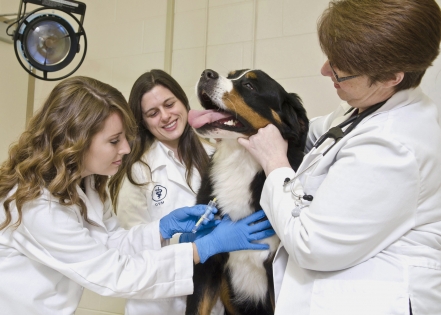
MSU veterinary medicine doctoral student Shauna Trichler (l) takes a blood sample from a patient with assistance from research resident Sandra Bulla (c) and Dr. Kari Lunsford. They are part of a College of Veterinary Medicine team studying the role of platelets in diagnosing canine cancer. Photo by: Tom Thompson

MSU veterinary medicine doctoral student Shauna Trichler (l) takes a blood sample from a patient with assistance from research resident Sandra Bulla (c) and Dr. Kari Lunsford. They are part of a College of Veterinary Medicine team studying the role of platelets in diagnosing canine cancer. Photo by: Tom Thompson

Their investigation began with only a tiny blood platelet, but quickly they discovered opportunities for growth and expanding the breadth of the research.

“We have a lot to gain by looking at platelets and how they influence cancer and healing,” said Dr. Camillo Bulla. “A part of our research is looking at the platelet. The platelet is very small, but it gives us a large picture. We hope to be able to find a tumor much sooner by taking a series of blood samples to look at platelet contents.”

Bulla is an associate professor in the college’s pathobiology and population medicine department. He and Dr. Kari Lunsford, a colleague at the college, have formed the Comparative Angiogenesis Laboratory at the university to better understand this process and treat canine patients.

As he explained, cancers need the creation of new blood vessels, called angiogenesis, to survive and grow, and tumors are able to create new blood vessels as pathways to travel and spread. They also are looking at the way platelets interact with tumor cells as they attempt to spread to the area surrounding the tumor or metastasize to distant sites in the body.

Lunsford, an associate professor in the clinical sciences department, said, “We know that metastasizing tumor cells need platelets but it is not yet known what the platelets do for the migrating (metastasizing) tumor. This is one of the questions we hope to help answer.”

“If treatments are successful and the cancer goes into remission, we would monitor the patient for a relapse of the disease by looking at its platelets,” Lunsford said. “This type of monitoring would be less invasive than taking biopsies and might also be an earlier indicator that the cancer is returning.”

According to Lunsford, platelets also carry information about tumors and metastasizing cancer cells, and the team hopes that by looking at specific proteins expressed in platelets (from a simple blood sample), they can identify new cancer earlier. Even more importantly, they want to identify when tumors are about to metastasize.

“Our lab has developed a new way to separate platelets from blood samples with far less contamination by other blood cells,” she said. “This new technique was developed by doctoral student Shauna Trichler, and is superior to any isolation technique previously used by researchers in human or veterinary medicine.”

For more information, read the entire Mississippi State University press release here.

Dog to human communication supported with technology

North Carolina State University researchers have developed a suite of technologies that can be used to enhance communication between dogs and humans, which has applications in everything from search and rescue to service dogs to training our pets.

“We’ve developed a platform for computer-mediated communication between humans and dogs that opens the door to new avenues for interpreting dogs’ behavioral signals and sending them clear and unambiguous cues in return,” says Dr. David Roberts, an assistant professor of computer science at NC State and co-lead author of a paper on the work. “We have a fully functional prototype, but we’ll be refining the design as we explore more and more applications for the platform.”

Dr David Roberts with one of his associates  Photo courtesy of North Carolina State University

Dr David Roberts with one of his associates. Photo courtesy of North Carolina State University

The platform itself is a harness that fits comfortably onto the dog, and which is equipped with a variety of technologies.

“There are two types of communication technologies,” says Dr. Alper Bozkurt, an assistant professor of electrical and computer engineering at NC State and co-lead author of a paper on the work. “One that allows us to communicate with the dogs, and one that allows them to communicate with us.”

“Dogs communicate primarily through body language, and one of our challenges was to develop sensors that tell us about their behavior by observing their posture remotely,” Roberts says. “So we can determine when they’re sitting, standing, running, etc., even when they’re out of sight – a harness-mounted computer the size of a deck of cards transmits those data wirelessly.

“At the same time, we’ve incorporated speakers and vibrating motors, called haptics, into the harness, which enable us to communicate with the dogs,” Roberts adds.

“We developed software to collect, interpret and communicate those data, and to translate human requests into signals on the harness,” says Rita Brugarolas, an NC State Ph.D. student and co-author of the paper.

The technology also includes physiological sensors that monitor things like heart rate and body temperature. The sensors not only track a dog’s physical well-being, but can offer information on a dog’s emotional state, such as whether it is excited or stressed.

These technologies form the core of the technology platform which can be customized with additional devices for specific applications.

“For example, for search and rescue, we’ve added environmental sensors that can detect hazards such as gas leaks, as well as a camera and microphone for collecting additional information,” Bozkurt says.

Other applications include monitoring stress in working dogs, such as guide dogs and other service dogs.  Physiological and behavioral sensors will provide insight into a dog’s mental and emotional state.

“This platform is an amazing tool, and we’re excited about using it to improve the bond between dogs and their humans,” says Dr. Barbara Sherman, a clinical professor of animal behavior at the NC State College of Veterinary Medicine and co-author of the paper.

The research team has published their research in the paper entitled Towards Cyber-Enhanced Working Dogs for Search and Rescue

Source:  North Carolina State University media release

Doctors believe in the health benefits of pet ownership

DogDoctor

The Human-Animal Bond Research Initiative (HABRI) Foundation has released the findings of a survey revealing the views of the family physician (also known as the GP) on the benefits of pets to health.

An online panel survey of 1,000 family doctors and general practitioners explored the doctors’ knowledge, attitudes and behavior regarding the human health benefits of pets.  The 28-question survey was conducted in August 2014 with a margin of error of +/- 3.1%.   The physicians in the survey had a median of 18 years in professional practice.

Key findings included:

  • 69% of doctors have worked with animals in a hospital, medical center or medical practice to assist patient treatment
  • 88% believe that interaction with pets improves a patient’s physical condition
  • 97% believe that interaction with pets improves mental health condition
  • 78% found that interaction with animals helped to improve the relationships of patients with staff
  • 97% of doctors reported that they believe there were health benefits resulting from pet ownership
  • 75% of doctors said they saw health improve in one or more patients as a result of pet ownership

The survey also revealed that while 69% of doctors at least occasionally discussed the health benefits of pets with patients, 56% identified ‘time constraints’ as the largest barrier to having these discussions.

“The Human Animal Bond Research Initiative funds research on the evidence-based health benefits on human-animal interaction, and this survey demonstrates that we are on the right track” said HABRI Executive Director Steven Feldman.

“HABRI hopes that this survey will help break down the barriers and get more doctors and their patients talking about the important, scientifically-validated health benefits of pets.”

Source:  HABRI media release

The genetics behind cleft lip and palate in dogs

Scientists studying birth defects in humans and purebred dogs have identified an association between cleft lip and cleft palate – conditions that occur when the lip and mouth fail to form properly during pregnancy – and a mutation in the ADAMTS20 gene.

“These results have potential implications for both human and animal health, by improving our understanding of what causes these birth defects in both species,” said Zena Wolf, BS, a graduate student at the University of California, Davis School of Veterinary Medicine.

Lentil, a French Bulldog born with cleft lip and palate.  Photo by CNN.  Read more about Lentil's story here

Lentil, a French Bulldog born with cleft lip and palate. Photo by CNN. Read more about Lentil’s story here

In both humans and dogs, cleft lip and cleft palate occur naturally with varying degrees of severity, and can be caused by various genetic and environmental factors. Since purebred dogs breed only with each other, there is less genetic variation to consider, making cleft lip and cleft palate easier to understand in these populations, Ms. Wolf explained.

From previous studies, the researchers knew that a mutation in the dog genes DLX5 and DLX6, which are involved in face and skull development, explained 12 of 22 cases of cleft palate. However, a mutation in the corresponding human genes accounted for just one of 30 cases in the study sample.

To search for additional genes that may be involved, Ms. Wolf and colleagues performed a genome-wide association study (GWAS), a study that compares the genomes of dogs with cleft lip and cleft palate to those of dogs without it. They found that the conditions were associated with a mutation in the gene ADAMTS20 that caused the protein it encodes to be shortened by 75 percent. Previous studies had shown that ADAMTS20 is involved in the development and shaping of the palate, but no specific mutations that occur in nature had been identified. A similar GWAS in people with cleft lip and cleft palate suggested that mutations in the human version of the ADAMTS20 gene may also increase the risk of these conditions.

“Cleft lip and cleft palate are complex conditions in people, and the canine model offers a simpler approach to study them,” Ms. Wolf said. “Not only does this research help people, but it helps dogs, too,” she added.

Future directions include searching for additional genes that may be associated with cleft lip and cleft palate, and extending the research to other breeds of dogs, such as Labrador Retrievers and Whippets.

Source:  The American Society of Human Genetics press release


Animal therapy’s positive effects on college students

Animal-assisted therapy can reduce symptoms of anxiety and loneliness among college students, according to researchers at Georgia State University, Idaho State University and Savannah College of Art and Design. Their findings are published in the latest issue of the Journal of Creativity in Mental Health.

German Shepherd Sophie is a trained assistance dog.  Photo courtesy of Georgia State University

German Shepherd Sophie is a trained assistance dog. Photo courtesy of Georgia State University

The researchers provided animal-assisted therapy to 55 students in a group setting at a small arts college in the southeastern United States.  They found a 60 percent decrease in self-reported anxiety and loneliness symptoms following animal-assisted therapy, in which a registered therapy dog was under the supervision of a licensed mental health practitioner.

Eighty-four percent of the participants reported their interaction with the therapy dog, Sophie, was the most significant part of the program.

The group sessions were held twice monthly during an academic quarter. Students were invited to stop by and interact with the therapy dog as long as they wished, up to two hours. They were allowed to pet, hug, feed, brush, draw, photograph, sit near and play fetch with the therapy dog.

Dr. Leslie Stewart of Idaho State, who led the study, began the research as a Ph.D. student at Georgia State. She collaborated with Drs. Franco Dispenza, Lindy Parker and Catherine Chang of Georgia State and Ms. Taffey Cunnien of Savannah College of Art and Design.

The prevalence of anxiety and loneliness on college campuses has increased, placing extra demands on college counseling centers. Budget strains have made it necessary for these centers to find creative ways to meet the needs of their students.

This study suggests animal-assisted therapy could be an effective way for college counseling centers to meet the growing demands of their students. It is one of the first to apply animal-assisted therapy in a group, college setting and use a systematic form of measurement.

“College counseling centers are also becoming more and more reflective of community mental health agencies,” Dispenza said. “That’s something that’s been noted in the field in probably the last 10 to 15 years. College counseling centers aren’t seeing students struggling with academics, which major to pick or how to study. They’re coming in with post-traumatic stress disorder, anxiety disorders, pervasive mood disorders and considerable contextual strains that are happening out in the world, such as poverty and experiences of homelessness, as well as a history of medical issues and family health issues.”

To become a registered therapy dog, the animal and handler must complete a series of evaluations and courses, which involve their grooming, temperament, previous training and relationship with their handler. Dogs can be ideal therapy animals because they have become so domesticated and the seeming ability to read cues between dogs and humans is probably the most pronounced. For instance, a dog can tell when a human is sad, Dispenza said.

“The presence of a therapy dog facilitates a therapeutic connection between the client and the mental health professional,” Parker said. “When you’re trying to do mental health work with someone, establishing that therapeutic relationship and rapport is so important. Any way to do it faster or more effectively only helps facilitate the therapeutic process.”

Source:  Georgia State University media release

The human-animal bond using functional MRI

How closely does the relationship between people and their non-human companions mirror the parent-child relationship? Credit: © christingasner / Fotolia

How closely does the relationship between people and their non-human companions mirror the parent-child relationship?
Credit: © christingasner / Fotolia

It has become common for people who have pets to refer to themselves as  “pet parents,” but how closely does the relationship between people and their non-human companions mirror the parent-child relationship?  A small study from a group of Massachusetts General Hospital (MGH) researchers makes a contribution to answering this complex question by investigating differences in how important brain structures are activated when women view images of their children and of their own dogs.  Their report is being published in the open-access journal PLOS ONE.

“Pets hold a special place in many people’s hearts and lives, and there is compelling evidence from clinical and laboratory studies that interacting with pets can be beneficial to the physical, social and emotional wellbeing of humans,” says Lori Palley, DVM, of the MGH Center for Comparative Medicine, co-lead author of the report.  “Several previous studies have found that levels of neurohormones like oxytocin – which is involved in pair-bonding and maternal attachment – rise after interaction with pets, and new brain imaging technologies are helping us begin to understand the neurobiological basis of the relationship, which is exciting.”

In order to compare patterns of brain activation involved with the human-pet bond with those elicited by the maternal-child bond, the study enrolled a group of women with at least one child aged 2 to 10 years old and one pet dog that had been in the household for two years or longer.  Participation consisted of two sessions, the first being a home visit during which participants completed several questionnaires, including ones regarding their relationships with both their child and pet dog. The participants’ dog and child were also photographed in each participants’ home.

The second session took place at the Athinoula A. Martinos Center for Biomedical Imaging at MGH, where functional magnetic resonance imaging (fMRI) – which indicates levels of activation in specific brain structures by detecting changes in blood flow and oxygen levels – was performed as participants lay in a scanner and viewed a series of photographs.  The photos included images of each participant’s own child and own dog alternating with those of an unfamiliar child and dog belonging to another study participant.  After the scanning session, each participant completed additional assessments, including an image recognition test to confirm she had paid close attention to photos presented during scanning, and rated several images from each category shown during the session on factors relating to pleasantness and excitement.

Of 16 women originally enrolled, complete information and MR data was available for 14 participants.  The imaging studies revealed both similarities and differences in the way important brain regions reacted to images of a woman’s own child and own dog.  Areas previously reported as important for functions such as emotion, reward, affiliation, visual processing and social interaction all showed increased activity when participants viewed either their own child or their own dog.  A region known to be important to bond formation – the substantia nigra/ventral tegmental area (SNi/VTA) – was activated only in response to images of a participant’s own child.  The fusiform gyrus, which is involved in facial recognition and other visual processing functions, actually showed greater response to own-dog images than own-child images.

“Although this is a small study that may not apply to other individuals, the results suggest there is a common brain network important for pair-bond formation and maintenance that is activated when mothers viewed images of either their child or their dog,” says Luke Stoeckel, PhD, MGH Department of Psychiatry, co-lead author of the PLOS One report. “We also observed differences in activation of some regions that may reflect variance in the evolutionary course and function of these relationships.  For example, like the SNi/VTA, the nucleus accumbens has been reported to have an important role in pair-bonding in both human and animal studies. But that region showed greater deactivation when mothers viewed their own-dog images instead of greater activation in response to own-child images, as one might expect. We think the greater response of the fusiform gyrus to images of participants’ dogs may reflect the increased reliance on visual than verbal cues in human-animal communications.”

The investigators note that further research is needed to replicate these findings in a larger sample and to see if they are seen in other populations – such as women without children, fathers and parents of adopted children – and in relationships with other animal species.  Combining fMRI studies with additional behavioral and physiological measures could obtain evidence to support a direct relationship between the observed brain activity and the purported functions.

Source:  Massachusetts General Hospital media release

Pet food mislabeling – it happens!

Researchers in Chapman University’s Food Science Program have recently published a study on pet food mislabeling. The study focused on commercial pet foods marketed for dogs and cats to identify meat species present as well as any instances of mislabeling. Of the 52 products tested, 31 were labeled correctly, 20 were potentially mislabeled, and one contained a non-specific meat ingredient that could not be verified.

“Although regulations exist for pet foods, increases in international trade and globalization of the food supply have amplified the potential for food fraud to occur,” said Rosalee Hellberg, Ph.D., and co-author on the study. “With the recent discovery of horsemeat in ground meat products sold for human consumption in several European countries, finding horsemeat in U.S. consumer food and pet food products is a concern, which is one of the reasons we wanted to do this study.”

Chicken was the most common meat species found in the pet food products. Pork was the second most common meat species detected, and beef, turkey and lamb followed, respectively. Goose was the least common meat species detected. None of the products tested positive for horsemeat.Pet Food Fig. 1 Color

Of the 20 potentially mislabeled products, 13 were dog food and 7 were cat food. Of these 20, 16 contained meat species that were not included on the product label, with pork being the most common undeclared meat species. In three of the cases of potential mislabeling, one or two meat species were substituted for other meat species.

In the study, DNA was extracted from each product and tested for the presence of eight meat species: beef, goat, lamb, chicken, goose, turkey, pork, and horse.

“Pet food safety was another area of concern, particularly with pet foods that are specifically formulated to address food allergies in both cats and dogs,” continued Dr. Hellberg.

The pet food industry is a substantial market in the United States. Nearly 75 percent of U.S. households own pets, totaling about 218 million pets (not including fish). On average, each household spends $500 annually on their pets, equating to about 1 percent of household expenditures. In the past five years, pet industry expenditures have increased by $10 billion, with $21 billion spent on pet food alone in 2012.

The foods developed for pets are regulated by both federal and state entities. The U.S. Food and Drug Administration Center for Veterinary Medicine regulates animal feed and pet foods. While the U.S. Department of Agriculture regulates the interstate transportation and processing of animal products, as well as the inspection of animal product imports and exports.

While a seemingly high percentage of pet foods were found to be potentially mislabeled in this study, the manner in which mislabeling occurred is not clear; nor is it clear as to whether the mislabeling was accidental or intentional and at which points in the production chain it took place.

The study was published in the journal Food Control and was completed with Chapman undergrad student Tara Okuma.

I contacted Dr Hellberg to see if she would disclose the brands of foods that were mislabeled.  She replied “It was not our intention to single out pet food brands, but rather to investigate the issue as a whole. Therefore, we will not be releasing the names of the brands or specific products that were tested in this study.”

Kathleen Crisley, specialist in dog massage, rehabilitation and nutrition/food therapy, Canine Catering Ltd, Christchurch, New Zealand

Source of content:  Chapman University media release