Category Archives: research

Re-thinking dog domestication

A research team led by the University of Durham has published a study in the Proceedings of the National Academy of Sciences (USA).  This study shows that today’s modern breeds of dog have little in common genetically with their ancient ancestors. 

Dog domestication occurred over 15,000 years ago – and there is still much to learn!

Years of cross-breeding are the major influence on the genetic differences, although the researchers are quick to add that other effects on genetic diversity will include patterns of human movement and the impact on dog population sizes caused by major events such as World War I and World War II.

The research team analysed genetic data from 1,375 dogs representing 35 breeds. They also looked at data showing genetic samples of wolves because other research studies have concluded that the dog descended directly from the gray wolf.

Lead author Dr Greger Larson, an evolutionary biologist, says the study demonstrated just how much there is still to understand about the early history of dog domestication.  “We really love our dogs and they have accompanied us across every continent.  Ironically, the ubiquity of dogs combined with their deep history has obscured their origins and made it difficult for us to know how dogs became man’s best friend.”

The study also refutes claims of previous researchers that genetic differences in breeds such as the Basenji, Saluki and Dingo were evidence of an ancient heritage.  The Durham team’s study shows that these dogs are genetically different because they were geographically isolated and were not part of the 19th Century Victorian-initiated kennel clubs that blended lineages to create most of today’s breeds.

A Saluki (copyright Keith Dobney)

Source:  University of Durham press release

Aggressive dog? How agreeable is the owner?

Research from the University of Leicester’s School of Psychology  has revealed that young people who are more disagreeable are likely to own an aggressive dog.

‘Agreeableness’ means being less concerned with the needs or well-being of others.  Such people may be suspicious, unfriendly and competitive as well.

Participants were given personality tests and  indicated their preference for different types of dogs  . The dogs were independently rated according to how aggressive people perceived them to be. Bull terriers were rated as most aggressive, followed by boxers; retrievers and cocker spaniels were seen as least aggressive.

The study’s results also show a small effect suggesting that those who liked aggressive dogs showed signs of conscientiousness – being careful, reliable and thoughtful about their actions.

Whilst this finding (about conscientiousness) contradicts a long-held perception that owners of aggressive dogs are always irresponsible, Dr Vincent Egan, the study’s lead researcher suggests caution before reading too much into the conclusion:

“These results with Conscientiousness were unexpected, but the effect is a small one, and needs to be repeated in a different group of people. Studies of this kind tend to only look at a restricted age ranges, which may exaggerate findings which do not occur across the entire lifespan, so we believe a stereotype is always true, whereas it may only be true under certain conditions. Our study employed a broader age range.”

Dr Egan’s study has been published in the journal Anthrozoos.

What is your dog thinking? Researchers are on the case!

Researchers at Emory University have published new research into canine cognition.  Entitled Functional MRI in Awake Unrestrained Dogs, the paper outlines findings of research that required two dogs to remain motionless in an MRI machine.

Yes – that’s right. Motionless.  The two dogs were outfitted with special ear muffs to protect them from the noise of the MRI and trained to rest their heads on a chin rest inside the machine.   As the MRI took scans of the dog’s brain activity,  hand signals were used to show the dogs whether there was or wasn’t a food reward.

This is a first-ever study on awake dogs, rather than those that have been sedated.  Importantly, part of the animal ethics of the study was to ensure the dogs were willing participants.

The findings show a definite brain activity response when the hand signals indicated a food reward.  Those dogs are paying attention!

The lead researcher, Professor Gregory Berns, says “We hope this opens up a whole new door for understanding canine cognition and inter-species communication. We want to understand the dog-human relationship, from the dog’s perspective.”

Professor Bern’s dog Callie in training in a mock-up of the MRI scanner (copyright Emory University)

Listen to Professor Berns talk about this project in the Emory University YouTube video:

Source:  Emory University press release 4 May 2012

With age comes greater success (in hunting, at least)

At the meeting of the Society for American Archeology this week, two University of Cincinnati professors, Jeremy Koster and Ken Tankersley,  presented their results of research into hunting dogs in lowland Nicaragua.

The indigenous communities of the Mayangna and the Miskito in Nicaragua survive on subsistence hunting in the Bosawas Biosphere Reserve.  The reserve is part of the largest unbroken tracts of neotropical rainforest in Central America, north of the Amazon.   85% of the mammals that are hunted are caught with the assistance of dogs.

Nicaraguan hunters and their dogs on a hunt, photo by Jeremy Koster, University of Cincinnati

The research team found that as both male and female dogs reach three years of age, they tend to increase their hunting success.  Older, male and female dogs in the study population returned more game to their owners than did younger dogs.

Bigger dogs are able to track and corral bigger prey, which increases their hunting return rates.  Since male dogs are generally larger than females, the males had the greater success rates.

As far as sustainability is concerned, the researchers found that  dogs are more suited to wildlife sustainability than other hunting options available.  Hunters with firearms tend to disproportionately hunt prey that lives in trees, including slow-breeding primates.  Hunters with dogs tend to harvest relatively fast-breeding animals such as agoutis, pacas and armadillos.

Their main conclusion:  With age comes greater success!

(Let’s hope the same applies to us; I could use all the help I can get :))

Source:  University of Cincinnati press release

Hug me, I need the oxytocin

Oxytocin is a mammalian hormone that is released during the act of touching and hugging.   For these reasons, the hormone is often referred to as ‘the cuddle hormone’ or ‘the love hormone.’  (The hormone is also released during childbirth, by the way).

As a dog owner, your relationship with your dog is likely to involve you and your dog triggering the release of oxytocin in one another.  Temple Grandin, animal behaviourist and autism researcher, has found that ‘A dog’s oxytocin levels rise when his owners pet him and petting his dog raises the owner’s oxytocin too.’    In other words, this hormone plays a role in the human-animal bond.

In 2003, J.S.J. Odendaal and R.A. Meintjes of the  Life Sciences Institute at Pretoria published research into the blood levels of endorphins, oxytocin, prolactin, B-phenylethylamine and dopamine (all associated with pleasure response or relaxation) and cortisol (a known stress hormone) in people and dogs both before and after they interacted with each other.  The researchers compared levels of the neurochemicals under three scenarios:   1) after people petted their own dogs 2)  after they petted unfamiliar dogs and 3) after they sat quietly and read a book.

In both humans and dogs, the levels of the pleasure-response chemicals  rose after 5 to 24 minutes.  At the same time, cortisol levels in humans fell as they spent time with their pets.   The increase in oxytocin was highest in the group where people interacted with their own dogs, as opposed to dogs that were unfamiliar to them.

In 2008, Miho Nagasawa’s research team in Japan showed that only eye contact was necessary between dogs and their humans to increase oxytocin levels.  After 30 minutes of contact with their dog, owners showed an increase in oxytocin levels.

Dr Kerstin Uvnäs-Moberg from Uppsala University, studies oxytocin and its effects.  Her 2010 study showed that women and their dogs experienced increases in their oxytocin levels after only 10 minutes of contact.  When compared to a survey of the women, their oxytocin response was in direct correlation with the quality of the bond they felt for their pet.

For those of us who have experienced this bond during our lives, it is probably not surprising that there is a scientific reason for our feelings and that it is hormone-related.  But it’s nice to have science on our side.

For those of you raising puppies, these studies show that there  is a good scientific reason to ensure your  puppy is socialised.  It is not surprising  that dogs involved in hoarding cases or puppy mills are withdrawn and in many cases frightened of humans.  They aren’t accustomed to the positive effects of oxytocin release and in many cases have suffered other traumas.

Hey Daisy, give me a hug…I need the oxytocin.

Have you hugged your dog today?

Kathleen Crisley, specialist in dog massage, rehabilitation and nutrition/food therapy, The Balanced Dog, Christchurch, New Zealand

Benefits of taking Fido to work may not be far ‘fetched’

The  benefits of dogs in the workplace are the subject of new research published in the March issue of the International Journal of Workplace Health Management.

Researchers at Virginia Commonwealth University  found that the presence of dogs in the workplace may buffer the impact of stress during the work day in both their owners and the people that they come into contact with.

In this YouTube video, principal investigator Dr Randolph T Barker (no pun intended) talks about the costs of stress to employers through lost work time and the benefits of increased productivity.

The researchers conducted their study at Replacements Ltd, the pet-friendly workplace that I featured here in March 2011.

Although Dr Barker is a Professor of Management, he collaborated with specialists in psychiatry and biostatistics for this study.  The researchers emphasise that their results are preliminary and that the next step is to expand the study to a larger sample size in an organisational setting.

I wonder which firm will put their hand up for that study?

Hip dysplasia – it’s not just genetics

Doctoral research by Randi I. Krontveit at the Norwegian School of Veterinary Science has revealed that environmental factors play a larger role in the development of hip dysplasia than previously thought.

The critical period is from birth to the age of three months.  Activities such as walking up steps on a daily basis during this critical period increased the risk of developing hip dyplasia.

The study group consisted of 500 dogs in four breeds:  the Labrador Retriever, the Newfoundland, the Leonberger and the Irish Wolfhound.

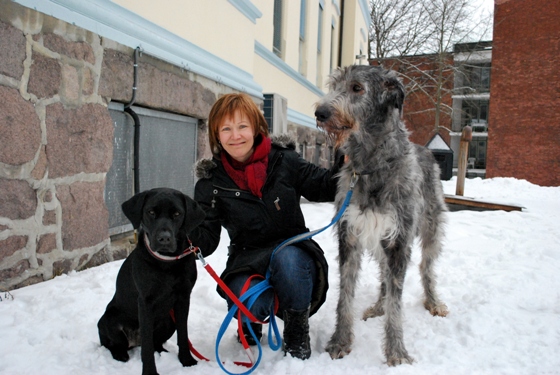
Randi I. Krontveit with two of her study subjects. Photo courtesy of the Norwegian School of Veterinary Medicine

Environmental factors were assessed by questionnaires filled out by breeders and owners alongside examinations by veterinarians.  Dogs were followed for a period of ten years, making the findings of the study particularly robust.

Puppies born in the spring or summer and at breeders’ who lived on a farm or small holding had a lower risk of developing hip dysplasia.  After about eight weeks, the puppies began to live with their new owners. The opportunity to exercise daily in parks up until the age of three months reduced the risk of hip dysplasia.

Overall, it would appear that daily exercise out in gently undulating terrain up until the age of three months has a positive impact when it comes to preventing the disease.

For more information about this research, you can email Dr Krontveit via this page at the Norwegian School of Veterinary Medicine.

Epilepsy gene discovery in dogs

The journal PLoS ONE has published research this week by Professor Hannes Lohi of the University of Helsinki.  Professor Lohi and his research team have isolated a gene linked to epilepsy in Belgian Shepherds.

The gene is found on canine chromosome 37.  The research team isolated the gene by comparing the genome of dogs with epilepsy against those of dogs that were in a healthy control group.  The gene could increase the risk of epilepsy by a factor of 7.

Genetic epilepsy is also referred to as ‘idiopathic epilepsy.’  A co-author on the article has said that as many as 20% of the Belgian Shepherd breed is estimated to have epilepsy and so the research could underpin the development of a genetic test for the disease.

Seizures can result in abnormal movements, usually on one side of the body, followed by cramping in the limbs.  Drooling and vomiting are other symptoms.

This research group is responsible for other genetic discoveries in dogs.  Through their research, the group has developed a canine DNA bank in Finland containing 40,000 samples from 250 different breeds of dogs.  They have previously identified the epilepsy gene EPM2B in Miniature Wirehaired Dachshunds and a gene LGI2 in Lagotto Romagnolos and collaborated with other researchers in the discovery of an epilepsy gene in Tibetan Terriers.

Source:  Helsingin yliopisto (University of Helsinki) (2012, March 23).   New epilepsy gene located in dogs. ScienceDaily. Retrieved March 25, 2012, from http://www.sciencedaily.com­ /releases/2012/03/120323205337.htm?utm_source=feedburner&utm_medium=email&utm_campaign=Feed%3A+sciencedaily%2Fplants_animals%2Fdogs
+%28ScienceDaily%3A+Plants+%26+Animals+News+–+Dogs%29

New research into virus infection in dogs

Researchers at the University of Pennsylvania School of Veterinary Medicine and the Perelman School of Medicine have published new research into an Epstein Barr-like virus that can infect and may cause lymphomas in dogs.

The findings means that humans and dogs share a similar biology – at least when it comes to the infection by the virus.  (Epstein Barr is the cause of diseases such as mononucleosis and is linked to the development of more serious diseases including non-Hodgkins and Hodgkins lymphomas.)

How does infection occur?

In humans, the Epstein Barr virus infects B cells.  After an acute phase of infection, which passes in many people without them even being aware of it,  the virus goes into a latent phase.  Most people show no symptoms during this phase.  In some, however the virus promotes unnatural growth of B cells and this contributes to the development of lymphoma.

Dogs develop lymphomas that share some characteristics with human lymphomas.  These conditions are relatively common in certain breeds such as the golden retriever.

Researchers think this line of enquiry is promising because they may be able to study the rates of infection and responses to treatment in dogs and this may have spinoffs for human treatment.

You can read the entire University of Pennsylvania media statement here.

Quality of life improves when obese dogs shed excess weight

Researchers at the University of Liverpool have published the results of a study into the quality of life of obese dogs in The Veterinary Journal.

The researchers tracked various quality of life indicators with the owners of 50 dogs who were classified as obese.  These dogs were of various breeds and a mixture of males and females.   The same questionnaire was repeated once the dogs went through a weight loss programme (for the dogs that were successful in losing weight, and those that were not).

Photo courtesy of University of Liverpool

The vitality scores for the dogs that lost weight increased and their scores for emotional disturbance and pain decreased. The more body fat that the dogs lost, the greater their improvement in vitality.

Some people may think ‘these results are a no-brainer’ but in veterinary and other clinical medicine fields, the norm is ‘evidence-based medicine.’  That is, practitioners like veterinarians want results from research that is measurable and defensible when applying or recommending treatments.

Since obesity is linked to problems with the heart, arthritis and other conditions, research likes this helps to underpin the importance of the healthy weight message.

The same basic principles for weight loss in dogs apply to humans:  use portion control, increase exercise and activity, and eat healthy foods.