Category Archives: special dogs and awards

Fake service dog products

Non-profit agency Canine Companions for Independence is circulating a petition to the U S Department of Justice to urge them to take action against fake service dog/assistance dog products.

These  products, mostly sold online, fraudulently portray a dog as an assistance dog.   As service animals, they will be permitted inside grocery stores, restaurants and other public places where family pets are otherwise not allowed.

As a result of these acts of fraud, people with disabilities who have a legitimate need for an assistance dog face added discrimination and are being denied access to public places, which is in violation of the Americans with Disabilities Act.

I’m a big supporter of dog-friendly workplaces, hotels, and shopping (as evidenced by the postings on this blog), but I do not support gaining access through fraud.  My biggest concern is that people with disabilities and their dogs may be discriminated against because members of the public will lack confidence in service dog certification systems.  (‘That’s a service dog?  Yeah, right.’)

As an example, check out last month’s publicity when Air New Zealand allowed access to two French bulldogs whose owners carried papers certifying them as psychiatric dogs.  Air New Zealand obeyed the law but the scepticism of the journalists and public who commented on the article was clear.

We simply can’t afford to have the public doubt the authenticity of assistance dog and service dog training programmes.  If you agree with me, please support this cause and sign the Canine Companions petition here.

Chandi

Chandi book cover

I have just finished reading Chandi:  The Rescue Dog Who Stole a Nation’s Heart by Tina Humphrey.  Chandi is the story of Humphrey’s rescue dog who she trained for Heelwork to Music.  Published in 2012, the book opens when Humphrey meets her first dog, Pepper, in 1994.  Chandi is adopted from a shelter in 1998 and, for a time, Humphrey trains and competes with both dogs in Heelwork to Music and Freestyle competitions.

Tina, who teaches piano and violin, has a natural ear for music and is able to choreograph routines for her dogs that emphasize the stories behind the music.

Chandi is a love story.  It is about the bond that Tina shares with both of her dogs and the devotion she has for both of them.  She is an advocate for a raw diet and natural health care (no wonder I was attracted to the book),  in part inspired by her mother who fought cancer for many years using natural therapies.  (Part of the book tells the story of how Tina suffers the loss of both of her parents, at separate times, with her dogs there as emotional support).

We also share in Tina’s heartache when, in 2007, she and Chandi suffer the loss of Pepper.  Anyone who has had to say goodbye to their beloved dog understands Tina’s pain when it is time for Pepper to be put to sleep.

Chandi and Tina win many competitions in their years together including several trophies at Crufts.  In 2010, after almost 12 years of competing and sharing their lives, they audition for Britain’s Got Talent and go all the way to the finals, ultimately finishing in fourth place.  By then, they are celebrities and enjoy a nationwide tour of the show’s finalists plus other interviews and promotions.  And that’s where the book finishes…on a high note.

On 26 April 2013, Chandi died at the age of 14 years 10 months.  She developed a condition that was thought to be pyometra.  However, during surgery to remove her uterus and spleen, it was discovered that Chandi’s body had many other tumours that could not be removed.   Tina made the heart-breaking decision that it was time for Chandi to go and was there when she was put to sleep on the surgical table.

Today, Tina is training a new puppy named Grace and is blogging about her experiences with her new canine companion.    You can follow them on Facebook.

 And through the wonders of YouTube, here are Tina and Chandi’s performances on Britain’s Got Talent:

Auditions

Semi-Finals

Finals

Kathleen Crisley, specialist in dog massage, rehabilitation and nutrition/food therapy, The Balanced Dog, Christchurch, New Zealand

First dementia dogs start work

The first ever “dementia dogs” who are specially trained to help people with early-stage dementia have started work in Scotland.

You can watch the story of Oscar, a Golden Retriever and Kaspa, the Labrador in this BBC News item:

The canine ambassador at the Fairmont Hotel

At the Fairmont Hotel MacDonald in Edmonton (Canada), you will be greeted by a very special staff member – Smudge the Yellow Labrador!

SmudgeSmudge is a failed guide dog (due to her enthusiastic/over-friendly nature) and so thanks to a working arrangement with the Canadian National Institute for the Blind, Smudge came to work at the hotel.

Guests can book to take Smudge out for a walk and she will visit meetings on request.  Look for her (on her bed, by the concierge desk) when you are visiting.

Smudge also has her own Facebook page and you can follow her activities there.

Here’s a bit more about Smudge:

Kabang, the snoutless dog

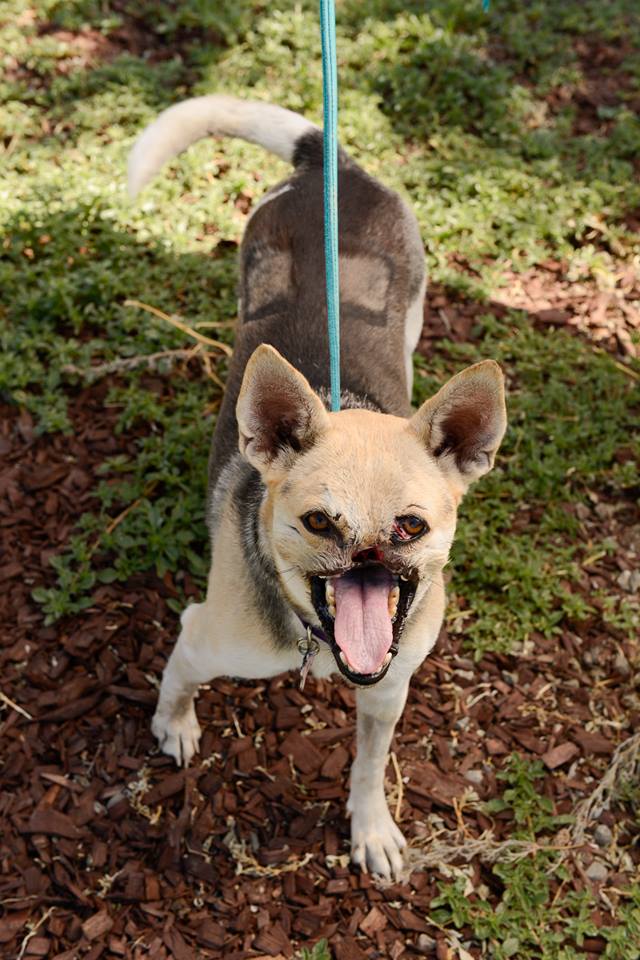
Kabang wasn’t always snoutless; she was just a family dog in the Philippines.  And then one day in December 2011, she leaped in front of a motorcycle to save the lives of the family’s daughter and niece.

In the process, her snout and upper jaw were ripped off by the motorcycle’s wheel.  With devastating injuries and limited veterinary care locally, a Care for Kabang fundraising campaign  gathered enough funds to get her to California for surgery in late 2012.

Kabang, ready to go home (Photo by UC Davis)

Kabang, ready to go home (Photo by UC Davis)

Once there, doctors discovered that the dog also had a life-threatening cancer and gave her chemotherapy.  The chemotherapy meant  that surgeons had to delay any plans for surgery on her face.  She also had to be treated for heartworm before that surgery could proceed.

In the end, veterinarians couldn’t reconstruct Kabang’s jaw, but they did heal her wounds during her seven-month stay.   Her surgeries included dental work and teeth extractions followed by closing of opened wounds and the restoration of her nasal function.

Earlier this week, Kabang returned home to a hero’s welcome, as noted by this BBC report:

Kabang is now considered an ambassador of ‘dogwill’ to show the power of the unconditional love and devotion our dogs show us each day.  Zamboanga City Mayor Celso Lobregat signed Executive Order 503-2013, making Kabang the official symbol of responsible pet ownership and advocacy against animal cruelty.

Her owner, Rudy Bunggal, has been struggling with financial and personal demons associated with alcohol.  He’s now been given a new home by the local government, which will pay for the house to be prepared for their arrival by the end of this month.  The new house is larger, made of concrete, has a stable roof and is located in a more pleasant environment than Rudy’s shanty house behind a petrol station.

The dog of the Mary Rose

The Mary Rose, vice-flagship of Henry VIII’s war fleet, had been in service for 34 years when she went into action against the French in the battle of the Solent in Portsmouth Harbour.   The year was 1545.  On the second day of the conflict, the Mary Rose turned to starboard and sank rapidly.

Among the 500 crew that perished in the sinking was the captain’s dog, a whippet-terrier cross whose job it was to hunt down the rats that were on board the ship.  The dog’s remains were found close to the door of the captain’s quarters, suggesting that it had been trapped inside when the ship sank.

The ship’s remains were preserved by the silt and clay of the harbour.  The ship was discovered in 1971 and excavated during the period 1979 to 1982, when many artifacts were saved and preserved.  The hull of the ship was raised in 1982.

The Mary Rose is now a museum in Portsmouth, England where on one side you can view the hull of the ship and on the other, you can observe the preserved contents of the ship, including the skeleton of the master’s dog, laid out as if in mirror image to the ship’s hull.

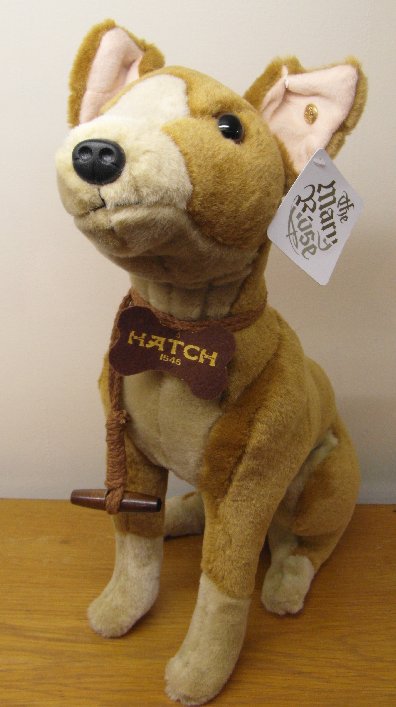
The museum’s gift shop sells a 37 cm tall stuffed dog- affectionately named ‘Hatch’, a replica of what the captain’s dog probably looked like.

You can buy Hatch at the Mary Rose gift shop for  £ 25.00

You can buy Hatch at the Mary Rose gift shop for £ 25.00

Fala – a presidential dog

If you are visiting Washington, DC, one of the best memorials on the Mall is to commemorate the life and achievements of Franklin Delano Roosevelt (FDR).

Fala and FDR

And one reason I liked this monument is that FDR’s dog, Fala, is also featured and this makes him unique – the only presidential dog that has been honoured in this way.

Fala, a Scottish Terrier, lived from 7th April 1940 to 5th April 1952.  FDR renamed the dog referring to the name of his 15th century Scottish ancestor (John Murray), “Murray the Outlaw of Falahill, ”  The name was then shortened to “Fala.”

Fala close up

Fala accompanied FDR everywhere; it was said that FDR fed Fala personally.  Fala’s leather collar had a silver plate on it which read, “Fala, the White House.”

Fala was often present during FDR’s fireside chats (via radio) to the US public.  So, it makes sense that Fala is seen at the FDR memorial sitting at his master’s side.

The Fala statue is quite large; this is me sitting next to it (for scale).

The Fala statue is quite large; this is me sitting next to it (for scale).

Travelling through LAX? Meet the PUPS!

Los Angeles International Airport (LAX) is known for its frantic pace and passenger volumes.  While it can be an exciting place, it can also be stressful.

Dogs are about to make this airport a whole lot better!

PUPS, Pups Unstressing Passengers, was launched last week.  This new programme involves trained dogs and their volunteer handlers who will wander throughout the gate and departure areas to visit with passengers.  They’ll provide comfort as well as be knowledgeable about the airport.

Each volunteer had a 4-hour classroom session to enable them to be familiar with the airport, the layout of airlines, and operational procedures.

This YouTube video provides an overview of the programme, including the collectible trading cards that will be available portraying each dog’s photo!

Can’t wait to travel through LAX on my next trip!  (And maybe, for those of us traveling from New Zealand, San Francisco’s airport will start a similar initiative.)

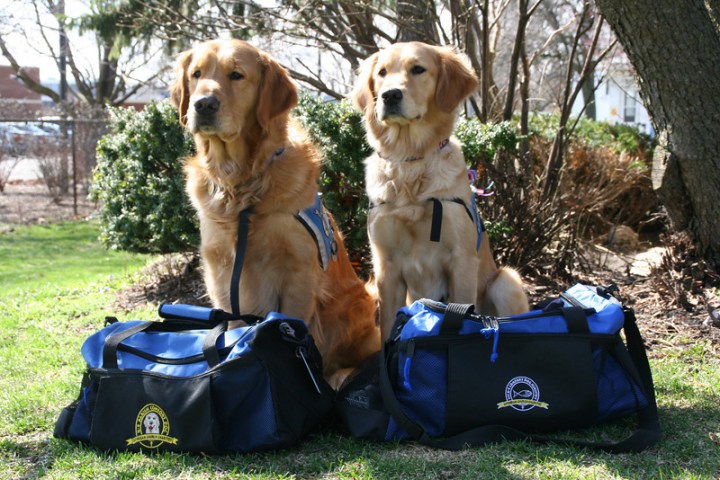
Luther and Ruthie go to Boston

Luther and Ruthie are two comfort dogs provided by Lutheran Church Charities

Luther and Ruthie are two comfort dogs provided by Lutheran Church Charities

Golden Retrievers trained as comfort dogs have arrived in Boston to help with the traumatised survivors of the Boston Marathon bombings.

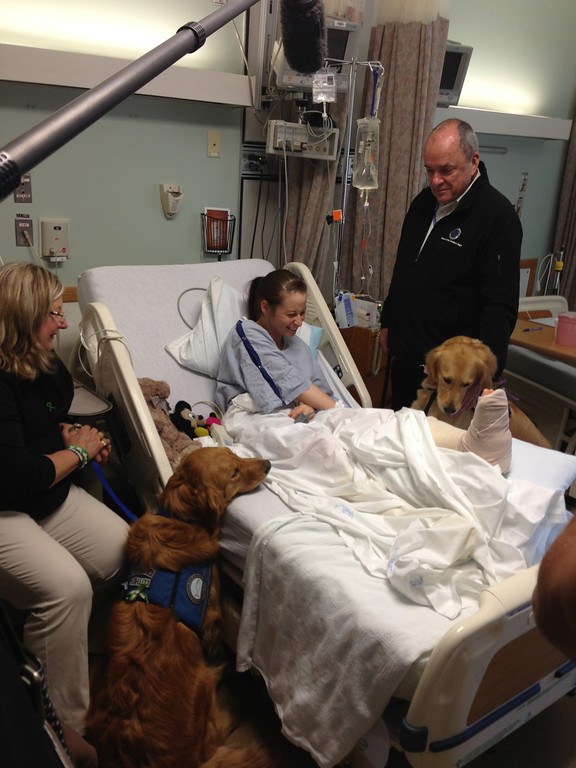
Just as they did in Newtown, Connecticut last year, the dogs and their handlers will visit with survivors and their families to engage them in conversation, to give them a hug and a cuddle and to provide comfort.

Luther and Ruthie visit with a survivor before surgery for a leg injury (courtesy Lutheran Church Charities)

Luther and Ruthie visit with a survivor before surgery for a leg injury (courtesy Lutheran Church Charities)

The comfort dogs show us (again) the special skills that dogs have to provide solace and they also prove that dogs can be socialised and trained to enter public places without causing problems.  The volunteers from Lutheran Church Charities give of their time freely.

Thank you!

Comfort dogs in Boston

Protecting the paws of the canine cop

Police dogs in Berlin, Germany have been outfitted with neoprene boots that stop broken glass and other objects from injuring a dog when it is working.

The tailor-made shoes cost €80 (roughly NZ$120).

Police dog in boots

When the shoes were trialled, the police found that there was a reduction in the number of injuries at high-risk events (which include such things as football games and public riots).

police dog wearing shoes

The idea of dogs wearing protective footwear isn’t new.

The City of Duesseldorf outfitted its police dogs in 2008.

Sources:

The Times

Metro