“No matter how little money and how few possessions you own, having a dog makes you rich.”
– Louis Sabin

“No matter how little money and how few possessions you own, having a dog makes you rich.”
– Louis Sabin
We all know that we share love with our dogs. But microbes?
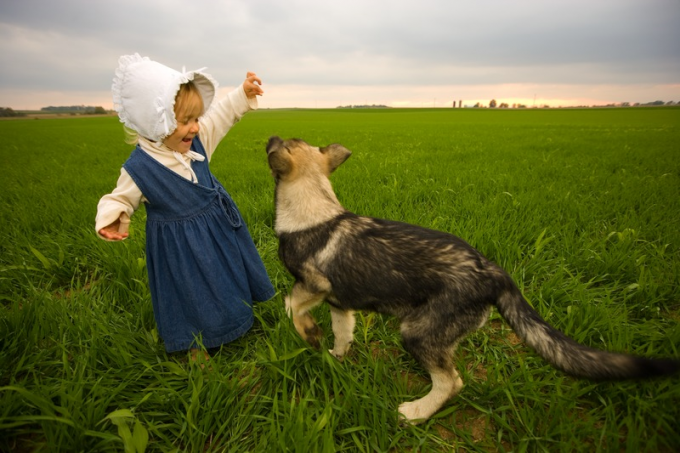
A new study indicates parents are more likely to share bacteria with their dogs than their kids. Photo courtesy Natural Resources Conservation Services
Researchers at the University of Colorado Boulder have looked at the types and transfer modes of microbes from the guts, tongues, foreheads and palms (or paws) of members of 60 American families, including dogs. They found that humans shared more microbes with their dog than their own children.
The team swabbed various parts of the body to obtain microbial samples on couples, children and dogs. For humans, the team looked at the tongue, forehead, right and left palm and fecal samples to detect individual microbial communities. Dogs were sampled similarly, except that fur was sampled instead of skin on the forehead and all four paws were swabbed for bacteria in the absence of canine palms.
“One of the biggest surprises was that we could detect such a strong connection between their owners and pets,” said Associate Professor Rob Knight, the study’s leader.
The micro-organisms humans carry around have been linked to a broad spectrum of diseases ranging from malnutrition and obesity to diabetes, asthma and depression. “There is mounting evidence that exposure to a variety of environmental sources of microbes can affect long-term health, findings known as the ‘hygiene hypothesis,’ ” said doctoral student Se Jin Song.
Proposed by British epidemiologist Richard Strachen in 1989, the hypothesis is that children who have had a lack of exposure to bacteria and micro-organisms might be more prone to getting sick because many microbes have co-evolved with people to be beneficial.
Dogs were a key part of this research, said Knight. “Since so many people consider their pets truly a part of the family, it seemed appropriate to include them in a study involving family structure.”
The results of the study have been published in the journal eLIFE.
Posted in dog ownership, research
Tagged eLIFE, microbes, research, University of Colorado
Veterinarian Dr Jean Dodds is the inventor of patented NutriScan, a saliva test for food intolerance and sensitivities.
Many people confuse food allergy with intolerance. Intolerances are the third most common disorder found in dogs and symptoms can include itchy skin or irritable bowel problems. When people seek out my advice on nutrition, it is often because they know their dog is having a reaction to their food. Sometimes, picking the culprit is easy (it depends on what the core diet is in the first place), but in others, there appears to be multiple ingredients that are the offenders.
Enter NutriScan, which tests for intolerances to 22 different food ingredients.
Food allergy is an immediate reaction mediated by production of IgE and IgG antibodies. Food sensitivity and intolerance, by contrast, measures a more delayed body response to offending foods by measuring production of IgA and IgM antibodies primarily in mucosal secretions from the bowel.
NutriScan is split into two test panels, so you can order one or both:
Panel 1: Panel 2:
Beef Chicken Eggs
Corn Barley
Wheat Millet
Soy Oatmeal
Cow’s Milk Salmon
Lamb Rabbit
Venison/Deer Rice
Chicken Quinoa
Turkey Potato
White Fish Peanut/Peanut Butter
Pork Sweet Potato
Dr. Dodds recommends that dogs are tested annually because canine food tolerances and intolerances change over time.
I’m pleased to be able to offer this testing to my clients, with NutriScan test kits on hand and ready to be sent to the United States once we take the saliva sample. Within a week of ordering my test kit supply, my first canine saliva sample is on its way.
Posted in dog care, dog nutrition and labelling
Tagged allergy, Dr Jean Dodds, food allergy, food intolerance, intolerance, NutriScan, saliva test
When this happens at our house, I say ‘There will be no kisses for the rest of the day!’

Tomorrow is Anzac Day, a public holiday throughout New Zealand and Australia. Last year, I wrote about Caesar the Anzac Dog. This year, it is Sergeant Stubby. Although not from New Zealand or Australia, this dog embodies the spirit and companionship that were hallmarks of WWI.

Photo courtesy of Smithsonian’s National Museum of American History
Thousands of young Americans answered a call to arms in 1917. In New Haven, Connecticut, a four-legged volunteer (a bull terrier mix) wandered into a local training camp for the 102nd Infantry, 26th Yankee Division and befriended a young private named J. Robert Conroy. Lacking official papers, Conroy smuggled his canine friend aboard the troop ship Minnesota.
Stubby, as he was named (for his short tail), became New England’s most decorated canine war hero.
By February 1918, Stubby was experiencing the battlegrounds of France. He would leave the trenches and go into the dangerous “no man’s land” of exploding mines, barbed wire and bomb craters to find, comfort and lead rescuers to missing or wounded soldiers. Once he experienced mustard gas, he was a keen gas detector and warned his fellow soldiers when gas attacks were imminent.
During the Battle of the Argonne, he helped to capture an enemy spy. Official accounts note that Stubby leaped from the safety of the trench, bit a previously undetected intruder on the seat of his pants and held him there until the alarmed German was disarmed.
Grateful residents sewed Stubby a chamois blanket that became his uniform. On it were embroidered the flags of The Allies, three chevrons indicating the rank of sergeant and a fourth “wounded chevron” which he received for injuries suffered in a grenade attack. Service medals for action at Verdun, St. Mihiel and Chateau Theirry and Meuse-Argonne were later pinned to his blanket. It now sits with his stuffed remains at the Smithsonian in Washington D.C.

Stubby, including his coat, are on display at the Smithsonian in Washington DC.
Stubby survived the war and returned to the United States with Robert Conroy. When Conroy enrolled at Georgetown University to study law, Stubby became a mascot to the local team, the Hoyas. The pair also visited the White House and were featured in numerous parades. When he died in 1926, Stubby’s obituary was published in many newspapers.
Posted in Uncategorized
Tagged Anzac Day, Georgetown University, Robert Conroy, Sargeant Stubby, Sargent Stubby, Smithsonian
Los Angeles International Airport (LAX) is known for its frantic pace and passenger volumes. While it can be an exciting place, it can also be stressful.
Dogs are about to make this airport a whole lot better!
PUPS, Pups Unstressing Passengers, was launched last week. This new programme involves trained dogs and their volunteer handlers who will wander throughout the gate and departure areas to visit with passengers. They’ll provide comfort as well as be knowledgeable about the airport.
Each volunteer had a 4-hour classroom session to enable them to be familiar with the airport, the layout of airlines, and operational procedures.
This YouTube video provides an overview of the programme, including the collectible trading cards that will be available portraying each dog’s photo!
Can’t wait to travel through LAX on my next trip! (And maybe, for those of us traveling from New Zealand, San Francisco’s airport will start a similar initiative.)
I caught up with an acquaintance this week who had asked me a while ago for a recommendation of a vet who could give her a second opinion on her dog’s heart condition. Her Chihuahua was on many different medications for heart problems and she was not happy with her health or progress.
So I asked her how things were going…and she told me that she had managed to get her dog off all medications.
The miracle cure? ‘We’ve taken one kilo (2.2 pounds) off of her’
Wow. A Chihuahua is a very small dog and so a kilo of extra weight is definitely classed as obesity. Here’s what an obese Chihuahua looks like:

An obese Chihuahua
It is in your dog’s best interest to manage their weight and keep it in the healthy range. This is usually achieved with a combination of exercise and a proper diet.
Obesity shortens lives!
Posted in dog care
Tagged Chihuahua, heart condition, heart problems, miracle cure, obesity, proper diet, weight loss
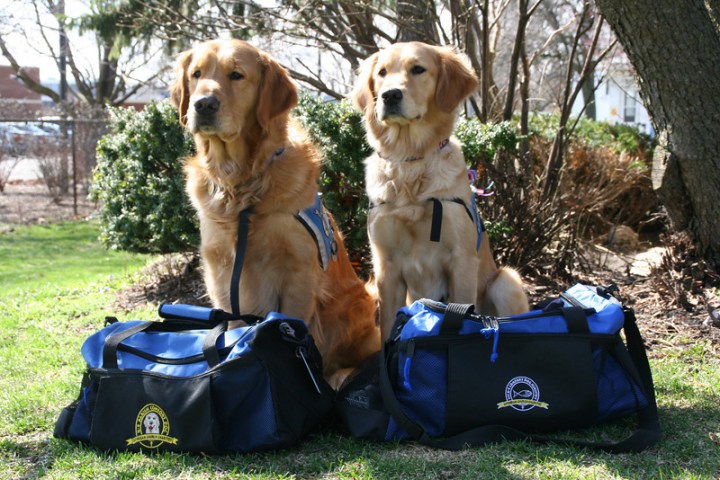
Luther and Ruthie are two comfort dogs provided by Lutheran Church Charities
Golden Retrievers trained as comfort dogs have arrived in Boston to help with the traumatised survivors of the Boston Marathon bombings.
Just as they did in Newtown, Connecticut last year, the dogs and their handlers will visit with survivors and their families to engage them in conversation, to give them a hug and a cuddle and to provide comfort.
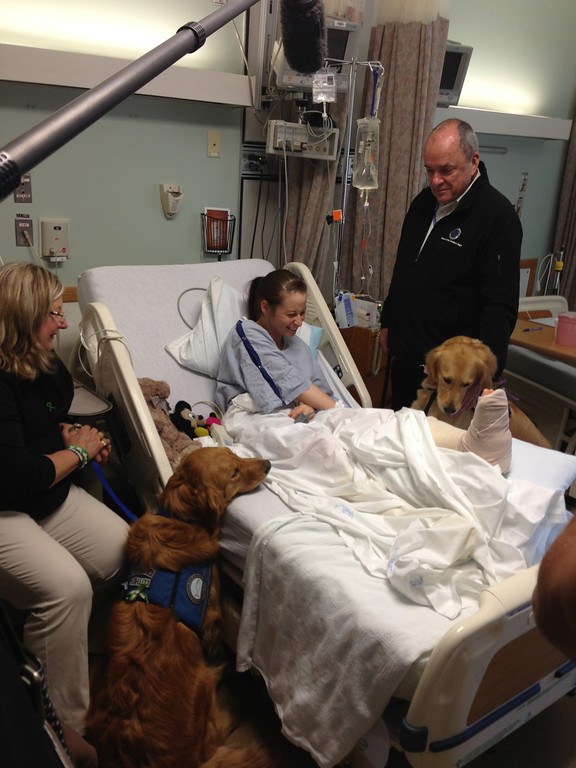
Luther and Ruthie visit with a survivor before surgery for a leg injury (courtesy Lutheran Church Charities)
The comfort dogs show us (again) the special skills that dogs have to provide solace and they also prove that dogs can be socialised and trained to enter public places without causing problems. The volunteers from Lutheran Church Charities give of their time freely.
Thank you!

Posted in Dogs, special dogs and awards
Tagged bombings, Boston, Boston Marathon, golden retrievers, Luther, Lutheran Church Charities, newtown connecticut, Ruthie, volunteer
For all our friends and family in Boston, this Boston Terrier is for you – we are thinking of you and join you in your grief.








 DoggyMom.com