Dog hair blankets in Native America?

Mass spectrometry has been used to resolve a debate about the fibres used to weave Native American blankets.

The blankets have been known as ‘dog hair’ blankets because oral histories passed down by descendents of the Salish weavers, who were indigenous to the Pacific coast of North America, told of the blankets being woven from the hair of dogs who were specially bred for their fur.

copyright University of York Department of Archaeology

Researchers at the University of York‘s Departments of Biology, Archaeology and Chemistry analysed the protein composition of 25 textile samples from 11 different locations.  These textiles were housed in famous collections like the Smithsonian Institution and some came from the expeditions of Lewis and Clark (1803-1806) and Wilkes (1838-1842).

The researchers didn’t find any garments that were made of purely dog hair.

There was evidence of dog hair in a robe of fur and six textile samples, primarily in a blend with goat hair.  The researchers concluded that the dog fur was used to supplement goat hair as a bulking material.

They have published their findings in the journal Antiquity.

The public relations nightmare of unscooped poop

Every sector has an issue that, if not managed, becomes its downfall.  In the dog world, I think this issue is poo.  More specifically, it is poo that is not cleaned up.

A woman complained in our newspaper recently about the amount of dog poo that had not been picked up at a local dog park. I have been at our dog park and watched as dog owners conveniently ‘don’t see’ their dog do a poop.  Even less common (and perhaps something to do with kiwi culture?), are the other dog owners who see it but do not bring it to the dog owner’s attention.   I have found that most dog owners are embarrassed and very willing to clean up when the fact of the dog’s neglected poo is mentioned.

In Poole (UK), the local council has resorted to more overt tactics to get dog owners to recognise the errors of their ways.  They spray paint piles of poo green to highlight the scale of the problem.  It was reported that 200 piles of poo were found in one street alone.[1]  The painting campaign augmented other initiatives such as a crackdown by council officers in issuing fines.

In New Zealand, we have the benefit of a lower population density but that should not make us complacent about this problem.  Cities such as Auckland and Christchurch are actively encouraging infill housing and more urban development to stop urban sprawl.  Over time, people and dogs will be living much closer together.

We need to find ways to peacefully co-exist with one another; and leaving faeces for people to step in is not one of them.  There are also indications that dog waste contributes to water pollution through runoff.

Since August 2009 (when most supermarkets began charging for carry bags) free bags are harder to come by.  Our dog park has posted at least one plea for urgent bag donations.  However, is the lack of a plastic bag an adequate excuse for not cleaning up after your dog? 

There are plenty of other sources of bags and responsible dog owners always have a supply, even in the glove box of the car. Ask your non-dog-owning friends and co-workers to save bags for you.  Bread bags and produce bags work just as well as carry bags.  As a last resort, a roll of freezer bags will set you back a couple of dollars at the supermarket.  The last roll I purchased allowed me to pick up no less than 60 piles of poo!

It is very concerning to see the evidence of dog owners who are not cleaning up after their dog.  It gives all of us a bad name.  If your dog could talk, I wonder if they would say, “I poop.  You pick it up.  Any questions?”[2]


[1] BBC News, August 2010

[2] Puget Sound Starts Here campaign poster (Washington, USA)

Kathleen Crisley, specialist in dog massage, rehabilitation and nutrition/food therapy, The Balanced Dog, Christchurch, New Zealand

Dog intelligence

Most dog owners have an opinion about their dog’s intelligence.  I regularly hear comments like, “He’s so smart, he’s ahead of the rest of his obedience class” or “He’s not very bright, but we love him.”

 When I was working on my management qualification years ago, we were told to go home and ask our partner/flatmate about how they solved problems.  Ebony, my Labrador flatmate at the time, came up with these tips, which I thought were very intelligent:

  1. Remember that chasing your tail does not get you anywhere.  It also makes you dizzy and less able to focus on the task at hand.
  2. Eat regularly and often.  Problem solving is hard work and requires energy.
  3. Don’t underestimate the value of a nap.  A problem looks different after you’ve had a good sleep.
  4. If you stare at a problem long enough, it might move on its own.
  5. Don’t be afraid to ask for help.  Try looking cute.
  6. If looking cute doesn’t work, try whining.
  7. If whining fails, loud retching noises are guaranteed to get the attention of those around you.
  8. Some problems soften over time.  Burying them in the garden hastens this process.
  9. Some problems require more immediate attention.  An immediate problem, if left unattended, is likely to result in a much more smelly mess to be cleaned up later.

There are many published works on the subject of dog intelligence.  Over the years, I’ve read countless research studies into this subject.  There are many institutions involved in the research.  All projects have the goal of understanding how dogs think.

Professor Stanley Coren of the University of British Columbia has authored several books about dog intelligence.  He states that dogs have the intellectual capacity of a two-year old and can understand more than 150 words.[1]

Researchers at the Max Planck Institute for Evolutionary Anthropology have studied the ability of dogs to interpret human gestures.  When researchers hid food beneath one container in a group and pointed to the ‘right’ container, dogs consistently picked up on those cues better than even chimpanzees (a species widely studied because of the evolutionary link between apes and humans).

Earlier this year, a research team at the University of Otago reported on their study that showed that dogs could readily distinguish happy human sounds from sad or angry ones, suggesting an ability to understand human emotions.

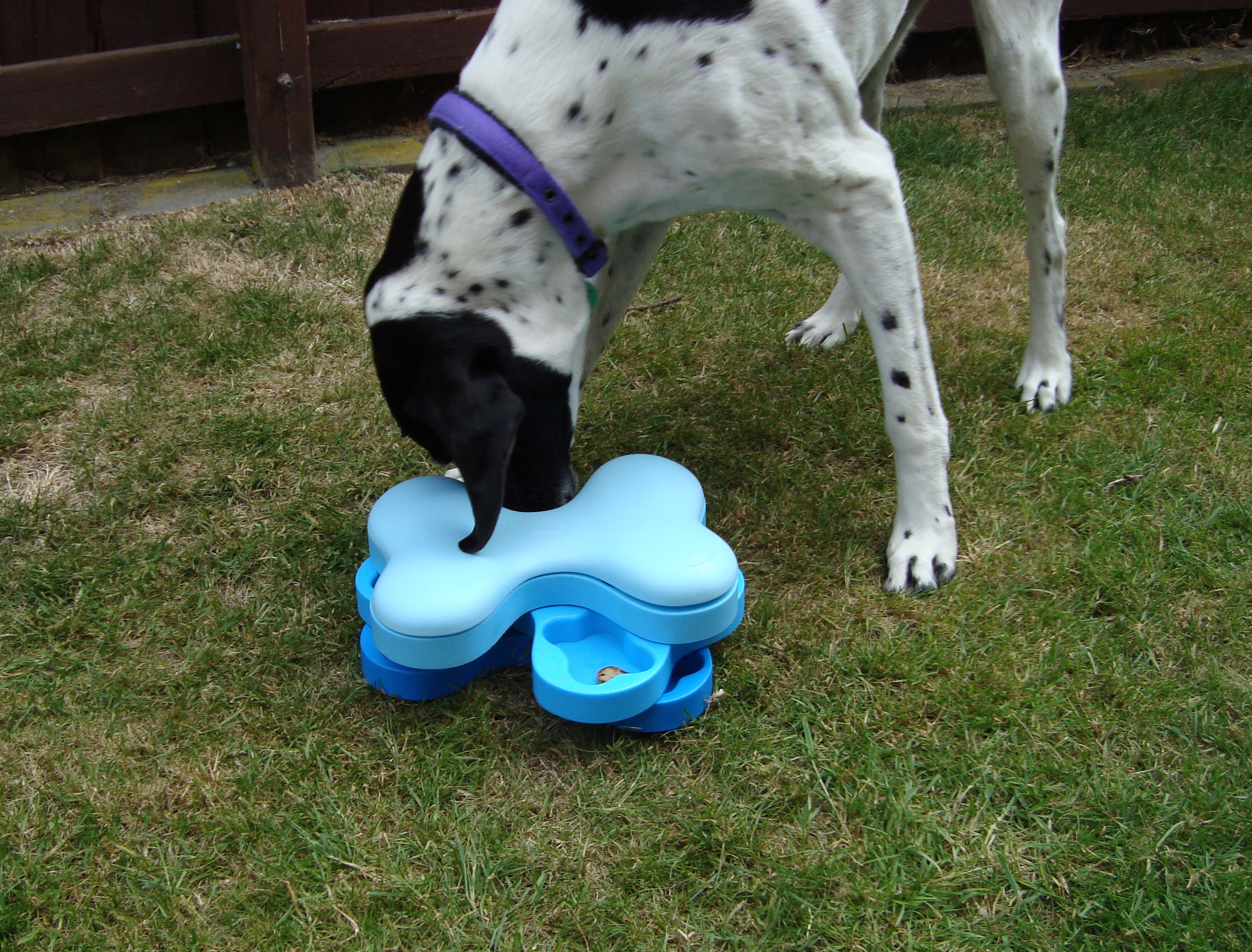
Even the dog toy market has recognised that dogs need mental stimulation.  The Nina Ottosson range, for example, offers a range of skill level toys designed to make your dog think about how to reveal their food reward.

Daisy demonstrates her intelligence with a Nina Ottosson toy

Despite all of this evidence, including videos of my Daisy using her interactive toys, many of the non-dog people in my life remain unconvinced about the intelligence of dogs.  I believe that persistence will pay off.  Over time we will see more and more research about the intellectual capacity of our dogs.  The non-believers will become believers.


[1] Science Daily, 10 August 2009

Doggy quote of the month for July

“A good dog is one of the best things of all to be.”

–  Dean Koontz, author

Of dogs, house dust and asthma…

This is a tale of how owning a dog can help protect your child from asthma.  Strange, but true.

Researcher Dr Kei Fujimura used mice to test the impact of house dust from homes where a dog lived and from those that didn’t.  She found (and her study was presented at a recent meeting of the American Society for Microbiology) that the dust from households with dogs seemed to have a beneficial effect.

Mice who were fed dust from these households developed an immune response to RSV(respiratory syncytial virus).  Infants who contract this virus have a marked increase in their risk of developing asthma.  RSV affects 90% of children worldwide.  That makes this study significant.

Dr Fujimura says these results support the hypothesis that exposure to animals in early childhood stimulates the immune system to resist the development of asthma and other allergies.

Another reason to introduce your children to the wonders of dog ownership at an early age!

Source:  Discovery News

The Lucky One

I’ve just finished reading The Lucky One by Nicholas Sparks.  What attracted me to the book was the fact that the story is predominantly set at a boarding kennel and that one of the main characters, Zeus, is a German Shepherd.  It helped that the book was previously on the New York Times Bestseller list and so others must have liked it too.

I hadn’t realised that Nicholas Sparks is a the author of novels like The Notebook and Nights in Rodanthe, which were successfully made into movies (I liked both movies).  As it turns out, The Lucky One has just been made into a film starring Zac Efron but it hasn’t shown here in New Zealand yet (more on that later).

This is a story of Logan, a veteran of the conflict in Iraq, who finds a photograph in the desert of a woman.  The photo goes unclaimed at the camp and so Logan keeps it and it becomes his good luck charm.  When he leaves the US Marines and returns to the United States, he goes on a quest to find the woman in the photo – with Zeus his loyal German Shepherd for company.

He finds Elizabeth, a divorced mother, living with her grandmother who runs a boarding  kennel.  He starts working there and through the book we learn about the original owner of the photo and the traumatic experiences that Logan endured during his time in Iraq.  We also learn about his best friend, Victor, who encouraged him to find the woman in the photo…

There’s some suspense at the end of the book (but I found this didn’t really live up to the marketing on the book’s cover).  I won’t tell you whether or not Logan and Elizabeth end up together, either.  I will say that this was a solid story and it’s pleasing to see a dog take up a major role in the book.  It’s worth a read.

And so back to the movie thing.  When I read the book, I definitely didn’t picture Zac Efron as Logan.  He’s too young and fresh-faced and lacks the solid build of a Marine – at least that’s my opinion.  I don’t think I’ll be going to see the film when it shows here – I liked the story but I didn’t love it.  (And I’m sorry if this offends the many Nicholas Sparks fans that are out there).

Finding dog friendly accommodation

Many sites operated by the major hotel and motel chains in the US are pet friendly – but many are not.    When planning a trip with your dog this (northern hemisphere) summer, there’s a site that can help you.  It’s called Pets Welcome.  This site has a search engine for finding dog friendly accommodation that fits with your trip’s itinerary.

Best of all, the site is not limited to the major chains.  Independent operators are also listed.  For example, during my recent trip to the Best Friends Animal Sanctuary, I stayed at the Treasure Trail Motel and they are included in the Pets Welcome directory.

There are lots of properties that are seeing the value in offering dog friendly accommodation.  Here’s a brief synopsis of the number of properties amongst the major chains:

Hotel/Motel Chain

Number of sites

 Candlewood Suites

100

 Clarion Inn and Suites

60

 Comfort Inn and Suites

550

 Comfort Inn

85

 Econolodge

380

 Extended Stay America

680

 Holiday Inn

450

 Holiday Inn Express

375

 La Quinta Inn and Suites

700

 Motel 6

1000+

 Quality Inn

300

 Red Roof Inn

360

Blue’s compromise

Last month, I wrote about Blue, an elderly Australian Cattle Dog who was facing an uncertain future in Elephant Butte, New Mexico.

This week, it was announced that the town officials had reached a compromise with Blue’s nominated owners (Blue was abandoned early in life and formed connections with some residents more than others).

Blue will be exempt from the city’s leash law, but his owners will need to keep him contained on their commercial property through the use of an electric fence.

Read more about Blue’s compromise here in the New York Times.

Fences for Fido

The animal welfare sector is comprised of many volunteer organisations.  One special one working in the Oregon and Washington area is Fences for Fido.

This volunteer effort has been working since 2009 to build fences for dogs so they can be released from their chains.  Chained dogs rarely have the quality of life of other pets and are vulnerable to aggression from other dogs who are able to roam into their territory and take advantage of the dog’s restrictions.  Studies show that dogs who are chained can respond in one of two ways:  they become aggressive or they become withdrawn and unresponsive.

More importantly, dogs who are chained are unlikely to have the same bonds and stable relationship with their owners/family.  Many are isolated and live a lonely existence and suffer from neglect.

Without prejudice, Fences for Fido assists these dog owners by building fenced sections on weekends.  Materials and time are all donated and there is also support for neutering/spaying and veterinary care when needed.   The group works to educate families about dog care during the extreme seasons of summer and winter.

This group also follows up with families that have received its assistance twice each year to ensure that the dogs remain unchained and in good condition.

Almost 300 dogs have been helped by Fences for Fido so far.

That’s a special group!

Here’s a video of their first-ever fence building project – for Chopper – in 2009:

No pets left behind – pet disaster planning in San Francisco

The City of San Francisco is providing leadership in the area of disaster planning for pets.  Following the disaster of Hurricane Katrina in 2005, when  pet owners were refused shelter if they brought their pets with them, the Pets Evacuation and Transportation Standards Act of 2006 made federal funding available for authorities to plan to help companion animals that are affected by disasters.

In San Francisco,  pet-disaster responders will have authorised training and they will use a network of 125 temporary shelters to evacuate animals.  Injured animals will be treated in a $300,000 mobile animal disaster medical command unit (funding for this is still pending).

Best of all, the city’s department of Animal Care and Control has a No Pets Left Behind policy.  Whenever a citizen is rescued, their pets will be rescued too.

For those of us who have lived through a major disaster like Christchurch’s 2010 and 2011 earthquakes, we know the importance of having supplies and an evacuation plan for your pets.  It’s also a challenge to get authorities coordinated to respond to animal welfare problems during major events.

Read more about San Francisco’s disaster planning in this New York Times article.

Kathleen Crisley, specialist in dog massage, rehabilitation and nutrition/food therapy, The Balanced Dog, Christchurch, New Zealand