“If there are no dogs in Heaven, then when I die I want to go where they went.”
– Will Rogers, actor and cowboy

“If there are no dogs in Heaven, then when I die I want to go where they went.”
– Will Rogers, actor and cowboy
Michael Vick is known for two things: NFL football and dog fighting.
Earlier this week, Michael Vick was named the Subway Sportsman of the Year at the Black Entertainment Television (BET) awards for his efforts as the quarterback for the Philadelphia Eagles. His performance was lauded as exceptional “after being off the field for 20 months.”
The win has sparked outrage amongst animal lovers and activists in the United States with a petition on Facebook to boycott the Subway restaurant chain (No Way Subway). There are those who say that, as sponsor of the award, the Subway corporation cannot influence the outcome of voting. Others with experience in the management of professional sport say that the restaurant chain’s management would have been told of the outcome of the voting regardless of the winner – giving them time to prepare publicity about it. Protestors say that this would have been an opportunity for Subway to distance themselves from the winner if they had wanted to.
This debate opens up wounds that are still fairly recent for most dog lovers. Michael Vick pleaded guilty for his actions that spanned the years 2001 – 2007 as a co-conspirator and financial backer of a dog fighting ring. That’s over 6 years of criminal behaviour and only 4 years later, he’s back playing NFL football, earning big bucks for it, and – now- public accolades.
Is it time to forgive Michael Vick?
The details behind the Vick dog fighting ring are not pretty. The pit bulls involved in the operation were terrorized to make them mean and angry. Dogs who were deemed to be unsuitable for fighting were cruelly killed. A 2009 article in the San Francisco Chronicle provides some of the ugly details of the ill-treatment of the dogs. For example, how the dogs were electrocuted by attaching jumper cables to their ears and throwing them into a swimming pool to struggle and die. The sides of the pool had telltale scratches and dents from the dogs as they fought to escape.
Is it time to forgive Michael Vick?
A big enabler of forgiveness is when an offender expresses regret for their actions and the consequences of them. Unfortunately, there is nothing on the record that shows that Michael Vick understood the cruel nature of some of his offending.
In his public statement after pleading guilty to a range of charges, Mr Vick acknowledges that he was ‘immature’ and how he let his fans down. Is this regret for the offending or regret for getting caught?
For more details of the case, read the plea agreement and statement of facts which I have also downloaded for you.
Michael Vick’s comeback to professional football has come comparatively soon compared to the years he spent offending. Is this right? Or is it the usual story of professional athletes getting put on a pedestal because of their prowess on the sports field? The official record on this case is that Michael Vick has paid his debt to society and is a free man to go about his profession as a professional football player.
Is it time to forgive Michael Vick? Only you can decide for yourself after weighing up the facts.
For the record: I’m not ready to forgive Michael Vick. He hasn’t shown he’s sorry and with the attention he is now getting for his football play, I doubt he ever will. I have to respect, however, that he is technically a free man. That doesn’t make me happy and I reserve the individual right to protest against any company or franchise that backs him. In my opinion, his lack of true remorse is equivalent to an endorsement of animal cruelty and dog fighting and organisations would do well by distancing themselves from such an individual. I’m not ready to forgive Michael Vick and I don’t want to see him endorsed by any awards programme.
Footnote: As part of the plea agreement, Michael Vick was required to establish a fund for the care and rehabilitation of the dogs found at his Bad Newz Kennels. Their story is told in a book which I highly recommend:
The Lost Dogs: Michael Vick’s Dogs and their Tale of Rescue and Redemption.

Kathleen Crisley, Fear-Free certified professional and specialist in dog massage, rehabilitation and nutrition/food therapy, The Balanced Dog, Christchurch, New Zealand
Posted in animal welfare
Tagged BET awards, cruelty, dog fighting, Facebook, Michael Vick, NFL, petitions, pit bulls, Sportsman of the Year, The Lost Dogs
Any columnist who begins an article with “It’s about time the dog got a little more respect” is bound to get my attention.
In this article Gareth Cook, a columnist with The Boston Globe, discusses the research of Brian Hare who compared the intelligence of dogs with chimpanzees and found that the dogs are more intelligent in many aspects.
The lesson: “To be smart, first play nice.”
Kathleen Crisley, Fear-Free certified professional and specialist in dog massage, rehabilitation and nutrition/food therapy, The Balanced Dog, Christchurch, New Zealand
Tagged Boston Globe, Brian Hare, chimpanzee, Gareth Cook, intelligence
VPI™ Pet Insurance is the largest insurer of pets in the United States. Each year, the company compiles statistics on the most common conditions that policy holders submit claims for.
The purpose of compiling this list is to show dog owners how some of the problems that their dog may have had in the past could be covered by pet insurance. It’s a marketing exercise, of course, but it is useful.
In 2010, the top ten conditions for dogs were:
1) Ear infection
2) Skin allergy
3) Skin allergy or hot spots
4) Gastritis/vomiting
5) Enteritis/diarrhoea
6) Arthritis
7) Bladder infection
8) Soft tissue trauma
9) Non-cancerous tumour
10) Hypothyroidism
Pet insurance is an individual choice and you need to consider your dog’s risk profile, your ability to pay premiums, weighed up against your ability to fund medical bills in the future and your preferences for types of medical or specialist care for your dog.
The best way to make a decision about purchasing insurance is to do your homework. Information such as this list put out by VPI can help inform your decision.
For my New Zealand readers, see my earlier blogs on coverage of massage/physiotherapy by New Zealand pet insurers.
Will my dog’s massage be covered by our insurance, Part I (Pet n Sur)
Will my dog’s massage be covered by our insurance, Part II (Petplan)
Will my dog’s massage be covered by our insurance, Part III (Ellenco)
Will my dog’s massage be covered by our insurance, Part IV (Petprotect)
Kathleen Crisley, specialist in dog massage, rehabilitation and nutrition/food therapy, The Balanced Dog, Christchurch, New Zealand
Posted in dog care
Tagged dog care, Ellenco, medical conditions, ownership, pet insurance, Pet-N-Sur, Petplan, Petprotect, VPI insurance, VPI pet insurance
 Among a growing number of dog-friendly accommodation options in the US, the Inn by the Sea sets itself apart by offering dog-friendly accommodation combined with support of locally made dog products.
When you book their Inncredible Pets package you and your dog receive:
This package currently starts at US$472.21 per night for a garden suite (higher rates for a spa suite or at peak times).
The Inn is located on popular Crescent Beach which does not allow dogs in the summer months of April – October. Inn staff can advise you on beaches that allow dogs during these times.
Kathleen Crisley, Fear-Free certified professional and specialist in dog massage, rehabilitation and nutrition/food therapy, The Balanced Dog, Christchurch, New Zealand
As a dog owner as well as a canine massage therapist, I can honestly say that one of the most important things you can do for your dog is to have a good veterinarian. However, many people I have met through my practice seem to move from vet practice to vet practice – never really giving a vet the chance to get to know their dog.
Of course, sometimes the moving around can’t be helped – people change jobs or other circumstances happen that require them to move house and location. However, in other cases, it seems the owner is looking for the ‘best deal’ in a consultation fee or they have had a bad experience with an office (not necessarily the vet) and don’t want to return there.
So, here’s my advice on finding a good (and possibly great) veterinarian:
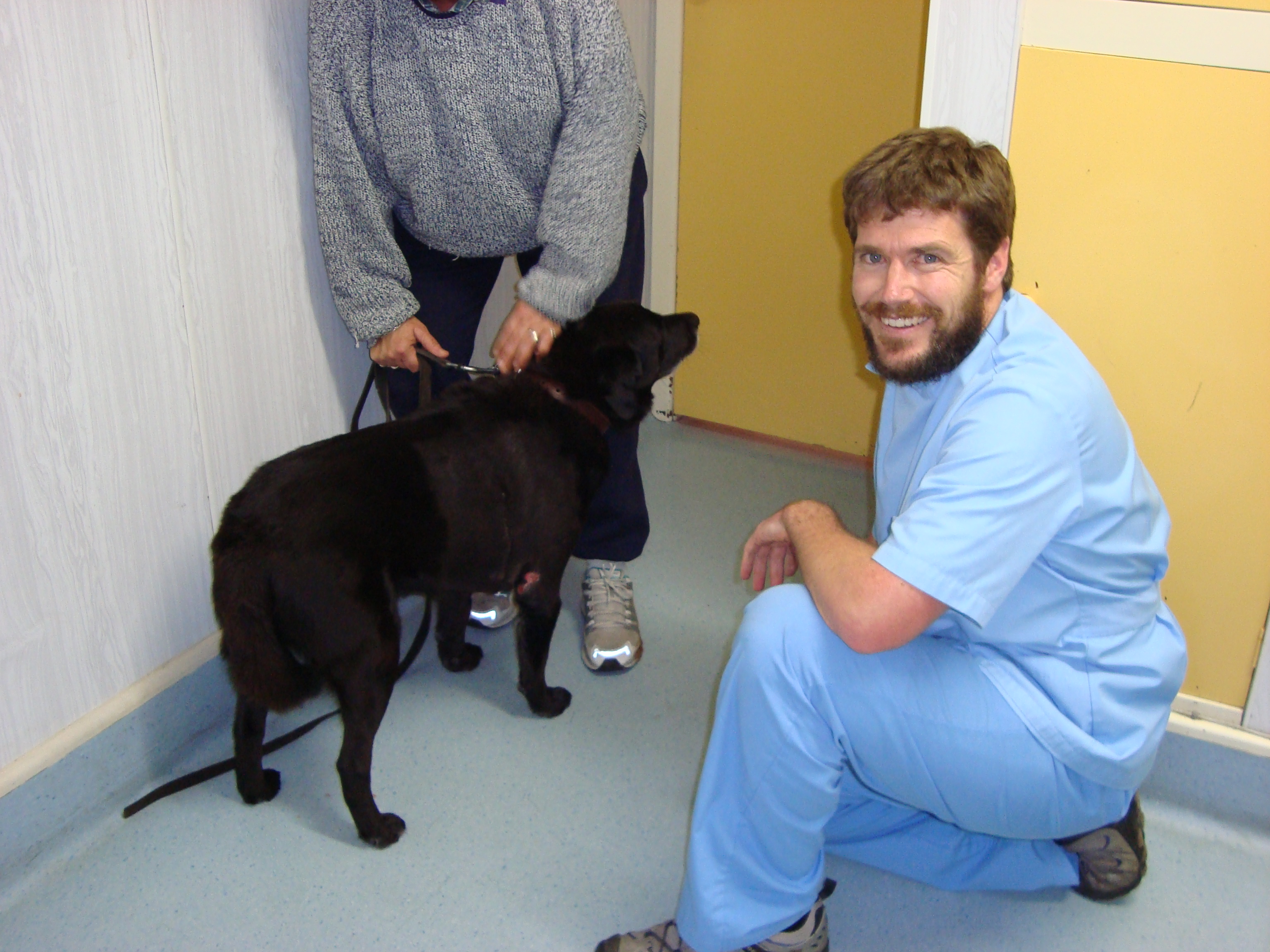
Dr Tim Nottage of Merivale-Papanui Veterinary Clinic with a happy client
Finally, if you have been using a veterinary practice for some time but have become concerned that the treatment and level of care/attention is no longer up to par – I advise you to raise it with the veterinarian. All businesses need feedback. For example, I had one client who felt that the changes in staff at her local veterinary practice meant that the standard of care had gone down. The nurses were all new, young, and inexperienced. She still liked the vet, however. A short discussion to share her concerns didn’t solve the problem overnight, but it started the vet thinking that the staff needed more training particularly in the area of customer service. My client’s next experience at the office improved and she didn’t have to go in search of another vet.
Kathleen Crisley, Fear-Free certified professional and specialist in dog massage, rehabilitation and nutrition/food therapy, The Balanced Dog, Christchurch, New Zealand
The New Zealand Government has chosen a digital cartoon dog, Seymour, as its mascot in the Going Digital campaign.

Seymour of the Going Digital campaign
Like many other countries, New Zealand will transition to only digital television starting next year. This change affects many people who have older style televisions and who do not currently use digital reception devices such as those provided by Freeview and Sky TV.
Seymour is a cute little black and white dog. You can view his commercials on the Going Digital website.
Kathleen Crisley, Fear-Free certified professional and specialist in dog massage, rehabilitation and nutrition/food therapy, The Balanced Dog, Christchurch, New Zealand
Posted in dogs in advertising
Tagged campaign, Freeview, Going Digital, NZ Government, Seymour, Sky TV
The Foundation for Biomedical Research, located in Washington DC, estimates that there are 60,000 dogs in research facilities in the United States. (The Foundation advocates for ethical treatment of animals used in research.)
The beagle is commonly chosen as a research subject because of its size and temperament.
Unfortunately for the dogs involved in research, most facilities do not re-home the dogs after their ‘useful’ period has passed. Most are euthanised. One reason for this is that the facilities who conduct research involving dogs do not wish to be identified, for fear that they are targeted by activists who publicise their use of the dogs. In extreme cases, activists have been known to break into the facilities to release the dogs.
Some animal welfare agencies work behind the scenes to find ways to receive these dogs and find them new homes, also protecting the anonymity of the laboratories so they are encouraged to re-home more dogs in the future. The San Francisco Chronicle ran a story last week of one such re-homing effort involving nine beagles.
Re-homing an ex-laboratory dog is not always easy. Most of these dogs have never been outside and have never been housebroken because they spend their lives in a crate or cage. In the cases of these beagles, they were also de-barked (vocal chords were intentionally cut) to reduce noise in the laboratory.
The June re-homing exercise was the second for the Beagle Freedom Project, which mounted this wonderful video on YouTube of the rescue:
In future blog postings, I will provide some more information about dogs used in research and the points of view about whether or not the experimentation on them is essential. This is a major animal welfare issue and one that will not go away quickly as the world seeks to develop new treatments for human diseases and disorders.
Kathleen Crisley, Fear-Free certified professional and specialist in dog massage, rehabilitation and nutrition/food therapy, The Balanced Dog, Christchurch, New Zealand
Carrie is a Golden Retriever from Chile. Her owner, Jose Fuentes, has taught her to merengue with him. Thanks to the Internet, the pair has developed a reputation, appearing on television shows like The Late Show with David Letterman.
There has even been a petition, of sorts, to get Carrie and Jose onto Dancing with the Stars as a guest act!
Here are a few videos of Carrie, thanks to the power of You Tube.
Kathleen Crisley, Fear-Free certified professional and specialist in dog massage, rehabilitation and nutrition/food therapy, The Balanced Dog, Christchurch, New Zealand
Posted in Humor/humour
Tagged Carrie, Dancing with the Stars, David Letterman, Golden Retriever, Jose Fuentes, merengue, You Tube
The Peach Theatre Company in cooperation with radio station More FM and Purina are looking for a dog to play Toto in the upcoming production of the Wizard of Oz which will be performed in Auckland this September.
The producers are open-minded and will consider dogs other than the Cairn Terrier, who featured as the original Toto in the film. If you think your dog has star quality, then fill out the entry form here.
Kathleen Crisley, Fear-Free certified professional and specialist in dog massage, rehabilitation and nutrition/food therapy, The Balanced Dog, Christchurch, New Zealand
Posted in Dogs
Tagged Cairn Terrier, More FM, Peach Theatre Company, Purina, Toto, Wizard of Oz







 DoggyMom.com