Category Archives: Dogs

The 353rd UK soldier to die in Afghanistan

His name was Conrad Lewis and he died on 9  February 2011 from a sniper’s bullet.

On 1 December, his family welcomed a special dog out of quarantine – Peg. Peg, (short for Pegasus), was a stray adopted by Paratrooper Lewis only weeks before his death.

You can read Peg’s story here, in the Leamington Observer.

Doggy quote of the month for December

Thanks to the great people at German Shepherd Rescue of New England, here’s some food for thought this Christmas – a different version of the Twas the Night Before Christmas – by Stacey Vincent.

Twas the night before Christmas and all through the house
Not a creature was stirring, not even a mouse.
The stockings were hung by the chimney with care
In hopes that St. Nicholas soon would be there.

               The children were nestled all snug in their beds
With no thought of the dog filling their head.
And ma in her kerchief, and I in my cap,
Knew he was cold but didn’t care about that.
    

When out on the lawn there arose such a clatter,
I sprang from the bed to see what was the matter.
Away to the window I flew like a flash,
Figuring he was free of his chain and into the trash.

 The moon on the crest of the new fallen snow
Gave the luster of mid-day to objects below.
When, what to my wondering eyes should appear,
But Santa Claus – and his eyes full of tears.

He unchained the dog once so lively and quick,
Last year’s Christmas present, now painfully thin and sick.
More rapid than eagles he called the dog’s name.
And the dog ran to him, despite all his pain.

Now DANCER!

        Now PRANCER and VIXEN!!
On COMET!

     On CUPID!

        On DONER and BLITZEN!!

                       To the top of the porch!  To the top of the wall!

                       Let’s find this dog a home where he’s loved by all

 I knew in an instant there would be no gifts this year
For Santa Claus had made one thing quite clear …

   The gift of a dog is not just for a season.
We had gotten the pup for all the wrong reasons.

In our haste to think of the kids a gift
There was one important thing that we missed.

    A dog should be family and cared for the same.
You don’t give a gift then put it on a chain.

And I heard him exclaim as he rode out of sight,
“You weren’t given a gift!  You were given a life!”

Your dog, personal trainer

I just had to share this poster which I purchased from SPARC (Sport and Recreation.  It sums up one of the great benefits of dog ownership:  more exercise.

It has been said “If your dog is overweight than you are not getting enough exercise.”  Dogs need daily exercise and, in my case, I walk with Daisy twice per day.  Walking is excellent weight-bearing exercise, which helps keep bones strong which is a particular concern of many women as they age and are at risk of osteoporosis.

Get out there with your dog today and enjoy some quality time and exercise too!

Top 5 detection jobs for dogs

The American Kennel Club has marked the importance of working dogs by naming the top 5 detection jobs which are performed by dogs.  These jobs are:

  1. Bed bug sniffing  (best performed by breeds such as Beagles, Labrador Retrievers and Belgian Malinois)
  2. Search and rescue  – tracking missing persons, disaster rescue, etc.  (many mixed breeds perform well in this category – just ask the NZ USAR team!)  Also performed by Bloodhounds, Labrador and Golden Retrievers and German Shepherds
  3. Explosives detection (the AKC says that Belgian Malinois, German Shepherds and Vizsla do well in this category)
  4. Cancer detection (Labrador Retrievers – again!)
  5. Allergy alert dogs (Poodles, Portuguese Water Dog and Golden Retrievers seem suited to this work)

Wouldn’t it be nice to see more of these working dogs in use in New Zealand?  (See my previous article on Deak Helton’s research – September 2011)

Forty rescued lab beagles on their way to a better life

Read more here:

Forty Rescued Lab Beagles Have Much to Be Thankful For.

North America’s most pet-friendly airlines

As most of you know, I’m a big supporter of traveling with your dog when on holiday/vacation and I encourage you to support pet-friendly shops and accommodation providers in your area.

Petfinder.com recently released its findings for 2011’s most pet-friendly airlines.  This year, the site extended its coverage to Canada so it is now ranking airlines that service North America.

Petfinder reviewed airlines in the following categories:

  • what airline is most pet-friendly overall

Winner:  Pet Airways – a dedicated airline for transporting pets

  • offers the best amenities for pets and their parents

Winner:  JetBlue – for the 2nd year in a row.  JetBlue provides travelers with a pet carrier baggage tag, a travel “petiquette” guide, 300 TrueBlue points each way, and a comprehensive e-booklet with pet-friendly hotels, restaurants, parks and animal hospitals in some of JetBlue’s major cities.

  • best in offering transport to a variety of pets

Winner:   Frontier Airlines because they allow dogs, cats, rabbits, guinea pigs, hamsters and small birds in the cabin

  • best for flying multiple pets in the cabin

Winner:  Frontier Airlines, which allows up to 10 pet containers on each flight. Only one pet container is allowed per person, but the limit per flight means that multiple friends/relatives can travel with animals so the entire family arrives at its destination together

  • best service for large sized pets

Winner:  Pet Airways, the maximum height for a pet carried by the airline is 34 inches.  This allows for large sized breeds like Newfoundlands and Great Danes to fly.

All pet-friendly airlines which made the ranking were required to have zero pet deaths in the past reported year according to official government reports.

Cruciate ligament injuries in dogs

The knee joint can be vulnerable to injury in dogs just as it is in people because the bones are attached through soft tissues known as ligaments.   I received a call a couple of weeks ago from a friend saying, “Kathleen, I was at the dog park with Lea and she cried out and pulled up lame.  She won’t bear weight on it.  What do you think is wrong?”

Since I’m not a vet, I’m not qualified to diagnose injuries but this particular one sounded to me like a ‘classic’ cruciate ligament tear or rupture.   My friend didn’t want to pay after-hours vet prices on the weekend if he didn’t have to but equally didn’t want to wait to see a vet if her condition was serious or life-threatening.

I suggested that he rest Lea, keep her warm, dry and comfortable and go to the vet if there was an immediate change in her condition.   Otherwise, if she still wasn’t weight-bearing on Monday, then a visit to their regular vet was warranted.

As it turned out, Lea’s condition didn’t change over the weekend and a visit to the vet confirmed a cruciate ligament tear.  She’s now resting in the hope that the tear will heal itself.

In many cases, cruciate ligament injuries are partial tears and surgery isn’t required.  In others, full rupture of the ligament may mean that surgical repair is required.  Some dogs still need ongoing support for their legs regardless of whether the ligament was repaired surgically or not.   Leg braces that are made from a cast of the dog’s leg work well in many cases.

I work on dogs with these injuries in my canine massage practice.  Laser therapy helps to relieve the pain of the injury and support healing.  Passive range of motion exercises assist in keeping the leg joints mobile, but without pressure on the knee joint.  And hydrotherapy works wonders when the dog is ready for this type of more strenuous (but non-weight bearing) exercise!

Here’s a great video, courtesy of the folks at Vetstoria and YouTube about the symptoms and diagnosis of cruciate ligament ruptures.

Learn dog trivia and feed homeless dogs at the same time

Freekibble.com is another site that uses the internet to help dogs.

Every visitor to the site is asked to answer a Bow Wow trivia question and, as part of that process, you donate 10 pieces of kibble to homeless dogs.   The food is provided by principal sponsor Halo dog food.

The site will tell you whether or not you have answered the question correctly and you can also check on the statistics about the previous day’s answers.  Over 6.5 million meals have been provided to homeless cats and dogs through the Freekibble programme and the count is rising!

You can also request to receive a daily email reminder to ensure that you click on the site every day.

May I pet your dog?

I love walking Daisy in our neighbourhood and taking her to local parks, particularly our dog parks.  And what I really appreciate is when a child or adult approaches us and asks, “May I pet your dog?”

I always praise a child who asks me before touching Daisy, “Thanks for asking and yes – she’s very friendly.”  Teaching children how to approach a dog is a very important life skill.  A dog who isn’t friendly, or who has sore spots, may bite someone who touches it.  In addition, a child is on eye-level with a dog and so they can inadvertently challenge the dog with direct eye contact and – in the dog’s view – a too aggressive approach.

Daisy loves being petted anywhere on her body but,  generally, it is useful to teach children to pet a dog over its shoulder area and then with long, slow strokes down the body.  An approach to the head (at least initially) can be too much for some dogs.

Other key points:

#1 – Allow the dog to approach you, not the other way around.  Stand still and look down (away from the dog) which is less challenging to the dog. Let your hands fall loosely to the sides of your body with open palms and relaxed fingers.

#2 –  Let the dog sniff you.  This is its way of taking in information about you (remember that a dog has 250 million scent receptors in its nose and it can take in scents from a greater distance than we can).

#3 – Don’t reach for the dog or bend over it.  These motions are too aggressive for most dogs and even reserved or shy dogs may react.

#4 Respect the dog’s wishes if it doesn’t approach to interact with you or your child or shows signs of stress.

#5 For small dog owners, I generally advise  against holding your dog in your lap.  The dog will naturally have more of a protective instinct in this position, guarding you against harm, and feeling also that it is ‘trapped’ if it doesn’t like the person that is approaching.

#6  Watch the mouth!  A dog who licks its lips, pants a lot or yawns a lot is showing signs of discomfort.

#7  If your dog is going to have small children in its life, you can de-sensitise it by getting it used to having its ears, face and tail touched.  Regardless of how much we train people to avoid these areas with ‘strange’ dogs, these are naturally parts of the dog’s body that people are attracted to.

#8  Be prepared to accept a ‘no’ answer from the dog’s owner.  The owner knows their dog the best and there may be reasons for their refusal – some dog owners are more willing to share these reasons with others as part of saying no, others not.

If you have a child in your life that is simply dog-crazy, then here’s a picture book that will teach them the essential skills in approaching a new dog.  It’s May I Pet Your Dog?  The How-To Guide for Kids Meeting Dogs (and Dogs Meeting Kids) by Stephanie Calmenson.  Another book to add to your Christmas shopping list!
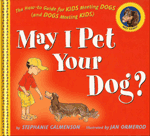
Using Harry the Dachshund, this book shows your child the ‘right’ way to approach a dog.

In Defence of Dogs

John Bradshaw, in his book In Defence of Dogs, explains that most dogs today live in urban environments where they are “expected to be simultaneously better behaved than the average human child and as self-reliant as an adult.”  Yet, many dogs still retain their natural traits such as herding instinct which are viewed as ‘problematic.’

Add on top of this the popularity of dog trainers who insist on the theory of dominance, and Mr Bradshaw says that our dogs are in crisis and need our support.

Mr Bradshaw’s book is about breaking down misconceptions.  He says in his Introduction, “We must strive to better understand their needs and their nature if their niche in human society is not to diminish.”

Mr Bradshaw is a passionate supporter of dogs and his book demonstrates his beliefs clearly.   If you are a dog owner who is concerned about the increasing restrictions on dogs in our modern, living environments or you are simply open-minded enough to explore other ways of looking at canine behaviour,  then this book is for you!