Are Christmas and your dog compatible?
Kathleen Crisley, specialist in dog massage, rehabilitation and nutrition/food therapy, Canine Catering Ltd, Christchurch, New Zealand

Are Christmas and your dog compatible?
Kathleen Crisley, specialist in dog massage, rehabilitation and nutrition/food therapy, Canine Catering Ltd, Christchurch, New Zealand
“The more I see of men, the more I admire dogs.”
– Madame Roland (also known as Marie-Jeanne “Manon” Philipon), 1754-1793, French political figure during the French Revolution
Meet the special dogs guarding The White House in Washington DC…

Secret Service K-9 Hurricane – black Belgian Malinois, left, and Jordan – black/tan Belgian Malinois. (Courtesy of U.S. Secret Service)
Secret Service guard dogs are in spotlight after latest White House fence jumping
Posted in special dogs and awards
Tagged belgian malinois, dogs, Secret Service, Washington DC, White, White House
Nearly one out of four dogs will develop cancer in their lifetime and 20 per cent of those will be lymphoma cases.
A team of researchers from the University of Leicester has helped Avacta Animal Health Ltd to develop a new user-friendly electronic system for diagnosing lymphoma in dogs in the early stages, and for remission monitoring.
Marketed as cLBT (canine lymphoma blood test), this is the first test of its kind to track the remission monitoring status of a dog after undergoing chemotherapy.
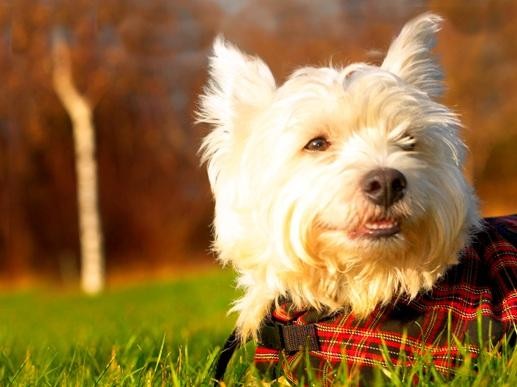
Photo by Avacta Animal Health Ltd
Led by Professor Alexander Gorban from the University’s Department of Mathematics, the University team together with experts from Avacta elaborated technology for differential diagnosis of canine lymphoma and for remission monitoring.
This technology is based on the cLBT, which detects the levels of two biomarkers, the acute phase proteins C-Reactive Protein and Haptoglobin.
The paper ‘Computational diagnosis and risk evaluation for canine Lymphoma’ by E.M. Mirkes, I. Alexandrakis, K. Slater, R. Tuli and A.N. Gorban has been published in the academic journal Computers for Biology and Medicine and is available at the following location: http://dx.doi.org/10.1016/j.compbiomed.2014.08.006
“Like many other much-loved humans, they believed that they owned their dogs, instead of realizing their dogs owned them.”
– Dodie Smith, English novelist and author of The Hundred and One Dalmatians

If you live in my local area of Christchurch (New Zealand), you are probably as worn out as I am about hearing about “The Rebuild” and “The New Central City.” It’s been especially frustrating for those of us who want to see a dog-friendly city because our needs are not being met.
So here’s one idea for the rebuilt Cathedral Square in central Christchurch.
A fountain for all to enjoy (but especially dogs!)
Kathleen Crisley, specialist in dog massage, rehabilitation and nutrition/food therapy, Canine Catering Ltd, Christchurch, New Zealand
I was never a fan of Joan Rivers. Her sense of humor was always a bit too course for my liking and, in her recent years as a fashion critic, I found many of her comments to be septic and often downright rude.
Nonetheless, I sympathize with her family, friends and fans at her loss.
There is, however, one very positive thing I can say about Joan Rivers. She loved dogs. This goes to show that we may have common ground with people who, on the face of it, we dislike. Anyone who loves dogs cannot be all bad; perhaps this fact alone will remind us to keep an open mind…
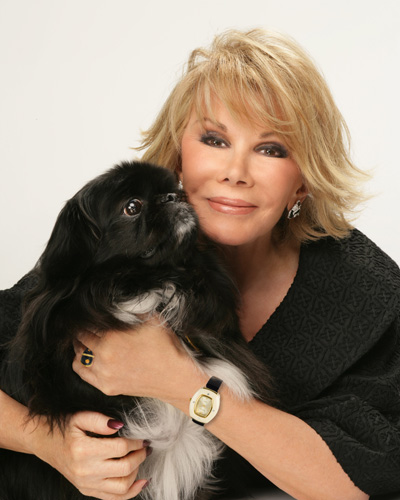
Joan Rivers and her dog, Max, who passed away earlier this year
(Photo by Chicago Now)
“Dogs are easier to love than people; they’re certainly more dependable,” Rivers once said in an interview with Chicago Now. “Once they love you, that’s it. A true friend in life is a dog.”
In her last known interview conducted in July of this year, Rivers spoke about her darker moments when, after the death of her husband in 1987 and a career that had bottomed-out, she contemplated suicide. Her dog stopped her:
What saved me was my dog jumped into my lap. I thought, “No one will take care of him.” It wasn’t a friendly dog — only to me. I adored this dog. He was theoretically a Yorkie, his mother cheated. His name was Spike. He was the way you want your dog to be, devoted only to you. I was sitting in this big empty house in Bel Air, with a phone with five extensions which we no longer needed. I had the gun in my lap, and the dog sat on the gun.

An earlier photo of Ms Rivers with her dogs (photo originally from Architectural Digest)
Rest in piece, Ms Rivers. I hope all of your dogs were there to meet you when you crossed the Rainbow Bridge.
Kathleen Crisley, specialist in dog massage, rehabilitation and nutrition/food therapy, Canine Catering Ltd, Christchurch, New Zealand
Posted in dog quotes, Dogs
Tagged Architectural Digest, Chicago Now, dogs, Joan Rivers, Max, Rainbow Bridge, suicide
Here’s more research that backs up my position on dogs and the Christchurch rebuild. Hopefully the CCDU and CERA will take note…
A study from the University of Liverpool has recommended investing in dog owner education and facilities as a strategy to target physical inactivity and problems such as obesity in both people and their pets.
The research team reviewed scientific papers published since 1990 (31 studies from the UK, USA, Australia and Japan) and found that access to dog-friendly walking environments and better education about dogs’ physical needs could all motivate people to get out and take more exercise with their pets.
An exercised dog is a healthy one, less likely to be obese, and who is less likely to develop behavioural problems like aggression and excessive barking.
Among the most common findings of all studies was that dog owners have a varied understanding of how much exercise their dog needs. This affected how much they took their dog for a walk; something that could be addressed with education programs.
People without access to high quality local areas that support dog walking, for example parks where dogs are allowed off-leash and poo-disposal facilities are provided, were less likely to walk with their dog and missed out on the associated health benefits.
“There are a large number of reasons why people do or don’t walk their dog and it is worth considering how we can address this when designing strategies for reducing obesity, or when planning urban areas and public open space. Not being able to let their dog off the leash is a particular put-off,” said Dr Carri Westgarth, co-author of the study.

Study authors Dr Carri Westgarth and Dr Hayley Christian take an off-lead walk (photo courtesy of University of Liverpool)
“The study also found that some people are worried about their dogs’ behaviour and may be less likely to take it out to the park – potentially out of embarrassment or worry about how it might act – but lack of walks may also be causing this bad behaviour, due to boredom, frustration or lack of socialisation.”
When I submitted to the CCDU in November 2012, I made the point that by having greater accessibility, owners have more opportunity to take dogs out – and that increases opportunity not only for exercise but also socialisation. We want good ownership to be more visible in our communities – thus making it the norm. Poor ownership would also be more visible – and subject to peer pressure combined with enforcement approaches.
Let’s have a dog-friendly central city with walking accessibility from one end to the other!
Kathleen Crisley, specialist in dog massage, rehabilitation and nutrition/food therapy, Canine Catering Ltd, Christchurch, New Zealand
Source: University of Liverpool media release
California’s Governor Jerry Brown has signed into law Assembly Bill 1965. The law will take effect on 1 January 2015 and will officially remove a ban on pets in restaurants.
For restaurants who want to allow dogs in their outdoor dining areas, the law officially allows them to do so. (Technically, restaurants that have allowed dogs in patio and other outdoor areas were breaking the law.)
This lead to inconsistent enforcement across the State.

Gary Ellis, left, and his dog Wilco, a Saluki, enjoy dinner at Zazie restaurant in San Francisco. Photo: Brant Ward, San Francisco Chronicle
“Amidst all the horrific and depressing news around us, I hope this bill helps make people a little happier, and businesses who wish to accommodate diners with dogs safe from being unnecessarily cited,” said assembly member Mariko Yamada, who championed the bill, on her Facebook page.
To comply, a restaurant must have an outdoor entrance that doesn’t require the pet to walk through the restaurant to get to the outdoor area and pets are not allowed in areas of food preparation.
“It will soon be legal to take your beagle with you to dinner,” Yamada said. “I wish everyone ‘bone-appétit’.”
New data from Dognition shows that female dogs tend to be more flexible navigators than males. This is the opposite of trends in humans, and gives us important insight into how dogs see the world.
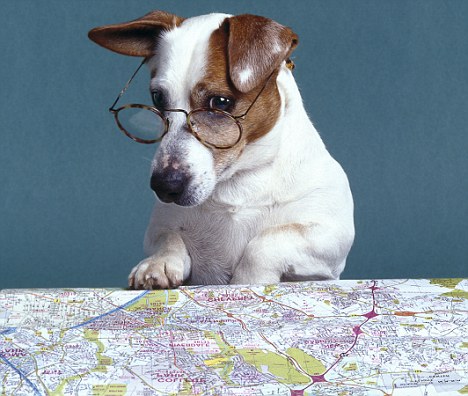
In the navigation game, part of the monthly Dognition subscription, owners hid food inside two bowls, and taught their dog that the treat was always on one side, for example always on the left. Then the owner brought their dog around to the opposite side and recorded which bowl their dog chose.
Female dogs were more likely to use an allocentric, or a landmark based strategy. They used objects in the room to figure out which bowl to choose. For instance, in the beginning, perhaps the bowl with the treats was near a door, or a lamp. When the females were brought around to the opposite side, they still looked for those landmarks, which means no matter which way they were oriented, they would always go back to the bowl they learned was ‘correct’ in the beginning.
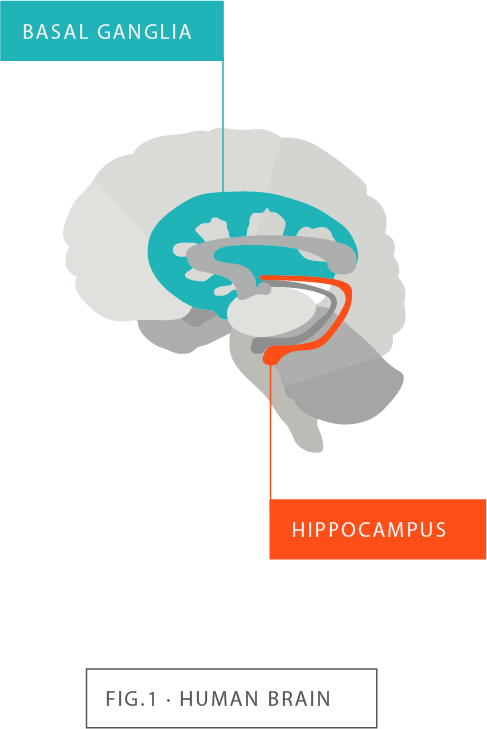
In people, this is called forming a mental map, or using a ‘bird’s eye’ view. Using allocentric navigation means the dogs were mostly relying on their hippocampus, a part of the brain that mediates spatial awareness and memory. This strategy is particularly effective in large and unfamiliar environments, and is the more flexible of the two strategies. Not surprisingly, humans who rely on environmental navigation are good at reading maps.
Male dogs were more likely to be egocentric navigators. They learned the association by thinking ‘the treat is on my right’. When owners brought the dogs around to the opposite side, these dogs chose the bowl on their right, which was the opposite bowl that they had chosen before. By using this strategy, the dogs were mostly relying on their basal ganglia, a part of the brain that mediates motor skills.
Before there were maps or navigational instruments, Pacific islanders used egocentric navigation for long sea voyages. They used the position of the stars in relation to themselves, (e.g. to get to this island, the Milky Way should be on my right). People who rely on egocentric navigation tend to make good cinematographers – they have a special talent for allowing others to see the world as they do.
The results are exactly the opposite as in humans, where men are usually allocentric navigators and women are egocentric navigators. Perhaps male dogs just need to get better at asking for directions.
Source: Dognition news
Posted in research
Tagged allocentric navigation, Dognition, dogs, egocentric navigation, female dogs, male dogs, map reading, navigation, navigators