Author Archives: DoggyMom.com

Finding dog friendly accommodation

Many sites operated by the major hotel and motel chains in the US are pet friendly – but many are not.    When planning a trip with your dog this (northern hemisphere) summer, there’s a site that can help you.  It’s called Pets Welcome.  This site has a search engine for finding dog friendly accommodation that fits with your trip’s itinerary.

Best of all, the site is not limited to the major chains.  Independent operators are also listed.  For example, during my recent trip to the Best Friends Animal Sanctuary, I stayed at the Treasure Trail Motel and they are included in the Pets Welcome directory.

There are lots of properties that are seeing the value in offering dog friendly accommodation.  Here’s a brief synopsis of the number of properties amongst the major chains:

Hotel/Motel Chain

Number of sites

 Candlewood Suites

100

 Clarion Inn and Suites

60

 Comfort Inn and Suites

550

 Comfort Inn

85

 Econolodge

380

 Extended Stay America

680

 Holiday Inn

450

 Holiday Inn Express

375

 La Quinta Inn and Suites

700

 Motel 6

1000+

 Quality Inn

300

 Red Roof Inn

360

Blue’s compromise

Last month, I wrote about Blue, an elderly Australian Cattle Dog who was facing an uncertain future in Elephant Butte, New Mexico.

This week, it was announced that the town officials had reached a compromise with Blue’s nominated owners (Blue was abandoned early in life and formed connections with some residents more than others).

Blue will be exempt from the city’s leash law, but his owners will need to keep him contained on their commercial property through the use of an electric fence.

Read more about Blue’s compromise here in the New York Times.

Fences for Fido

The animal welfare sector is comprised of many volunteer organisations.  One special one working in the Oregon and Washington area is Fences for Fido.

This volunteer effort has been working since 2009 to build fences for dogs so they can be released from their chains.  Chained dogs rarely have the quality of life of other pets and are vulnerable to aggression from other dogs who are able to roam into their territory and take advantage of the dog’s restrictions.  Studies show that dogs who are chained can respond in one of two ways:  they become aggressive or they become withdrawn and unresponsive.

More importantly, dogs who are chained are unlikely to have the same bonds and stable relationship with their owners/family.  Many are isolated and live a lonely existence and suffer from neglect.

Without prejudice, Fences for Fido assists these dog owners by building fenced sections on weekends.  Materials and time are all donated and there is also support for neutering/spaying and veterinary care when needed.   The group works to educate families about dog care during the extreme seasons of summer and winter.

This group also follows up with families that have received its assistance twice each year to ensure that the dogs remain unchained and in good condition.

Almost 300 dogs have been helped by Fences for Fido so far.

That’s a special group!

Here’s a video of their first-ever fence building project – for Chopper – in 2009:

No pets left behind – pet disaster planning in San Francisco

The City of San Francisco is providing leadership in the area of disaster planning for pets.  Following the disaster of Hurricane Katrina in 2005, when  pet owners were refused shelter if they brought their pets with them, the Pets Evacuation and Transportation Standards Act of 2006 made federal funding available for authorities to plan to help companion animals that are affected by disasters.

In San Francisco,  pet-disaster responders will have authorised training and they will use a network of 125 temporary shelters to evacuate animals.  Injured animals will be treated in a $300,000 mobile animal disaster medical command unit (funding for this is still pending).

Best of all, the city’s department of Animal Care and Control has a No Pets Left Behind policy.  Whenever a citizen is rescued, their pets will be rescued too.

For those of us who have lived through a major disaster like Christchurch’s 2010 and 2011 earthquakes, we know the importance of having supplies and an evacuation plan for your pets.  It’s also a challenge to get authorities coordinated to respond to animal welfare problems during major events.

Read more about San Francisco’s disaster planning in this New York Times article.

Kathleen Crisley, specialist in dog massage, rehabilitation and nutrition/food therapy, The Balanced Dog, Christchurch, New Zealand

Announcing the National Fire Dog Monument

The winning design features a firefighter looking upon his detection dog, who is ready for duty

The non-profit organisation National Fire Dog Monument has been successful in its fundraising to build a monument to Certified Accelerant Detection Dogs.  The bronze statue is entitled “From Ashes to Answers” and will be permanently displayed in front of a fire station in Washington, DC.

The inspiration for the dog in the sculpture is Erin, Colorado’s first arson dog who died from cancer.

As the statue is transported to its final home, there will be a roadshow from June 21 to 28, 2012 stopping in 12 cities starting in Denver, Colorado and ending in Washington, with other stops in Kansas, Illinois, Missouri, Indiana, Pennsylvania, New Jersey and New York.   The full schedule of stops  can be found here.

Arson dogs are trained to detect hydrocarbons and other accelerants that are used to deliberately light fires.  The use of dogs in this service is yet another way that working dogs are used to benefit communities and the new monument is a fitting tribute to their contribution.

The importance of pain management

Whenever I take on a new client, I use a health questionnaire that covers current conditions as well as the dog’s health history.  One of the issues I address is any recent changes to the dog’s behaviour or living conditions.

What I am trying to ascertain is if a dog is in pain or having adjustment difficulties. There is a clear link between pain and aggression and this has been supported in a recent study by researchers at the Autonomous University of Barcelona in Spain.

In the Spanish study, which has been published in the Journal of Veterinary Behavior, 12 dogs that were brought in by their owners for ‘aggression problems’ were studied.  All were found to have pain-induced aggression with eight diagnosed as having hip dysplasia.

The breeds in the study were:  a Giant Schnauzer, Irish Setter, Pit Bull, Dalmatian, two German shepherds, Neapolitan Mastiff, Shih-tzu, Bobtail, Catalan Sheepdog, Chow Chow and Doberman.

The researchers concluded “if the pet is handled when in pain, it will quickly act aggressively to avoid more discomfort without the owner being able to prevent it.”

So, when a dog is behaving differently or is “out-of-sorts”, a visit to the vet is recommended.  Behaviour changes can be the first indicator that something is wrong and your vet can help to run appropriate tests to see if there is an underlying health problem.

Dogs have a way of not telling us they are in pain until a problem is more pronounced because their natural instinct is to protect themselves by not exhibiting any noticeable vulnerabilities.  Therapies such as massage and low level laser (which I employ in my canine rehabilitation practice) are useful in helping to manage pain through appropriate stimulation of acupressure points and managing muscle, tendon and ligament condition.  I’m also a strong supporter of acupuncture and refer clients to a local vet who is trained in veterinary acupuncture.

These complementary therapies can be employed alongside traditional pain medications such as NSAIDs to support your dog’s quality of life.  When pain is managed, quality of life improves for everyone in the household.

Source:  Plataforma SINC. “If your dog is aggressive, maybe it is in pain.” ScienceDaily, 13 Jun. 2012. Web. 15 Jun. 2012.


If your dog voted for President

The philosopher Immanuel Kant once said, “We can judge the heart of a man by his treatment of animals.”  If dogs were allowed to vote in the upcoming US presidential election, I believe that this would be their main criteria for voting.

US President Barack Obama kept his promise to his daughters when he was elected to the US presidency and the family adopted Bo, a Portuguese Water Dog.  Bo currently features in the President’s commemorative photo issued by the Democratic National Committee:

The official photo issued by the Democratic National Committee

In stark contrast is presidential candidate Mitt Romney’s reputation for caring for the family’s dog, Seamus.  Romney placed Seamus into a dog crate on top of the family’s car in 1983 for a long car trip from Boston to Ontario, Canada.  Romney defended his actions by saying that he outfitted the crate with a ‘modified’ windshield.   When Seamus soiled the crate and the rear window of the car, Romney calmly stopped the car and used a hose on Seamus.  (Romney’s team has commended his approach, citing it as an example of his emotion-free crisis management.)  (You can read more about Romney’s treatment of Seamus and others in this Vanity Fair article.)

When interviewed by ABC’s Diane Sawyer, she asked Romney if he would do it again.  He replied, “Certainly not with the attention it’s received.”  (No comment about the appropriateness of his actions, just the attention).

This act of cruelty has been described by Scott Crider as a ‘deal-breaker’ for Romney’s candidacy.  Crider has started the Dogs Against Romney movement which includes a Facebook page.

Supporters can also buy various Dogs Against Romney merchandise from the movement’s website.  For example, your dog can wear a bandana that says “I ride inside” or you can use a coffee mug at the office “Dogs aren’t luggage”

So, who would your dog vote for?  Romney or Obama?

I leave you with the words of Mahatma Gandhi:

“The greatness of a nation and its moral progress can be judged by the way in which its animals are treated.”


Animal Welfare Act Review workshop

An invitation is extended to all interested parties who would like to take part in a forum to share ideas in the review of the Animal Welfare Act planned for later this year (2012).

It is proposed that this open forum will allow each organisation to bring their ideas for improvements to the Act to share and explore as a collective so that their thoughts may be reinforced and enhanced with additional  views.  In this informal setting much can be achieved and uniformity will result.  Bring your ideas and your ideals and emerge with a stronger resolve.

Date: Friday 3rd August 2012

Time: Commences at 11am, concludes around 4pm (with lunch in the middle!)

Venue: Auckland SPCA Education Centre, (Harrison Room), 50 Westney Road, Mangere, Auckland

If you wish to attend the Animal Welfare Act Review workshop please confirm your attendance no later than Thursday 26th July 2012 by emailing Michelle Clay, Secretary of the NZ Companion Animal Council at michelle.clay@xtra.co.nz

Yorkie waits for 2 days for his truck driver owner to return

Truckies from all over the USA routinely travel with a canine sidekick.  In the case of Michael Siau, an Arkansas-based trucker, he almost lost his sidekick, Rambo this week.

A Yorkie, little Rambo decided to get out of the truck in Missouri at a rest stop and Siau didn’t notice until he was hundreds of miles away.

This story ends happily, however, with the two united with the help of a local animal shelter.  Read the entire Associated Press story here.

Dog dreaming

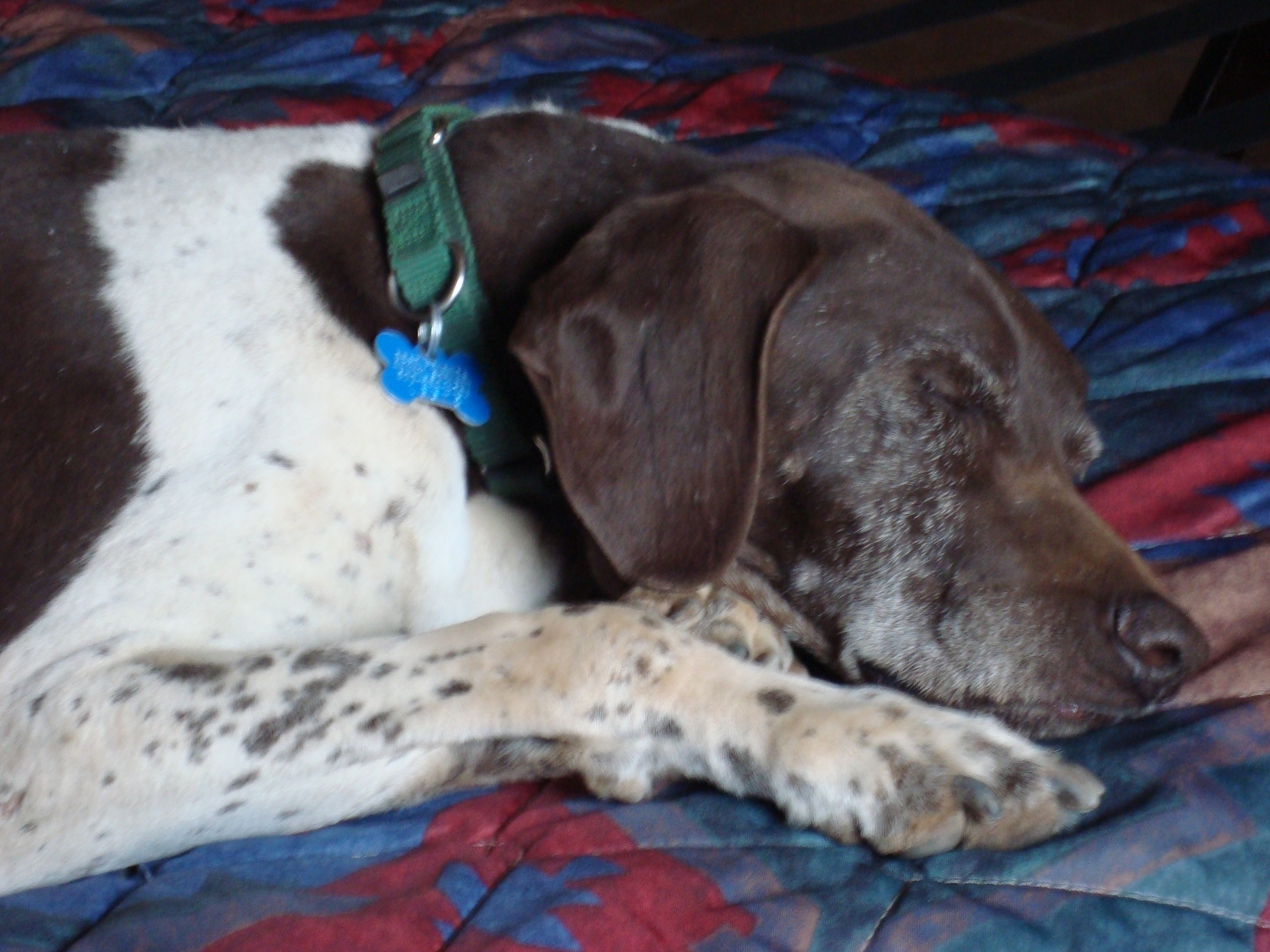
We’ve all seen our dogs deeply asleep, with paws and legs twitching.  There have even been times when my dog puts her head up while sleeping and howls like a wolf.  (She usually wakes herself up, too).

Do our dogs dream?

All evidence points to an answer of ‘yes’.

Researchers know, for example, that the EEGs (electroencephalograms) of sleeping dogs show brain wave activity similar to humans during sleep.  There is a period of sleep known as REM sleep (REM means rapid eye movement) when breathing becomes irregular and the eyes twitch.  Sound familiar?

When humans have been wakened during REM sleep, they report that they have been dreaming and so there is no reason to think that our dogs aren’t dreaming. 

Matthew Wilson, Associate Professor of Brain and Cognitive Sciences at the Massachusetts Institute of Technology says that animals have complex dreams and are able to retain and recall long sequences of events while they are asleep. 

His work involved rats and monitoring their brain wave activity when they were asleep and awake.  He also tracked the effect of sleep on learning of repetitive tasks.

Professor Wilson has said of his work “dreams are the ultimate off-line experience. This work demonstrates that animals are capable of re-evaluating their experiences when they are not in the midst of them.”

By the way, dogs, cats and rabbits are crepuscular which means that they naturally tend to be more active at dawn and at dusk.  Humans are diurnal which means they are most active during the day (which explains why night shifts are so hard on people).  Dogs seem to adjust their own sleep habits to match those of their owners.