Category Archives: dog care

UK research supports worming and cleaning up after your dog

Researchers at the University of Bristol’s School of Veterinary Sciences have published their research, which supports the need for ongoing worming of dogs and the need for owners to clean up their dog’s poo.

At issue is the parasitic worm, Toxocara, which are a rare cause of disease in humans, responsible for occasional cases of abdominal pain, loss of sight, and potentially asthma and epilepsy.

Using data from the University, the researchers estimated relative contributions of dogs and the other hosts of the parasites, cats and foxes.   With the help of additional information from a previous study, the researchers estimated that nearly four tonnes of dog waste are produced in Bristol each day and nearly 1,000 tonnes throughout the UK.

Given that each adult female worm can lay 12,500 eggs or more per day, this equates to around 3.7 billion eggs shed per day within the city of Bristol.

“These results are not all that surprising but they are likely to differ widely between places. We provided a method for estimating different sources of contamination with Toxocara eggs anywhere in the world.  This will hopefully help locally appropriate control measures to be put in place. The data also provides a baseline against which future changes can be measured, as we currently lack any good evidence of how effective steps such as anti-fouling legislation are in reducing egg load and human disease” says Dr Eric Morgan the lead author of the paper.

The research team’s findings have been published in the journal Veterinary Parasitology.

Source:  University of Bristol media statement

On time percentage

If Daisy was a commercial airline, she’d happily report a 100% on time percentage for flight arrivals and departures.  But Daisy isn’t an airline, she’s my adored dog who doesn’t understand public holidays.

Today is Waitangi Day in New Zealand and many people would have taken the opportunity to sleep in for a while.  Not me.

Daisy arrived at my bedside at 6:30 am to remind me that it was time for breakfast.  I fed her and then tried to go back to sleep.  At 7:00 am she was back – what are you doing in bed?!  It’s time for walkkies!

Daisy reminds me that is is 7:00 am and time for walkkies

Daisy reminds me that it is 7:00 am and time for walkkies

Dogs have a remarkable grasp of time and routine.  I think it is essential for dog owners to establish a good routine for their dog, because it gives the dog security and a sense of well-being – they know their needs will be taken care of.

I just wish we could establish a Plan B routine – for public holidays….

Doggy shot glasses for the hot summer

It’s been a really hot summer here in Christchurch and, as Daisy is a senior dog, I want her to be as comfortable as possible.

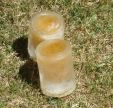
In the spring, the folks at Jose Cuervo tequila gave me some molds for freezing water into shot glasses when I bought a bottle of their tequila.  Well, I use them, but I fill the insides with beef stock and then re-freeze…

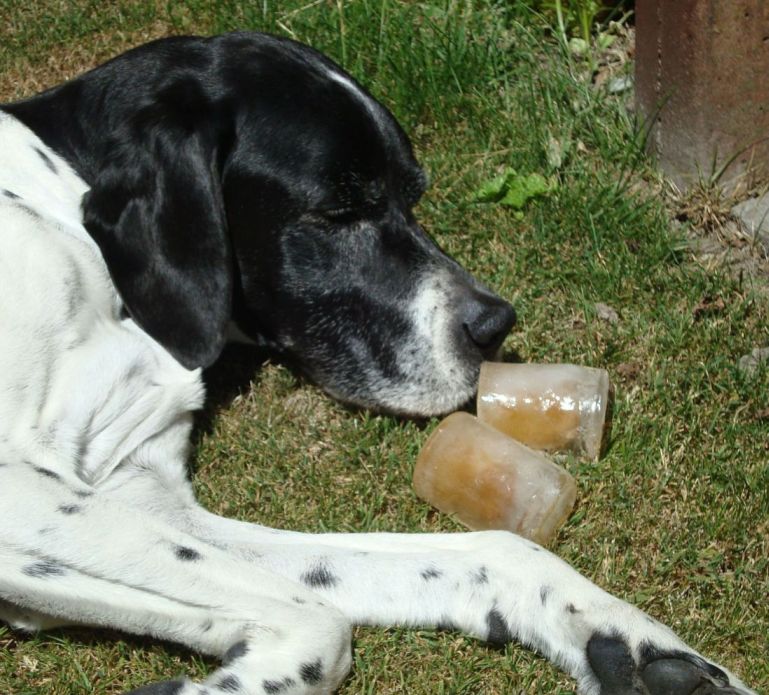
The result?  Doggy shot glasses filled with frozen stock!  It probably won’t be much of a marketing tool for Jose Cuervo, but Daisy loves them.

These shot glasses of ice are re-frozen after I fill them with beef stock

These shot glasses of ice are re-frozen after I fill them with beef stock

Daisy loves her specially made ice blocks

Daisy loves her specially made ice blocks

Bully sticks – a source of calories and bacteria

Researchers at the Cummings School of Veterinary Medicine at Tufts University and the University of Guelph have some news for you about bully sticks.

Photo courtesy of Tufts University

Photo courtesy of Tufts University

The research team analysed the treats for caloric density and bacterial contamination and they asked owners about their knowledge of the treats through a survey.

The sample size in the study was 26 bully sticks, purchased from different places in the United States and Canada.

The bully sticks contained between nine and 22 calories per inch, meaning that the average sized stick packed 88 calories or 9 percent of the daily caloric requirements of a 5o pound (22.7 kg) dog or 30 percent of the requirement for a 10 pound (4.5 kg) dog.

‘With obesity in pets on the rise, it is important for pet owners to factor in not only their dog’s food, but also treats and table food,’ said Lisa M Freeman, Professor of Nutrition.

The 26 treats were also tested for bacterial contamination.  One (4%) was contaminated with Clostridium difficile, one (4%) contaminated with methicillin-resistant Staphylococcus aureus (MRSA), and seven (27%) were contaminated with Escherichia coli including one sample that was resistant to treatment with tetracycline.

Although the sample size in this project was small, the researchers advise all pet owners to wash their hands after touching treats.  The risk could be higher for the very young, elderly, pregnant or immuno-compromised dog owners.  They acknowledge that research on a larger sample size is also needed.

The survey portion of the study showed that many dog owners are not aware of the ingredients in their dog’s treats, with many demonstrating ignorance of the definition of a ‘by-product.’

The results of the study have been published in the January 2013 issue of the Canadian Veterinary Journal.

Source:  Tufts Now media statement

I didn’t want to say anything…

Most of my regular readers know that I work as a canine massage therapist and helping elderly dogs and those recovering from injuries is very rewarding for me.   Many of my clients use massage for their dogs as a way of staving off the need for non-steroidal inflammatory drugs (NSAIDs), or at least to keep the dosages of these drugs as low as possible.

So here’s a wee story of something that happened to me this week.

I was working on a dog who I have been seeing for 18 months.  He’s a lovely Labrador and he is starting to have the aches and pains of old age.  With a regular 5-weekly regime of massage, he’s been pain free.

Because I know this boy well, I could pick up that he was tight through his hind legs – a muscle called the biceps femoris.  When I said ‘he’s tight down here’ to his owner, she replied, ‘I didn’t want to say anything…I wanted to see if you’d notice.’

This happens fairly often.  Some people like to test me to see if I actually know what I’m doing (some owners remain doubtful about complementary therapies) but most of the time it is because owners doubt if the changes they observe are real.  When you live with someone with a chronic health condition and see them on a daily basis, it is often hard to pick up changes in their condition.

In this case, it was the latter.  This lady wasn’t confident that she was really seeing her dog running stiffly.  He was tight, but was moving freely when he left after his massage.

Success for the week!

What’s the lesson here? It’s unrealistic to expect a massage therapist to ‘solve’ a dog’s problem in a single visit.  Dogs have to get used to the therapist and massage is a new experience for them.  So, the first visit is usually a time when they aren’t as relaxed because they are uncertain.

Because I keep notes on every massage session, I can refer back to these to track a dog’s condition.  This is no different than what your vet does.  When I am familiar with a dog and their unique characteristics, I’m much better able to pick up changes and act swiftly to help.

Please consider your dog’s therapist as a member of your healthcare team and part of your dog’s preventative healthcare regime.  It’s much better than the ‘ambulance at the bottom of the cliff.’

Kathleen at work with Zara (another client).  copyright June Blackwood

Kathleen at work with Zara (another happy customer) copyright June Blackwood

A dog’s breakfast

When someone says something is a ‘dog’s breakfast’ – it’s not usually a compliment.

That’s because the term means any kind of mixture or smorgasbord of cast-off foods that was cobbled together and fed to the dog.  This could have been items that were destined for the garbage, or perhaps a meal that was going to be fed to the humans in the household, but went badly wrong.

Well, in our household, the dog’s breakfast is cooked specifically for her.  Today, it was cranberry treats – our newest recipe.  (Like many dogs, Daisy’s main meal is in the evening – but a little something in the morning keeps her blood glucose levels where they should be and ensures she feels like the rest of the family.)

Daisy's breakfast this morning was Cranberry Treats, a wheat-free recipe and the newest from Canine Catering

Daisy’s breakfast this morning was Cranberry Treats, a wheat-free recipe and the newest from Canine Catering

Give your dog a hug from us

I love dog people.  I mean – true dog people.  And for that reason, I love doing business with companies that are managed by dog people.

Take D-Fa, for example.  We’re having a very hot summer here in Christchurch and Daisy really needs her cool collar.  Unfortunately, the ice pack insert has lost some of its fluid and is no longer working as well.  I contacted D-Fa and they said they’d send me a replacement pack for only $5.00.

Well, the pack has arrived (Daisy is very happy).  And I’m happy because I got good service from them but also a nice note:

Hope this finds you well.  Sorry you didn’t have these for the screamingly hot day in Christchurch yesterday, but here they are now (hope it doesn’t start to snow as a result).

Thanks and let us know if there is anything else we can do for you.

Cheers and give your dog a hug from us.

I’ve previously endorsed Cool Collars and recommend them to my clients, particularly those that own elderly dogs.  I’m also a fan of their Float Doggy flotation vests.

Thanks D-Fa…from a satisfied dog person (customer)

Understanding homeopathic remedies

In my last blog post, I explained how I was going to start treating Daisy with homeopathic fragaria and calc renalis to support good dental health.

So now I’d like to remind everyone how homepathic remedies are made.

This diagram outlines the process, but doesn’t fully explain how the remedies are made.  (I was sent this diagram a long time ago and I’m not sure of the original source for it).

Homeopathic dilutions diagram

Step 1:  Make a mother tincture

The first step is to create a mother tincture out of the plant source.   The plant material is cut up and crushed and left to soak in an alcohol and water solution in a dark place for some time.  The period of soaking is long enough to draw the properties of the plant into solution.   When the maker of the remedy understands that the mixture is ready, they will strain off any residual plant material.  This is the mother tincture.

Step 2:  Potentization

One drop of the mother tincture is put into a vial and then nine drops of a solution of alcohol and water and shaken vigorously.  This results in a 1X potency.  With one drop of the 1X potency and nine drops of the diluting solution and another good shake and you have 2X potency.

For the potency of 1C, this process is done 100 times.  (C is the Roman numeral for 100).

In most cases, homeopathics start with a 6C potency.  Other common potencies are 12C, 30C and 200C.  I’m most familiar with the 30C potency which is often the starting point (it’s what I’ll be using).  However, when there’s an acute condition that requires a bit more energy, I use 200C.

It’s also important to understand how your homeopathic remedy is made.  My homeopathic vet prefers that the remedies are made by hand by an experienced homeopathic pharmacist.  Major commercial brands like Weleda, on the other hand, use a manufacturing process for potentizing.

Homeopathy is a really interesting discipline and just one of the complementary therapies available to help your dog attain and maintain optimal health.

Managing dental health

Yesterday, Daisy had a dental cleaning at our vet’s.  She didn’t really have dog breath but her annual examination revealed that her teeth weren’t in the best condition.   She didn’t need any extractions, but she had gingivitis in her rear teeth and, as it turns out, signs of receding gums.

Daisy is a senior girl and we absolutely can’t risk having another procedure where she requires anesthesia.

I have really tried to support her mouth health through 2-3 times per week brushing with dog toothpaste and the feeding of dental chews.  She doesn’t tolerate raw bones well – which routinely either over-stimulate her bowels or cause constipation.  (When she shared a kennel with her father once a week at daycare, it was great because she could chew on his cast-offs without these problems.)

Daisy is also rather picky and so she won’t chew on chew toys like the twisted rope chews (I think she believes it’s beneath her).  If food/taste isn’t involved in the chew, she’s just not interested.

So, what’s next for our regime?

Well, the first thing is making brushing of her teeth a daily event.  I’m motivated to do this because I know the consequences of not doing it and luckily, Daisy is used to it.

But I want to do more and preferably in as natural a way as possible.

I’m also going to try homeopathics.  The two that come recommended are fragaria and calc renalis because these  keep tartar soft and more able to be removed through chewing and brushing.  The standard 30C concentrations are what we are going to start with by adding it to her water bowl.

I’ve also read that boiled oxtail is a good chew.  So I’m off to find oxtail at the supermarket/butcher.  I’m also hopeful of finding other chews that Daisy will tolerate – I’m going to source a deer antler chew shortly.

Remember, that dental health is essential.  I’ve previously written about this subject in Dog breath is no laughing matter.

Please feel free to share what you do to keep your dog’s teeth in top condition either through this blog or my Facebook page.  (Yes, I know about the raw diet – but Daisy hasn’t tolerated even a managed transition to raw feeding in the past.   I’m not against feeding raw, I just know from my practice that not all dogs are suited to the raw diet for a range of reasons).

Cranberries and urinary tract infections

Many holistic veterinarians are now recommending the use of cranberries in the long-term treatment of pets who are susceptible to urinary tract infections, or UTI.

Diabetic dogs, in particular, seem to develop UTI more regularly than the normal dog population.  Spayed females are also more susceptible to infections.

Cranberries

When a dog has a UTI, they often struggle to eliminate urine or, when they do pee, not much comes out.  Sometimes blood is seen in the urine, the urine may smell stronger, or it has a dark colour.  If your dog has a UTI, then seeing your veterinarian for antibiotics is essential.  A urinary tract infection left untreated means your dog is uncomfortable and in pain and if the infection travels to the kidneys, then your dog is in serious trouble.

Cranberries can assist when your dog is being treated for a UTI because cranberries help to acidify the urine which helps to prevent bacteria growth.

But what about prevention?  This is where the cranberries come into their own.  Not only does the cranberry acidify the urine, but studies show that they have the ability to prevent bacteria from sticking to the walls of the bladder and urinary tract and so they minimise the chance of an infection recurring.

Some owners treat their dog with cranberry powder because the juice is tart and unpalatable.  Owners must be careful because lots of cranberry juices are full of sugar (that’s a warning for humans as well as pets).

I’m working on a wheat-free cranberry biscuit recipe now that will feature as the January/February special.  I’ve just perfected my recipe and the latest batch is looking great – with the added benefit of no artificial colours!

Dog peeing

In order to prevent recurring urinary tract infections, it’s also really important to ensure your dog has lots of fresh, clean water to drink and has lots of opportunities to go outside and pee.  For diabetic dogs, care must be given to their daily diet to manage their blood sugars (another reason to watch the sugar content of any cranberry supplements).