“A good dog is one of the best things of all to be.”
– Dean Koontz, author

“A good dog is one of the best things of all to be.”
– Dean Koontz, author
This is a tale of how owning a dog can help protect your child from asthma. Strange, but true.
Researcher Dr Kei Fujimura used mice to test the impact of house dust from homes where a dog lived and from those that didn’t. She found (and her study was presented at a recent meeting of the American Society for Microbiology) that the dust from households with dogs seemed to have a beneficial effect.
Mice who were fed dust from these households developed an immune response to RSV(respiratory syncytial virus). Infants who contract this virus have a marked increase in their risk of developing asthma. RSV affects 90% of children worldwide. That makes this study significant.
Dr Fujimura says these results support the hypothesis that exposure to animals in early childhood stimulates the immune system to resist the development of asthma and other allergies.
Another reason to introduce your children to the wonders of dog ownership at an early age!
Source: Discovery News
Posted in dog ownership, research
Tagged American Society for Microbiology, asthma in children, dog ownership, dogs, Kei Fujimara, protection, research

I’ve just finished reading The Lucky One by Nicholas Sparks. What attracted me to the book was the fact that the story is predominantly set at a boarding kennel and that one of the main characters, Zeus, is a German Shepherd. It helped that the book was previously on the New York Times Bestseller list and so others must have liked it too.
I hadn’t realised that Nicholas Sparks is a the author of novels like The Notebook and Nights in Rodanthe, which were successfully made into movies (I liked both movies). As it turns out, The Lucky One has just been made into a film starring Zac Efron but it hasn’t shown here in New Zealand yet (more on that later).
This is a story of Logan, a veteran of the conflict in Iraq, who finds a photograph in the desert of a woman. The photo goes unclaimed at the camp and so Logan keeps it and it becomes his good luck charm. When he leaves the US Marines and returns to the United States, he goes on a quest to find the woman in the photo – with Zeus his loyal German Shepherd for company.
He finds Elizabeth, a divorced mother, living with her grandmother who runs a boarding kennel. He starts working there and through the book we learn about the original owner of the photo and the traumatic experiences that Logan endured during his time in Iraq. We also learn about his best friend, Victor, who encouraged him to find the woman in the photo…
There’s some suspense at the end of the book (but I found this didn’t really live up to the marketing on the book’s cover). I won’t tell you whether or not Logan and Elizabeth end up together, either. I will say that this was a solid story and it’s pleasing to see a dog take up a major role in the book. It’s worth a read.
And so back to the movie thing. When I read the book, I definitely didn’t picture Zac Efron as Logan. He’s too young and fresh-faced and lacks the solid build of a Marine – at least that’s my opinion. I don’t think I’ll be going to see the film when it shows here – I liked the story but I didn’t love it. (And I’m sorry if this offends the many Nicholas Sparks fans that are out there).
Posted in dog books
Tagged german shepherd, Marines, movies, new york times bestseller, Nicholas Sparks, Nights in Rodanthe, The Lucky One, The Notebook, Zac Efron, Zeus
Many sites operated by the major hotel and motel chains in the US are pet friendly – but many are not. When planning a trip with your dog this (northern hemisphere) summer, there’s a site that can help you. It’s called Pets Welcome. This site has a search engine for finding dog friendly accommodation that fits with your trip’s itinerary.
Best of all, the site is not limited to the major chains. Independent operators are also listed. For example, during my recent trip to the Best Friends Animal Sanctuary, I stayed at the Treasure Trail Motel and they are included in the Pets Welcome directory.
There are lots of properties that are seeing the value in offering dog friendly accommodation. Here’s a brief synopsis of the number of properties amongst the major chains:
|
Hotel/Motel Chain |
Number of sites |
| Candlewood Suites |
100 |
| Clarion Inn and Suites |
60 |
| Comfort Inn and Suites |
550 |
| Comfort Inn |
85 |
| Econolodge |
380 |
| Extended Stay America |
680 |
| Holiday Inn |
450 |
| Holiday Inn Express |
375 |
| La Quinta Inn and Suites |
700 |
| Motel 6 |
1000+ |
| Quality Inn |
300 |
| Red Roof Inn |
360 |
Posted in dog-friendly accommodation
Tagged Best Friends, Best Friends Animal Sanctuary, Candlewood Suites, Clarion, Comfort Inn, comfort inn and suites, dog friendly accommodation, Econolodge, Extended Stay America, Holiday Inn, Holiday Inn Express, La Quinta, Motel 6, motel chains, pet friendly accommodation, Pets Welcome, Quality Inn, Red Roof Inn, travel, Treasure Trail Motel
This week, it was announced that the town officials had reached a compromise with Blue’s nominated owners (Blue was abandoned early in life and formed connections with some residents more than others).
Blue will be exempt from the city’s leash law, but his owners will need to keep him contained on their commercial property through the use of an electric fence.
Read more about Blue’s compromise here in the New York Times.
Posted in Dogs
Tagged Blue, electric fence, Elephant Butte, leash laws, New Mexico, New York times
The animal welfare sector is comprised of many volunteer organisations. One special one working in the Oregon and Washington area is Fences for Fido.
This volunteer effort has been working since 2009 to build fences for dogs so they can be released from their chains. Chained dogs rarely have the quality of life of other pets and are vulnerable to aggression from other dogs who are able to roam into their territory and take advantage of the dog’s restrictions. Studies show that dogs who are chained can respond in one of two ways: they become aggressive or they become withdrawn and unresponsive.
More importantly, dogs who are chained are unlikely to have the same bonds and stable relationship with their owners/family. Many are isolated and live a lonely existence and suffer from neglect.
Without prejudice, Fences for Fido assists these dog owners by building fenced sections on weekends. Materials and time are all donated and there is also support for neutering/spaying and veterinary care when needed. The group works to educate families about dog care during the extreme seasons of summer and winter.
This group also follows up with families that have received its assistance twice each year to ensure that the dogs remain unchained and in good condition.
Almost 300 dogs have been helped by Fences for Fido so far.
That’s a special group!
Here’s a video of their first-ever fence building project – for Chopper – in 2009:
Posted in animal welfare, dog care
Tagged aggression, bonds, families, Fences for Fido, fencing, neuter, Oregon, spay, Washington
The City of San Francisco is providing leadership in the area of disaster planning for pets. Following the disaster of Hurricane Katrina in 2005, when pet owners were refused shelter if they brought their pets with them, the Pets Evacuation and Transportation Standards Act of 2006 made federal funding available for authorities to plan to help companion animals that are affected by disasters.
In San Francisco, pet-disaster responders will have authorised training and they will use a network of 125 temporary shelters to evacuate animals. Injured animals will be treated in a $300,000 mobile animal disaster medical command unit (funding for this is still pending).
Best of all, the city’s department of Animal Care and Control has a No Pets Left Behind policy. Whenever a citizen is rescued, their pets will be rescued too.
For those of us who have lived through a major disaster like Christchurch’s 2010 and 2011 earthquakes, we know the importance of having supplies and an evacuation plan for your pets. It’s also a challenge to get authorities coordinated to respond to animal welfare problems during major events.
Read more about San Francisco’s disaster planning in this New York Times article.
Kathleen Crisley, specialist in dog massage, rehabilitation and nutrition/food therapy, The Balanced Dog, Christchurch, New Zealand
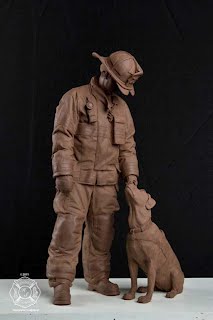
The winning design features a firefighter looking upon his detection dog, who is ready for duty
The non-profit organisation National Fire Dog Monument has been successful in its fundraising to build a monument to Certified Accelerant Detection Dogs. The bronze statue is entitled “From Ashes to Answers” and will be permanently displayed in front of a fire station in Washington, DC.
The inspiration for the dog in the sculpture is Erin, Colorado’s first arson dog who died from cancer.
As the statue is transported to its final home, there will be a roadshow from June 21 to 28, 2012 stopping in 12 cities starting in Denver, Colorado and ending in Washington, with other stops in Kansas, Illinois, Missouri, Indiana, Pennsylvania, New Jersey and New York. The full schedule of stops can be found here.
Arson dogs are trained to detect hydrocarbons and other accelerants that are used to deliberately light fires. The use of dogs in this service is yet another way that working dogs are used to benefit communities and the new monument is a fitting tribute to their contribution.
Whenever I take on a new client, I use a health questionnaire that covers current conditions as well as the dog’s health history. One of the issues I address is any recent changes to the dog’s behaviour or living conditions.
What I am trying to ascertain is if a dog is in pain or having adjustment difficulties. There is a clear link between pain and aggression and this has been supported in a recent study by researchers at the Autonomous University of Barcelona in Spain.
In the Spanish study, which has been published in the Journal of Veterinary Behavior, 12 dogs that were brought in by their owners for ‘aggression problems’ were studied. All were found to have pain-induced aggression with eight diagnosed as having hip dysplasia.
The breeds in the study were: a Giant Schnauzer, Irish Setter, Pit Bull, Dalmatian, two German shepherds, Neapolitan Mastiff, Shih-tzu, Bobtail, Catalan Sheepdog, Chow Chow and Doberman.
The researchers concluded “if the pet is handled when in pain, it will quickly act aggressively to avoid more discomfort without the owner being able to prevent it.”
So, when a dog is behaving differently or is “out-of-sorts”, a visit to the vet is recommended. Behaviour changes can be the first indicator that something is wrong and your vet can help to run appropriate tests to see if there is an underlying health problem.
Dogs have a way of not telling us they are in pain until a problem is more pronounced because their natural instinct is to protect themselves by not exhibiting any noticeable vulnerabilities. Therapies such as massage and low level laser (which I employ in my canine rehabilitation practice) are useful in helping to manage pain through appropriate stimulation of acupressure points and managing muscle, tendon and ligament condition. I’m also a strong supporter of acupuncture and refer clients to a local vet who is trained in veterinary acupuncture.
These complementary therapies can be employed alongside traditional pain medications such as NSAIDs to support your dog’s quality of life. When pain is managed, quality of life improves for everyone in the household.
Source: Plataforma SINC. “If your dog is aggressive, maybe it is in pain.” ScienceDaily, 13 Jun. 2012. Web. 15 Jun. 2012.
Tagged acupressure, aggression, Autonomous University of Spain, behavior, behaviour, Bobtail, Catalan Sheepdog, Chow Chow, Dalmatian, Doberman, dog massage, dogs, german shepherd, Giant Schnauzer, health history, hip dyplasia, Journal of Veterinary Behavior, ligament, low level laser, massage, mastiff, muscle, NSAIDs, pain, Pit Bull, research, tendon, therapies, veterinary acupuncture
The philosopher Immanuel Kant once said, “We can judge the heart of a man by his treatment of animals.” If dogs were allowed to vote in the upcoming US presidential election, I believe that this would be their main criteria for voting.
US President Barack Obama kept his promise to his daughters when he was elected to the US presidency and the family adopted Bo, a Portuguese Water Dog. Bo currently features in the President’s commemorative photo issued by the Democratic National Committee:

The official photo issued by the Democratic National Committee
In stark contrast is presidential candidate Mitt Romney’s reputation for caring for the family’s dog, Seamus. Romney placed Seamus into a dog crate on top of the family’s car in 1983 for a long car trip from Boston to Ontario, Canada. Romney defended his actions by saying that he outfitted the crate with a ‘modified’ windshield. When Seamus soiled the crate and the rear window of the car, Romney calmly stopped the car and used a hose on Seamus. (Romney’s team has commended his approach, citing it as an example of his emotion-free crisis management.) (You can read more about Romney’s treatment of Seamus and others in this Vanity Fair article.)
When interviewed by ABC’s Diane Sawyer, she asked Romney if he would do it again. He replied, “Certainly not with the attention it’s received.” (No comment about the appropriateness of his actions, just the attention).
This act of cruelty has been described by Scott Crider as a ‘deal-breaker’ for Romney’s candidacy. Crider has started the Dogs Against Romney movement which includes a Facebook page.
Supporters can also buy various Dogs Against Romney merchandise from the movement’s website. For example, your dog can wear a bandana that says “I ride inside” or you can use a coffee mug at the office “Dogs aren’t luggage”
So, who would your dog vote for? Romney or Obama?
I leave you with the words of Mahatma Gandhi:
“The greatness of a nation and its moral progress can be judged by the way in which its animals are treated.”







 DoggyMom.com