Category Archives: research

Of dogs, house dust and asthma…

This is a tale of how owning a dog can help protect your child from asthma.  Strange, but true.

Researcher Dr Kei Fujimura used mice to test the impact of house dust from homes where a dog lived and from those that didn’t.  She found (and her study was presented at a recent meeting of the American Society for Microbiology) that the dust from households with dogs seemed to have a beneficial effect.

Mice who were fed dust from these households developed an immune response to RSV(respiratory syncytial virus).  Infants who contract this virus have a marked increase in their risk of developing asthma.  RSV affects 90% of children worldwide.  That makes this study significant.

Dr Fujimura says these results support the hypothesis that exposure to animals in early childhood stimulates the immune system to resist the development of asthma and other allergies.

Another reason to introduce your children to the wonders of dog ownership at an early age!

Source:  Discovery News

The importance of pain management

Whenever I take on a new client, I use a health questionnaire that covers current conditions as well as the dog’s health history.  One of the issues I address is any recent changes to the dog’s behaviour or living conditions.

What I am trying to ascertain is if a dog is in pain or having adjustment difficulties. There is a clear link between pain and aggression and this has been supported in a recent study by researchers at the Autonomous University of Barcelona in Spain.

In the Spanish study, which has been published in the Journal of Veterinary Behavior, 12 dogs that were brought in by their owners for ‘aggression problems’ were studied.  All were found to have pain-induced aggression with eight diagnosed as having hip dysplasia.

The breeds in the study were:  a Giant Schnauzer, Irish Setter, Pit Bull, Dalmatian, two German shepherds, Neapolitan Mastiff, Shih-tzu, Bobtail, Catalan Sheepdog, Chow Chow and Doberman.

The researchers concluded “if the pet is handled when in pain, it will quickly act aggressively to avoid more discomfort without the owner being able to prevent it.”

So, when a dog is behaving differently or is “out-of-sorts”, a visit to the vet is recommended.  Behaviour changes can be the first indicator that something is wrong and your vet can help to run appropriate tests to see if there is an underlying health problem.

Dogs have a way of not telling us they are in pain until a problem is more pronounced because their natural instinct is to protect themselves by not exhibiting any noticeable vulnerabilities.  Therapies such as massage and low level laser (which I employ in my canine rehabilitation practice) are useful in helping to manage pain through appropriate stimulation of acupressure points and managing muscle, tendon and ligament condition.  I’m also a strong supporter of acupuncture and refer clients to a local vet who is trained in veterinary acupuncture.

These complementary therapies can be employed alongside traditional pain medications such as NSAIDs to support your dog’s quality of life.  When pain is managed, quality of life improves for everyone in the household.

Source:  Plataforma SINC. “If your dog is aggressive, maybe it is in pain.” ScienceDaily, 13 Jun. 2012. Web. 15 Jun. 2012.

Dog dreaming

We’ve all seen our dogs deeply asleep, with paws and legs twitching.  There have even been times when my dog puts her head up while sleeping and howls like a wolf.  (She usually wakes herself up, too).

Do our dogs dream?

All evidence points to an answer of ‘yes’.

Researchers know, for example, that the EEGs (electroencephalograms) of sleeping dogs show brain wave activity similar to humans during sleep.  There is a period of sleep known as REM sleep (REM means rapid eye movement) when breathing becomes irregular and the eyes twitch.  Sound familiar?

When humans have been wakened during REM sleep, they report that they have been dreaming and so there is no reason to think that our dogs aren’t dreaming. 

Matthew Wilson, Associate Professor of Brain and Cognitive Sciences at the Massachusetts Institute of Technology says that animals have complex dreams and are able to retain and recall long sequences of events while they are asleep. 

His work involved rats and monitoring their brain wave activity when they were asleep and awake.  He also tracked the effect of sleep on learning of repetitive tasks.

Professor Wilson has said of his work “dreams are the ultimate off-line experience. This work demonstrates that animals are capable of re-evaluating their experiences when they are not in the midst of them.”

By the way, dogs, cats and rabbits are crepuscular which means that they naturally tend to be more active at dawn and at dusk.  Humans are diurnal which means they are most active during the day (which explains why night shifts are so hard on people).  Dogs seem to adjust their own sleep habits to match those of their owners.

Caring for Nunavik’s sled dogs

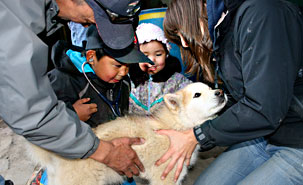
Andréanne Cléroux, a veterinary student at the University of Montreal International Veterinary Group, is conducting a project to design and deliver a first aid guide for dogs in northern Quebec.

A family with their dog in Nunavik. (Credit: Sylvie Ricard)

“The problem relates mainly to animal health care, immunization, and dog population control,” Cléroux explains. “We wanted to create a guide that would provide basic tools for pet owners so they can provide care to their animal while waiting to contact the remote veterinary consultation service to get advice from a veterinarian at the CHUV (University of Montreal Veterinary Hospital).” 

Cléroux spent time developing the guide before travelling to northern Quebec to work on the draft with residents.  One of the challenges has been to develop a product that was good for those unfamiliar with dog care and still make it useful to mushers, who tend to know more about their dogs.

Cléroux has also created a first aid kit that includes all the necessary material to provide the care described in the manual and delivered it to several villages, with a goal to make it more widely available to all 14 communities in Nunavik.

Source:  University of Montreal press release


Re-thinking dog domestication

A research team led by the University of Durham has published a study in the Proceedings of the National Academy of Sciences (USA).  This study shows that today’s modern breeds of dog have little in common genetically with their ancient ancestors. 

Dog domestication occurred over 15,000 years ago – and there is still much to learn!

Years of cross-breeding are the major influence on the genetic differences, although the researchers are quick to add that other effects on genetic diversity will include patterns of human movement and the impact on dog population sizes caused by major events such as World War I and World War II.

The research team analysed genetic data from 1,375 dogs representing 35 breeds. They also looked at data showing genetic samples of wolves because other research studies have concluded that the dog descended directly from the gray wolf.

Lead author Dr Greger Larson, an evolutionary biologist, says the study demonstrated just how much there is still to understand about the early history of dog domestication.  “We really love our dogs and they have accompanied us across every continent.  Ironically, the ubiquity of dogs combined with their deep history has obscured their origins and made it difficult for us to know how dogs became man’s best friend.”

The study also refutes claims of previous researchers that genetic differences in breeds such as the Basenji, Saluki and Dingo were evidence of an ancient heritage.  The Durham team’s study shows that these dogs are genetically different because they were geographically isolated and were not part of the 19th Century Victorian-initiated kennel clubs that blended lineages to create most of today’s breeds.

A Saluki (copyright Keith Dobney)

Source:  University of Durham press release

Aggressive dog? How agreeable is the owner?

Research from the University of Leicester’s School of Psychology  has revealed that young people who are more disagreeable are likely to own an aggressive dog.

‘Agreeableness’ means being less concerned with the needs or well-being of others.  Such people may be suspicious, unfriendly and competitive as well.

Participants were given personality tests and  indicated their preference for different types of dogs  . The dogs were independently rated according to how aggressive people perceived them to be. Bull terriers were rated as most aggressive, followed by boxers; retrievers and cocker spaniels were seen as least aggressive.

The study’s results also show a small effect suggesting that those who liked aggressive dogs showed signs of conscientiousness – being careful, reliable and thoughtful about their actions.

Whilst this finding (about conscientiousness) contradicts a long-held perception that owners of aggressive dogs are always irresponsible, Dr Vincent Egan, the study’s lead researcher suggests caution before reading too much into the conclusion:

“These results with Conscientiousness were unexpected, but the effect is a small one, and needs to be repeated in a different group of people. Studies of this kind tend to only look at a restricted age ranges, which may exaggerate findings which do not occur across the entire lifespan, so we believe a stereotype is always true, whereas it may only be true under certain conditions. Our study employed a broader age range.”

Dr Egan’s study has been published in the journal Anthrozoos.

What is your dog thinking? Researchers are on the case!

Researchers at Emory University have published new research into canine cognition.  Entitled Functional MRI in Awake Unrestrained Dogs, the paper outlines findings of research that required two dogs to remain motionless in an MRI machine.

Yes – that’s right. Motionless.  The two dogs were outfitted with special ear muffs to protect them from the noise of the MRI and trained to rest their heads on a chin rest inside the machine.   As the MRI took scans of the dog’s brain activity,  hand signals were used to show the dogs whether there was or wasn’t a food reward.

This is a first-ever study on awake dogs, rather than those that have been sedated.  Importantly, part of the animal ethics of the study was to ensure the dogs were willing participants.

The findings show a definite brain activity response when the hand signals indicated a food reward.  Those dogs are paying attention!

The lead researcher, Professor Gregory Berns, says “We hope this opens up a whole new door for understanding canine cognition and inter-species communication. We want to understand the dog-human relationship, from the dog’s perspective.”

Professor Bern’s dog Callie in training in a mock-up of the MRI scanner (copyright Emory University)

Listen to Professor Berns talk about this project in the Emory University YouTube video:

Source:  Emory University press release 4 May 2012

With age comes greater success (in hunting, at least)

At the meeting of the Society for American Archeology this week, two University of Cincinnati professors, Jeremy Koster and Ken Tankersley,  presented their results of research into hunting dogs in lowland Nicaragua.

The indigenous communities of the Mayangna and the Miskito in Nicaragua survive on subsistence hunting in the Bosawas Biosphere Reserve.  The reserve is part of the largest unbroken tracts of neotropical rainforest in Central America, north of the Amazon.   85% of the mammals that are hunted are caught with the assistance of dogs.

Nicaraguan hunters and their dogs on a hunt, photo by Jeremy Koster, University of Cincinnati

The research team found that as both male and female dogs reach three years of age, they tend to increase their hunting success.  Older, male and female dogs in the study population returned more game to their owners than did younger dogs.

Bigger dogs are able to track and corral bigger prey, which increases their hunting return rates.  Since male dogs are generally larger than females, the males had the greater success rates.

As far as sustainability is concerned, the researchers found that  dogs are more suited to wildlife sustainability than other hunting options available.  Hunters with firearms tend to disproportionately hunt prey that lives in trees, including slow-breeding primates.  Hunters with dogs tend to harvest relatively fast-breeding animals such as agoutis, pacas and armadillos.

Their main conclusion:  With age comes greater success!

(Let’s hope the same applies to us; I could use all the help I can get :))

Source:  University of Cincinnati press release

Hug me, I need the oxytocin

Oxytocin is a mammalian hormone that is released during the act of touching and hugging.   For these reasons, the hormone is often referred to as ‘the cuddle hormone’ or ‘the love hormone.’  (The hormone is also released during childbirth, by the way).

As a dog owner, your relationship with your dog is likely to involve you and your dog triggering the release of oxytocin in one another.  Temple Grandin, animal behaviourist and autism researcher, has found that ‘A dog’s oxytocin levels rise when his owners pet him and petting his dog raises the owner’s oxytocin too.’    In other words, this hormone plays a role in the human-animal bond.

In 2003, J.S.J. Odendaal and R.A. Meintjes of the  Life Sciences Institute at Pretoria published research into the blood levels of endorphins, oxytocin, prolactin, B-phenylethylamine and dopamine (all associated with pleasure response or relaxation) and cortisol (a known stress hormone) in people and dogs both before and after they interacted with each other.  The researchers compared levels of the neurochemicals under three scenarios:   1) after people petted their own dogs 2)  after they petted unfamiliar dogs and 3) after they sat quietly and read a book.

In both humans and dogs, the levels of the pleasure-response chemicals  rose after 5 to 24 minutes.  At the same time, cortisol levels in humans fell as they spent time with their pets.   The increase in oxytocin was highest in the group where people interacted with their own dogs, as opposed to dogs that were unfamiliar to them.

In 2008, Miho Nagasawa’s research team in Japan showed that only eye contact was necessary between dogs and their humans to increase oxytocin levels.  After 30 minutes of contact with their dog, owners showed an increase in oxytocin levels.

Dr Kerstin Uvnäs-Moberg from Uppsala University, studies oxytocin and its effects.  Her 2010 study showed that women and their dogs experienced increases in their oxytocin levels after only 10 minutes of contact.  When compared to a survey of the women, their oxytocin response was in direct correlation with the quality of the bond they felt for their pet.

For those of us who have experienced this bond during our lives, it is probably not surprising that there is a scientific reason for our feelings and that it is hormone-related.  But it’s nice to have science on our side.

For those of you raising puppies, these studies show that there  is a good scientific reason to ensure your  puppy is socialised.  It is not surprising  that dogs involved in hoarding cases or puppy mills are withdrawn and in many cases frightened of humans.  They aren’t accustomed to the positive effects of oxytocin release and in many cases have suffered other traumas.

Hey Daisy, give me a hug…I need the oxytocin.

Have you hugged your dog today?

Kathleen Crisley, specialist in dog massage, rehabilitation and nutrition/food therapy, The Balanced Dog, Christchurch, New Zealand

Benefits of taking Fido to work may not be far ‘fetched’

The  benefits of dogs in the workplace are the subject of new research published in the March issue of the International Journal of Workplace Health Management.

Researchers at Virginia Commonwealth University  found that the presence of dogs in the workplace may buffer the impact of stress during the work day in both their owners and the people that they come into contact with.

In this YouTube video, principal investigator Dr Randolph T Barker (no pun intended) talks about the costs of stress to employers through lost work time and the benefits of increased productivity.

The researchers conducted their study at Replacements Ltd, the pet-friendly workplace that I featured here in March 2011.

Although Dr Barker is a Professor of Management, he collaborated with specialists in psychiatry and biostatistics for this study.  The researchers emphasise that their results are preliminary and that the next step is to expand the study to a larger sample size in an organisational setting.

I wonder which firm will put their hand up for that study?