Protecting K-9 cops

The Vest-A-Dog Network is actively working to outfit police dogs with protective vests.  Started in 1999, with funds were raised by a local girl for Tiko who was a replacement dog for another who was killed in action, the movement has grown.

You can donate directly  via the Vest-A-Dog website to support the featured canine protector or you can read about how to start your own local network on the site.

The program funds a K-9 One™ vest to sponsored police dog units.  These vests are made with Dupont Kevlar, the same material found in protective vests for human police officers.  The vests are designed to be bulletproof, stabproof and to protect against blunt force trauma.

A vest for protection against stabbing and bullets currently costs US$825 which is why many local units have difficulty finding the funds to protect their canine officers.

The New Zealand Police have stated (on their website) that they looked at an Australian vest in 2008/09 and decided that the vest would not have protected dogs that were previously injured on the line of duty.

However, I wonder that if with shootings like that of police dog Gage in Christchurch in July 2010, if the NZ Police should look at alternatives.  I’ve emailed them with details of the Vest-A-Dog project.

Kathleen Crisley, specialist in dog massage, rehabilitation and nutrition/food therapy, The Balanced Dog, Christchurch, New Zealand

The Beagle

Since I have Beagles in my massage practice, I thought it would be useful to profile this medium-sized breed.

Teddy

Beagles regularly feature on the most popular breed list in the United States.    Using American Kennel Club registrations from 2011, the Beagle is the third most popular dog.

The Beagle originated in the United Kingdom where they were used as hunting dogs for rabbits and other prey animals because of their keen sense of smell and ability to track.  As a pet, owners have to watch their Beagle because he/she will easily follow its nose to track interesting smells – potentially wandering far from home.

Beagles are classified as being tri-colour (black, white and tan) or lemon (yellow) and sometimes even red or white.  An average life span is 15 years.

This breed is prone to hip dysplasia, intervertebral disc disease, and allergies.  Some develop seizure disorders and hypothyroidism.  Regular ear cleaning is recommended because their long, floppy ears (which are very appealing) help to create an ideal environment to hold moisture and bacteria in the ear canal.

The Beagle is a hound and can be extremely vocal, so good training is needed.  Beagles are also known for their appetites and so to keep the weight off, a balanced and healthy diet is needed with careful attention paid to how much the dog is eating during the day (treats, ‘finds’ on walks, etc.)  Plenty of exercise is also needed.

Owners of Beagles tell me that since they were bred as pack dogs (for hunting), they don’t do well as a solo dog in a household.  They need companionship and can become depressed if left alone for long periods of time.  (This depression can lead to problem barking problems, too.)

Beagles are often spotted at airports, cruise ship terminals and postal depots because they are widely used as agriculture and drug detector dogs.  That’s because they can be trained to put their keen noses to good use!  I even came across this YouTube clip from the television show The Doctors where Beagles and Dachshunds are being used as detector dogs for bed bug infestations:

Sadly, because of their size and temperament, they are often used in laboratories for animal testing.  In November 2011, I covered a story about 40 laboratory Beagles who had been rescued.

Perhaps the most famous Beagle is Snoopy (the cartoon by Charles Schulz).  Snoopy was obviously a white Beagle.

If you are looking for a lively pet with minimal grooming requirements and generally a good temperament, then the Beagle may be right for you!

Doggy quote of the month for May

“A lot of shelter dogs are mutts like me.”

– Barack Obama

Tiny Beyonce – a poster dog for Mother’s Day

Beyonce was born on 8 March 2012  to Casey, a pregnant dog that was scheduled to be euthanised.  She claimed the title of the World’s Smallest Puppy because she could fit into a teaspoon!  She wasn’t expected to survive but proved everyone wrong.

Beyonce was saved because of the efforts of The Grace Foundation of Northern California, an animal rescue and rehabilitation facility.  Her story was picked up widely in media outlets including CBS, The Washington Post, the Associated Press and Reuters.  Now The Grace Foundation is using Beyonce’s celebrity status in a new fundraising campaign for Mother’s Day.

Named the  I’m a Survivor Fund (after the Beyonce song), funds will be used to save healthy mums and their puppies.   Many of these dogs are euthanised in shelters across California and the wider United States (3.4 million in total each year) because of a lack of facilities and adoptive families.

The messages from the Tiny Beyonce campaign are simple:

1.  Spay and neuter your pets to prevent overpopulation of our furry friends

2.  Adopt from rescues and shelters to save animals in need

3.  Help a rescue or shelter save lives. Volunteer or donate services, resources, or money

All moms (and mums) deserve recognition on Mother’s Day.  Why not make a donation to the I’m a Survivor Fund as part of your Mother’s Day gift?

Lessons from a Freethinking Dog

I have just finished reading Merle’s Door (Lessons from a Freethinking Dog) by Ted Kerasote.  This book was published in 2007 and became a national bestseller.  That’s not a surprise.

Mr Kerasote is an accomplished author.  He has written for publications including National Geographic, the New York Times, and Science.  And he has other books to his name.

Merle’s Door, however, has to be one of Mr Kerasote’s top literary accomplishments and something that will be remembered as a hallmark of his writing career.  Buy it (don’t just download it into your Kindle).

Merle’s Door is a biography of Merle, a dog adopted by Kerasote when they met totally by accident in 1991.  Merle was ‘living rough’ in the Utah desert and Ted was on one of his many trips with friends to enjoy nature.

“You need a dog, and  I’m it” says Merle.  And so begins a lifetime of 13 years together where Ted learns to translate Merle’s thoughts, to give him free reign to learn about life and his surroundings and, in turn, Ted learns many things from Merle.

Using his dog door and the freedom that Ted allowed him, Merle becomes the unofficial mayor of Kelly, Wyoming and makes many friends.  Along the way Ted establishes a ‘dedicated quadruped couch’ in his house and Merle leaves lasting footprints in the varnish of the balcony of the house they built together (and where Kerasote still lives).

Merle’s Door is Merle’s biography.  Lovingly written by Ted, we learn about Merle’s trademark “Ha ha ha” as he would converse with Ted in a language all his own.  He’d go hunting for elk, but was gun-shy when hunting birds  (and we find out why later in the book).  He has his scraps with other dogs and comes out learning valuable life lessons.

Later in life, Merle’s back end starts to deteriorate and Ted employs the use of acupuncture and massage to help his dog recover (no wonder why I like this book!).  With respect, he lets Merle define what will be a good day and a bad day and they enjoy one another’s company to the end.

Mr Kerasote does a wonderful job in depicting the human-dog bond that so many of us dog lovers have appreciated in our lives.  And he does it with the flair of an accomplished writer.

Like all true dog stories, be prepared for the end of Merle’s life in 2004 which is  obviously written by someone who has lived through the last days of their dog’s life.  Have a box of tissues handy – you’ll need it.  (I did)

This is a book I intend on keeping and adding to my dog book collection.  I’m grateful for Mr Kerasote’s writing talent because, not only is this Merle’s story, but it is well referenced with footnotes to key pieces of dog research (15 pages of references in total).

Through Mr Kerasote’s writing, Merle’s story lives on for all of us to share.  A wonderful dog that walked this earth for almost 14 years and left pawprints on many hearts….

Caesar the Anzac Dog

Today around New Zealand, people have stopped their daily activities to commemorate another Anzac Day.

Did you know that New Zealand has its own special dog hero from World War I?  His name was Caesar.

A Bulldog, Caesar led the grand parade down Auckland’s Queen Street as the NZ Rifle Brigade left for the war.  Caesar was trained as a Red Cross dog and worked at the Battle of the Somme in 1916.  Dogs were particularly valuable to rescuers in No Man’s Land, as they helped to locate wounded men at night.

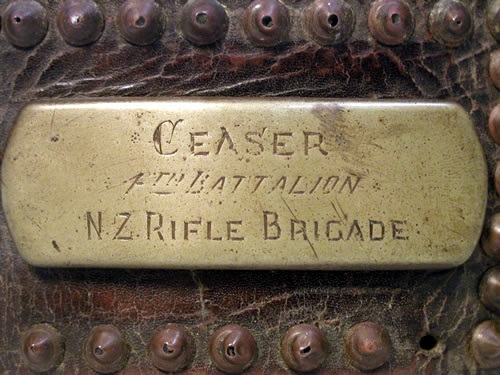
Caesar was killed in action.  His collar (which has his name spelled incorrectly) is on display at the Auckland War Memorial Museum.

Caesar's collar, with his name spelled incorrectly

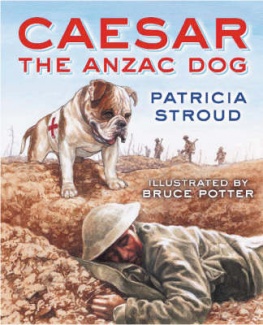
Author Patricia Stroud has written about Caesar in her book, Caesar the Anzac Dog.  Illustrated by Bruce Potter and published by Harper Collins, the book is useful for teaching schoolchildren about the war.  The publisher also offers a study guide for teachers.

If a pug can do it, so can you

Puglet the Pug features in this video to encourage us to do the right thing on Earth Day and every day.    Have a wonderful (and sustainable) week!

With age comes greater success (in hunting, at least)

At the meeting of the Society for American Archeology this week, two University of Cincinnati professors, Jeremy Koster and Ken Tankersley,  presented their results of research into hunting dogs in lowland Nicaragua.

The indigenous communities of the Mayangna and the Miskito in Nicaragua survive on subsistence hunting in the Bosawas Biosphere Reserve.  The reserve is part of the largest unbroken tracts of neotropical rainforest in Central America, north of the Amazon.   85% of the mammals that are hunted are caught with the assistance of dogs.

Nicaraguan hunters and their dogs on a hunt, photo by Jeremy Koster, University of Cincinnati

The research team found that as both male and female dogs reach three years of age, they tend to increase their hunting success.  Older, male and female dogs in the study population returned more game to their owners than did younger dogs.

Bigger dogs are able to track and corral bigger prey, which increases their hunting return rates.  Since male dogs are generally larger than females, the males had the greater success rates.

As far as sustainability is concerned, the researchers found that  dogs are more suited to wildlife sustainability than other hunting options available.  Hunters with firearms tend to disproportionately hunt prey that lives in trees, including slow-breeding primates.  Hunters with dogs tend to harvest relatively fast-breeding animals such as agoutis, pacas and armadillos.

Their main conclusion:  With age comes greater success!

(Let’s hope the same applies to us; I could use all the help I can get :))

Source:  University of Cincinnati press release

Heroic dogs in the face of house fires

Our local newspaper ran a story recently about a little dog that woke her owners when their garage caught fire.  Luckily, the damage was fairly minor and all (including the dog) escaped harm.

It was that story that got me thinking about all of the stories we hear, year in and year out, about dogs that act instinctively to warn their owners of danger or to get help.  Here’s just a few dog hero stories that I’d like to share about dogs who have saved their owners or alerted others about fires.

_____________________________________________________

Brutus alerts sleeping family to burning garage (February 2012)

Dog alerts sleeping family to house fire (December 2011)

Dogs saves owner during house fire – Clyde the Great Dane! (November 2011)

Dog warns Daytona man of fire in house (November 2011)

Dog warns man of house fire (October 2010)

And one last video, taken from the camera on board the vehicle of an Alaskan State Trooper – showing the family dog Buddy leading the officer to the family’s home which was on fire…

Kathleen Crisley, specialist in dog massage, rehabilitation and nutrition/food therapy, The Balanced Dog, Christchurch, New Zealand

Would a raised dog feeder help my dog?

A massage client asked me this question earlier this week.   The dog in question is a Boxer (beautiful boy) who happens to be suffering from degeneration in his spine.

Although he is doing well with regular swimming, acupuncture and massage therapy, his owner knows that he is comparatively young (8) and she wants him to have a good quality of life for a long time.  So that’s when we started talking about changes she could make to his physical environment to make things less stressful for him (ramps, steps, etc.)

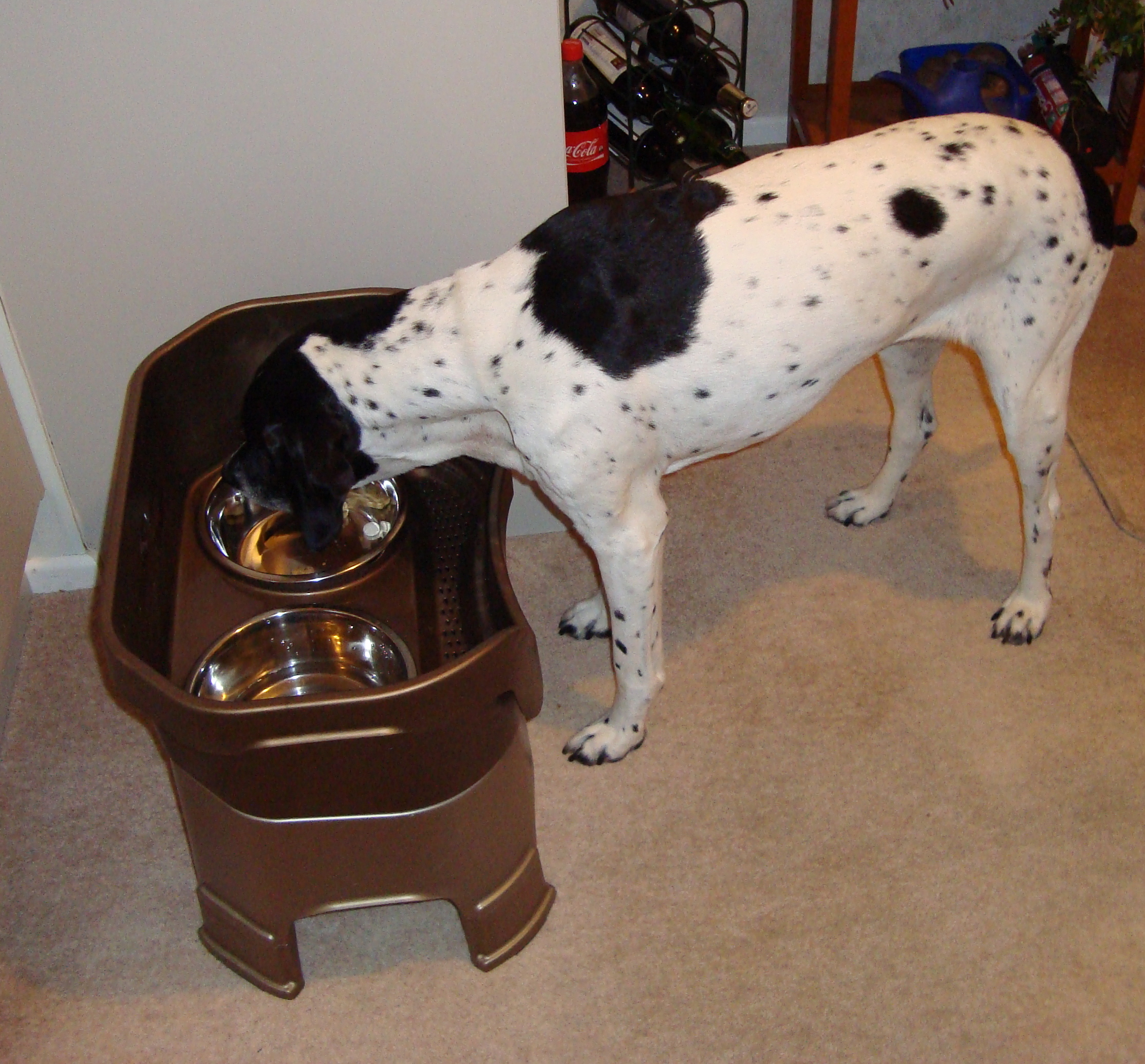
Would a raised feeder help my dog?

Raised feeders can be a real advantage for a dog with orthopaedic problems or arthritis.  Eating from a raised feeder helps to relieve strain on the neck and back, allowing the dog to eat without dramatically altering their posture and helping them to retain balance.

But – some studies have shown that dogs who are susceptible to bloat have an increased risk from eating from a raised feeder.  The most notable reference for this link is an article by Dr Larry Glickman in Journal of the American Veterinary Medical Association, Vol. 17, No. 10.

Gastric dilation-volvulus (GDV) is known by the common term ‘bloat’  and other terms such as ‘stomach torsion’ or ‘twisted stomach.’  Regardless of what name you use, the condition is life-threatening.  Dogs can die of bloat within several hours.   Even with treatment, as many as 25-33% of dogs who develop bloat will die.

In bloat, the stomach fills up with air and puts pressure on the other organs and the diaphragm. The pressure on the diaphragm makes it difficult for the dog to breathe. The air-filled stomach also compresses large veins in the abdomen, preventing blood from returning to the heart.

Filled with air, the stomach can easily rotate on itself, pinching off its blood supply. This rotation is known as volvulus.  The stomach begins to die and the entire blood supply is disrupted.  A dog with this condition can deteriorate very rapidly – meaning a trip to the vet as an emergency.

Purdue University ranks Boxers as the 16th breed most susceptible to bloat (Great Danes are the highest).  So, in this case, the owner decided not to opt for a raised feeder.  Not only is her Boxer on the higher risk list, but he also is a gobbler – making quick work of his food!

This is just one example where it pays to do a little research.  An idea that seems like a good one may not be so.