Author Archives: DoggyMom.com

Top 10 medical conditions for dogs

VPI™ Pet Insurance is the largest insurer of pets in the United States.  Each year, the company compiles statistics on the most common conditions that policy holders submit claims for.

The purpose of compiling this list is to show dog owners how some of the problems that their dog may have had in the past could be covered by pet insurance.  It’s a marketing exercise, of course, but it is useful.

In 2010, the top ten conditions for dogs were:

1)      Ear infection

2)      Skin allergy

3)      Skin allergy or hot spots

4)      Gastritis/vomiting

5)      Enteritis/diarrhoea

6)      Arthritis

7)      Bladder infection

8)      Soft tissue trauma

9)      Non-cancerous tumour

10)   Hypothyroidism

Pet insurance is an individual choice and you need to consider your dog’s risk profile, your ability to pay premiums, weighed up against your ability to fund medical bills in the future and your preferences for types of medical or specialist care for your dog.

The best way to make a decision about purchasing insurance is to do your homework.  Information such as this list put out by VPI can help inform your decision.

For my New Zealand readers, see my earlier blogs on coverage of massage/physiotherapy by New Zealand pet insurers.

Will my dog’s massage be covered by our insurance, Part I (Pet n Sur)

Will my dog’s massage be covered by our insurance, Part II (Petplan)

Will my dog’s massage be covered by our insurance, Part III (Ellenco)

Will my dog’s massage be covered by our insurance, Part IV (Petprotect)

Kathleen Crisley, specialist in dog massage, rehabilitation and nutrition/food therapy, The Balanced Dog, Christchurch, New Zealand

The Inn by the Sea, Cape Elizabeth, Maine

Among a growing number of dog-friendly accommodation options in the US, the Inn by the Sea sets itself apart by offering dog-friendly accommodation combined with support of locally made dog products.

When you book their Inncredible Pets package you and your dog receive:

  • a minimum of 2 nights in a single bedroom suite
  • a dog toy that is made in Maine
  • a personalised LL Bean dog bed (these beds are known for their quality and durability and LL Bean is a flagship retailer in Maine)
  • a 30-minute in-room dog massage to help your dog work out the kinks of the trip
  • a nightly entree from the Inn’s pet menu
  • a nightly pet turndown service that rewards you dog with a locally made dog treat

This package currently starts at US$472.21 per night for a garden suite (higher rates for a spa suite or at peak times).

The Inn is located on popular Crescent Beach which does not allow dogs in the summer months of April – October.  Inn staff can advise you on beaches that allow dogs during these times.

Kathleen Crisley, Fear-Free certified professional and specialist in dog massage, rehabilitation and nutrition/food therapy, The Balanced Dog, Christchurch, New Zealand

Choosing a veterinarian

As a dog owner as well as a canine massage therapist, I can honestly say that one of the most important things you can do for your dog is to have a good veterinarian.    However, many people I have met through my practice seem to move from vet practice to vet practice – never really giving a vet the chance to get to know their dog.

Of course, sometimes the moving around can’t be helped – people change jobs or other circumstances happen that require them to move house and location.  However, in other cases, it seems the owner is looking for the ‘best deal’ in a consultation fee or they have had a bad experience with an office (not necessarily the vet) and don’t want to return there.

So, here’s my advice on finding a good (and possibly great) veterinarian:

  • Ask your friends who own dogs who they use and why
  • Similarly, ask other dog owners you meet through obedience classes, dog park, etc.
  • Phone around and enquire about consultation fees and office hours that fit your schedule and lifestyle
  • Book a single, short consultation appointment to allow your dog to visit with the vet – see how he/she reacts to the vet and whether you like your experience at the practice.  If not – keep looking!
  • Most vet practices have more than one veterinarian; most owners and dogs develop a favourite vet.  However, it is always a good idea to have an appointment with the alternate vet once in a while so they have some  experience with your dog.  If you have an emergency on a day when your favourite vet isn’t on duty, you’ll understand the importance of having done this!
  • Ask about the staffing arrangements at the practice.  How many qualified nurses/technicians are there at any given time?  Is there a dedicated receptionist (because the best receptionists get to know the patients very well!)?
  • Is the facility set up for surgery if your pet needs it or will you have to go elsewhere to a ‘sister’ clinic?
  • What options are there for after-hours care or emergencies?
  • If you may want to pursue complementary therapies for your dog, how receptive is the vet to these?  Is the vet trained in homeopathy, for instance?
  •  Do other specialists work from the practice or, at a minimum, are they available through referral?
  • What type of payment options are offered at the practice?
  • Does the practice charge extra for filing insurance paperwork (if you choose to have pet insurance)?
  • Will the vet write a script for medicine that you choose to buy from a (reputable, of course) online pharmacy?

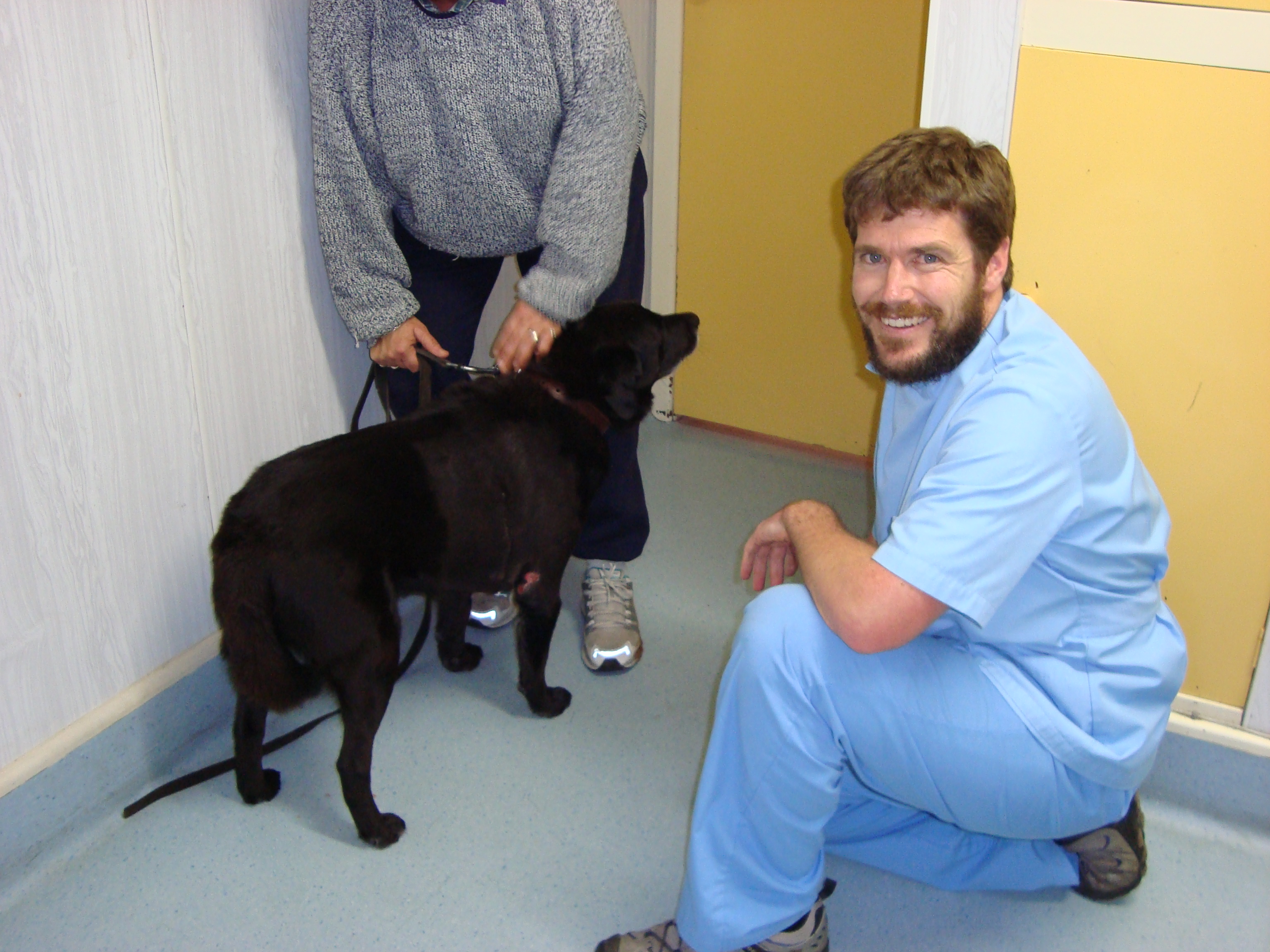
Dr Tim Nottage of Merivale-Papanui Veterinary Clinic with a happy client

Finally, if you have been using a veterinary practice for some time but have become concerned that the treatment and level of care/attention is no longer up to par – I advise you to raise it with the veterinarian.  All businesses need feedback.  For example, I had one client who felt that the changes in staff at her local veterinary practice meant that the standard of care had gone down.  The nurses were all new, young, and inexperienced.  She still liked the vet, however.  A short discussion to share her concerns didn’t solve the problem overnight, but it started the vet thinking that the staff needed more training particularly in the area of customer service.   My client’s next experience at the office improved and she didn’t have to go in search of another vet.

Kathleen Crisley, Fear-Free certified professional and specialist in dog massage, rehabilitation and nutrition/food therapy, The Balanced Dog, Christchurch, New Zealand

Seymour the dog helps kiwis move to digital tv

The New Zealand Government has chosen a digital cartoon dog, Seymour, as its mascot in the Going Digital campaign.

Seymour of the Going Digital campaign

Like many other countries, New Zealand will transition to only digital television starting next year.  This change affects many people who have older style televisions and who do not currently use digital reception devices such as those provided by Freeview and Sky TV.

Seymour is a cute little black and white dog.  You can view his commercials on the Going Digital website.

Kathleen Crisley, Fear-Free certified professional and specialist in dog massage, rehabilitation and nutrition/food therapy, The Balanced Dog, Christchurch, New Zealand

Rescuing beagles from the lab

The Foundation for Biomedical Research, located in Washington DC, estimates that there are 60,000 dogs in research facilities in the United States.  (The Foundation advocates for ethical treatment of animals used in research.)

The beagle is commonly chosen as a research subject because of its size and temperament.

Unfortunately for the dogs involved in research, most facilities do not re-home the dogs after their ‘useful’ period has passed.  Most are euthanised.  One reason for this is that the facilities who conduct research involving dogs do not wish to be identified, for fear that they are targeted by activists who publicise their use of the dogs.  In extreme cases, activists have been known to break into the facilities to release the dogs.

Some animal welfare agencies work behind the scenes to find ways to receive these dogs and find them new homes, also protecting the anonymity of the laboratories so they are encouraged to re-home more dogs in the future.   The San Francisco Chronicle ran a story last week of one such re-homing effort involving nine beagles.

Re-homing an ex-laboratory dog is not always easy.  Most of these dogs have never been outside and have never been housebroken because they spend their lives in a crate or cage.  In the cases of these beagles, they were also de-barked (vocal chords were intentionally cut) to reduce noise in the laboratory.

The June re-homing exercise was the second for the Beagle Freedom Project, which mounted this wonderful video on YouTube of the rescue:

In future blog postings, I will provide some more information about dogs used in research and the points of view about whether or not the experimentation on them is essential.  This is a major animal welfare issue and one that will not go away quickly as the world seeks to develop new treatments for human diseases and disorders.

Kathleen Crisley, Fear-Free certified professional and specialist in dog massage, rehabilitation and nutrition/food therapy, The Balanced DogChristchurch, New Zealand

Carrie dances the merengue

Carrie is a Golden Retriever from Chile.  Her owner, Jose Fuentes,  has taught her to merengue with him.  Thanks to the Internet, the pair has developed a reputation, appearing on television shows like The Late Show with David Letterman.

There has even been a petition, of sorts, to get Carrie and Jose onto Dancing with the Stars as a guest act!

Here are a few videos of Carrie, thanks to the power of You Tube.

Kathleen Crisley, Fear-Free certified professional and specialist in dog massage, rehabilitation and nutrition/food therapy, The Balanced Dog, Christchurch, New Zealand

The search for Toto

The Peach Theatre Company in cooperation with radio station More FM and Purina are looking for a dog to play Toto in the upcoming production of the Wizard of Oz which will be performed in Auckland this  September.

The producers are open-minded and will consider dogs other than the Cairn Terrier, who featured as the original Toto in the film.   If you think your dog has star quality, then fill out the entry form here.

Kathleen Crisley, Fear-Free certified professional and specialist in dog massage, rehabilitation and nutrition/food therapy, The Balanced Dog, Christchurch, New Zealand

Providing for your dog in your will

News has broken this week that Trouble, the Maltese previously owned by Leona Helmsley (‘The Queen of Mean’), died in December.  Helmsley left a US$12 million trust fund when she died in 2007 for the care of Trouble.  This amount was later reduced to US$2 million when relatives challenged the will.

If you are thinking about providing for your dog in your will – there is a right way and wrong way to do it.

Right way:  Check into the regulations in your area about establishing trust funds for the benefit of your pet’s care and open the trust fund now, making regular contributions.   Make sure you nominate someone to care for your dog after you have died, using the funds in the trust.

If pet trusts are not allowed in your area, you need to nominate a carer for your dog and then leave them money to support your dog’s care.

Wrong way:  Don’t leave money to your dog in your will.  Whether we like it or not, dogs are considered property and this status means that they cannot inherit money.  The money you leave to your dog will likely be re-distributed to other beneficiaries.

Here’s a good (and brief) article about providing for your dog in your will.

Kathleen Crisley, Fear-Free certified professional and specialist in dog massage, rehabilitation and nutrition/food therapy, The Balanced Dog, Christchurch, New Zealand

The National Mutt Census (USA)

With the advancement of DNA technology, more people want to know what their mixed breed dog is made up of.   More than half of all dogs in the USA are mixed breeds, making The Mutt the most popular dog!

Mars Veterinary, which has its own veterinarians and genetics research unit, decided to conduct the first-ever Mutt Census last year, inviting owners of mutts to complete an on-line questionnaire and requiring them to use a DNA test kit  called the Wisdom Panel ™.

It is now official that the German Shepherd Dog is the breed most commonly found in mixed breed dogs.  The Top 10 Mutt Breeds are:

The Top 10 Mutt Breeds

1. German Shepherd Dog
2. Chow Chow
3. Labrador Retriever
4. Boxer
5. Rottweiler
6. American Staffordshire Terrier
7. Miniature Poodle
8. Golden Retriever
9. Siberian Husky
10. Cocker Spaniel

To find out more about the Mutt Census, click on the logo below.  This will take you directly to the Mutt Census website.

Kathleen Crisley, Fear-Free certified professional and specialist in dog massage, rehabilitation and nutrition/food therapy, The Balanced DogChristchurch, New Zealand

Take your dog to work day 2011

Take Your Dog to Work Day is Friday, 24th June this year.

This day is used to help raise funds for animal care organisations around the world  as employers sponsor special events for employees and their dogs.  It has also become an opportunity to introduce employers to the benefits of a dog-friendly workplace.

The folks at Pet Sitters International started this event back in 1999 and their website gives you lots of useful information about how to get your employer on board, tips for success, and event ideas.

Their tips for Dog Day Success include:

  • designating some areas as off-limits to cater to employees who do not want to participate
  • having regular breaks for dog walks, possibly offering the services of a dog walker
  • ensuring all dogs are kept on leash
  • making sure employees have alternative arrangements if their dogs get sick or are unhappy in the office

There’s still time to organise your own Take Your Dog to Work Day for this year!

Kathleen Crisley, Fear-Free certified professional and specialist in dog massage, rehabilitation and nutrition/food therapy, The Balanced Dog, Christchurch, New Zealand
