When your comrade is your dog

News broke this week that Megan Leavey, a former corporal with the US Marines, has won her fight to be reunited with her ex-partner Rex.  Rex, her comrade-in-arms in Iraq, is a bomb-sniffing dog who is retiring at the age of 11.

Leavey originally asked to adopt Rex five years ago and was refused.

Both Megan and Rex were injured in 2006 when a bomb exploded in Ramadi.  Corporal Leavey was awarded a Purple Heart and subsequently discharged in 2007.   After her request to adopt Rex was declined, she followed the dog and his progress from afar.  When it became clear that Rex was to be retired from duty and likely to be put down, Leavey lobbied again for her chance to take care of Rex.

These photos, courtesy of Megan Leavey, show the pair together.

This slideshow requires JavaScript.

Hip dysplasia – it’s not just genetics

Doctoral research by Randi I. Krontveit at the Norwegian School of Veterinary Science has revealed that environmental factors play a larger role in the development of hip dysplasia than previously thought.

The critical period is from birth to the age of three months.  Activities such as walking up steps on a daily basis during this critical period increased the risk of developing hip dyplasia.

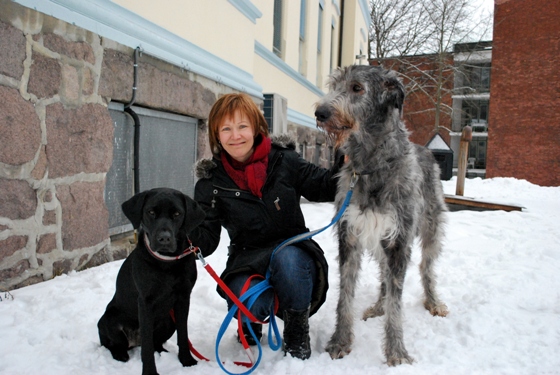
The study group consisted of 500 dogs in four breeds:  the Labrador Retriever, the Newfoundland, the Leonberger and the Irish Wolfhound.

Randi I. Krontveit with two of her study subjects. Photo courtesy of the Norwegian School of Veterinary Medicine

Environmental factors were assessed by questionnaires filled out by breeders and owners alongside examinations by veterinarians.  Dogs were followed for a period of ten years, making the findings of the study particularly robust.

Puppies born in the spring or summer and at breeders’ who lived on a farm or small holding had a lower risk of developing hip dysplasia.  After about eight weeks, the puppies began to live with their new owners. The opportunity to exercise daily in parks up until the age of three months reduced the risk of hip dysplasia.

Overall, it would appear that daily exercise out in gently undulating terrain up until the age of three months has a positive impact when it comes to preventing the disease.

For more information about this research, you can email Dr Krontveit via this page at the Norwegian School of Veterinary Medicine.

Huge dog to get hero medal after quake work

Congratulations to Guiness, the Irish Wolfhound!

Read the full story here.

Epilepsy gene discovery in dogs

The journal PLoS ONE has published research this week by Professor Hannes Lohi of the University of Helsinki.  Professor Lohi and his research team have isolated a gene linked to epilepsy in Belgian Shepherds.

The gene is found on canine chromosome 37.  The research team isolated the gene by comparing the genome of dogs with epilepsy against those of dogs that were in a healthy control group.  The gene could increase the risk of epilepsy by a factor of 7.

Genetic epilepsy is also referred to as ‘idiopathic epilepsy.’  A co-author on the article has said that as many as 20% of the Belgian Shepherd breed is estimated to have epilepsy and so the research could underpin the development of a genetic test for the disease.

Seizures can result in abnormal movements, usually on one side of the body, followed by cramping in the limbs.  Drooling and vomiting are other symptoms.

This research group is responsible for other genetic discoveries in dogs.  Through their research, the group has developed a canine DNA bank in Finland containing 40,000 samples from 250 different breeds of dogs.  They have previously identified the epilepsy gene EPM2B in Miniature Wirehaired Dachshunds and a gene LGI2 in Lagotto Romagnolos and collaborated with other researchers in the discovery of an epilepsy gene in Tibetan Terriers.

Source:  Helsingin yliopisto (University of Helsinki) (2012, March 23).   New epilepsy gene located in dogs. ScienceDaily. Retrieved March 25, 2012, from http://www.sciencedaily.com­ /releases/2012/03/120323205337.htm?utm_source=feedburner&utm_medium=email&utm_campaign=Feed%3A+sciencedaily%2Fplants_animals%2Fdogs
+%28ScienceDaily%3A+Plants+%26+Animals+News+–+Dogs%29

Daisy, this is Louie (and he’s not staying)

Several weeks ago, Daisy and I met a little dog  when we were out for our afternoon walk.   From his tag, I knew his name was Louie.  He was obviously lost and happy to follow us, but also lacked car sense (running across roads without stopping to look for traffic).   So, I encouraged him to come along with us and picked him up when we were approaching streets to cross.

I think together Daisy and I have ‘rescued’ three dogs in the last year who have lost their way from their homes.  In Louie’s case, matching him with his owner was not difficult because Louie’s owner had secured a name tag with her phone number to Louie’s collar (a move which I applaud and endorse).

Louie

Now, Daisy is an older girl and she is very congenial to all dogs and humans.  But, she prefers her routine and very young Louie was a little too much for her.  On arrival at home, she went to bed.  I went for the phone to call Louie’s owner who, as it turns out, was out of town.  She’d left Louie with a friend and he’d escaped.  Help was on the way within the next hour or so….

Daisy couldn’t help herself.  She had to come out and see what was happening in her house.  Louie wanted to play; Daisy wasn’t so sure.  Here’s a video of their encounter (latin dance music courtesy of the film that was playing on the tv at the time)…

Louie was picked up by his owner’s flatmate.

Today, my doorbell rang and Anna (owner) was there to thank me.  Louie, a Bichon/Poodle cross, decided to jump out of the car and say hello too, to both Daisy and I.  We were given a bottle of wine for our efforts (Daisy won’t indulge).  All’s well that ends well.

But Daisy is still glad we are a one-dog household…

Marilyn Monroe and her dogs

Over the course of her life, Marilyn Monroe owned a number of dogs.

A black and white mixed breed by the name of Tippy was given to then Normal Jean by her foster father.

A spaniel named Ruffles was an early companion around 1940-1942.

Her husband Jim Dougherty bought her a collie named Muggsie.

Around about the time that she was signed by Columbia Pictures in 1948, Marilyn reportedly owned a chihuahua but I can’t find a record of the name.

During her marriage to Arthur Miller, a basset hound named Hugo was their companion.  Miller retained ownership of Hugo when the couple divorced.

Marilyn Monroe and Maf, photo attributed to Eric Skipsey

Maf was a maltese given to Marilyn by Frank Sinatra.  The dog’s full name was Mafia Honey in honour of Sinatra’s alleged mafia connections.  When Marilyn died, the dog was given to Sinatra’s secretary.

In 2010, author Andrew O’Hagan documented Maf’s story in a book The Life and Opinions of Maf the Dog, and of His Friend Marilyn Monroe.  Written from Maf’s point of view, we read about Marilyn’s last two years  (she took the dog to Hollywood, New York and to Mexico).

One of Maf’s comments: “I mean, if you have to pee you have to pee and why not next to the swimming pool at the Chateau Marmont, right?”

A lot has been written about Marilyn and her all-too-short life.  What a nicer way to picture the actress than through her dog?  (Dogs don’t lie and they don’t tell tails – oops I mean tales)

Kathleen Crisley, specialist in dog massage, rehabilitation and nutrition/food therapy, The Balanced Dog, Christchurch, New Zealand

Dog friendly shopping in Colorado

****This is a re-print of my column that appeared in the December 2010 issue of NZ Dog World magazine.  Since that magazine is currently available to NZ Kennel Club members only, I’m re-publishing it here because it is a topic I’m passionate about.****

_________________________________________________________

I thought I’d share my experience of dog-friendly shopping in the state of Colorado, where I recently traveled for my business.

Colorado is a state that clearly values the companionship of dogs.  They were everywhere:  in trucks, cars and – unlike New Zealand – they were welcomed in many shops and public shopping areas.   On my flight from San Francisco to Denver, there was even a passenger who had a small dog in a carrier.  (Many U.S. airlines now allow small dogs into the cabin as carry-on luggage.)[1]

I wished my Daisy could have traveled with me to enjoy the sites (but she wouldn’t have appreciated the long flight or the required three-month quarantine on our return to New Zealand).

Dogs welcome

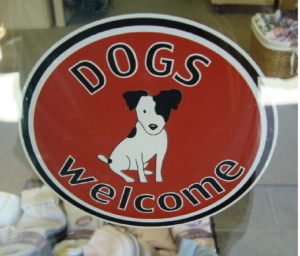
Dog owners could easily identify shops where their dog would be allowed to enter.  These shops displayed a Dogs Welcome logo in their window.  Interestingly, these shops sold clothing and footwear for people and were not just pet stores.  An outdoor mall in Castle Rock went a step further by providing grassed park areas and dispensers of plastic bags for dogs to have a ‘comfort stop.’
Other shops made up their own signs, such as one retailer whose sign proclaimed, “Four Legged Friends Welcome.”

I asked a shop attendant if they get many shoppers accompanied by their dogs.  She replied, “Yes.  Lots.  Particularly on weekends when people who work all week want to be out with their pet.”

Dog rest stops

I noticed that many communities welcomed dogs in their shopping areas by providing bowls of water for passing dogs to drink from.  I quickly became accustomed to seeing these ‘dog rest stops’ in virtually every town that we visited.

Rest stops varied in style and offerings.  Some were simply a single water bowl or raised water bowls.   Pet shops would often include extras, such as a bench for owners to sit in.  In Manitou Springs, a popular tourist destination at the foot of Pike’s Peak (elevation 4,800 m), a sweet shop provided vending machines with dog treats.  For 25 cents, a passing dog owner could purchase a handful of treats.

Good behaviour required

In all of the communities I visited, dogs and owners acted responsibly.  There was never a pile of poo left on the footpath and dogs didn’t jump on passers-by.  Responsible dog ownership is clearly essential for communities to embrace dog-friendly shopping.

And so, I leave you with good wishes for the summer holiday season and encourage you to think:  Is dog-friendly shopping appropriate for New Zealand and, if so, what will it take to get dog-friendly shopping established here?


[1] The dog carrier is considered the single piece of carry-on luggage for the owner; the dog must have current vaccinations and is not allowed out of the carrier during the flight.

Additional photos of my trip can be found in this blog post.

Kathleen Crisley, specialist in dog massage, rehabilitation and nutrition/food therapy, The Balanced Dog, Christchurch, New Zealand

Subaru’s latest dog commercial – camping

Subaru (USA) has added to its repertoire of dog-themed commercials.  This one is about camping.

Subaru has recognised that dog owners are a market niche – and cater to their needs with models like the Forester.  Ads by Subaru are common in US dog magazines.

Too bad Subaru in NZ hasn’t caught on to the dog-owning public…time will tell!

The sale of Ellenco to Southern Cross – a positive for pet owners

Southern Cross Benefits Ltd announced this week that it has purchased Ellenco Pet Insurance.  Although some may lament the loss of a ‘mom and pop’ operation that has operated for 22 years, I think the ownership transfer is a good thing for New Zealand dog (and other pet) owners.  Why?

  • Only 8% of dog owners in NZ currently have pet insurance (according to the NZ Companion Animal Council’s Companion Animals in NZ survey, July 2011)
  • The Southern Cross Healthcare Group, of which Southern Cross Benefits Limited is one company,  is the largest healthcare insurance provider in NZ
  • Ellenco’s owners could not afford to put up the $3 million bond required by new legislation and its previous bond of only $500,000 was a potential risk to policy holders
  • In my opinion, Southern Cross is a trusted brand in NZ and should encourage more pet owners to seriously consider the purchase of insurance
  • Southern Cross has acknowledged that surveys of its clients have shown that there is interest in pet insurance – so an audience that hasn’t been reached so far by  insurance providers is aware of the benefits of pet insurance –  but hasn’t had the confidence yet to buy a policy
  • Southern Cross Benefits Limited has an A+ (Strong) financial strength rating from Standard & Poor’s, is a Registered Financial Service Provider, and is a member of the Insurance & Savings Ombudsman’s Disputes Resolution Scheme

Insurance, like other business markets, matures over time.  This is a huge step for NZ in its recognition of the importance of pets and the associated costs of their healthcare.

Another big step in the pet insurance market here was when The Warehouse started offering Petplan insurance, furthering the marketing of pet insurance generally through a very popular retail outlet.

In the words of Ian MacPherson, CEO of Southern Cross Healthcare Group, “Pet insurance is a natural extension for Southern Cross. Many New Zealanders count their pets as part of the family. However, currently very few owners have pet insurance, meaning they are exposed to what can be very high bills should their pet be affected by an unexpected illness or injury.”

It is important to note that the policies of all pet insurance providers in NZ have coverage of some sort for complementary therapies.  Read my pet insurance fact sheet for more details.

Footnote:  Credit must be given to the founders of Ellenco, Rodger Cox and Jenny Ellenbroek.  Ellenco was the first firm to offer pet insurance in New Zealand, others have followed.  Many policy holders have benefited from the coverage of their company’s policies.  Alas, time has caught up with the small Christchurch-based operation.

The Insurance (Prudential Supervision) Act 2010 required insurers to put up higher bonds and the small firm could not afford this change.  Policy holders are lucky that the owners negotiated with Southern Cross for the purchase of the firm’s policies.  Until operations are transferred to Hamilton in 2013, there will be no change to Ellenco’s policy provisions.

Kathleen Crisley, specialist in dog massage, rehabilitation and nutrition/food therapy, The Balanced Dog, Christchurch, New Zealand
New research into virus infection in dogs

Researchers at the University of Pennsylvania School of Veterinary Medicine and the Perelman School of Medicine have published new research into an Epstein Barr-like virus that can infect and may cause lymphomas in dogs.

The findings means that humans and dogs share a similar biology – at least when it comes to the infection by the virus.  (Epstein Barr is the cause of diseases such as mononucleosis and is linked to the development of more serious diseases including non-Hodgkins and Hodgkins lymphomas.)

How does infection occur?

In humans, the Epstein Barr virus infects B cells.  After an acute phase of infection, which passes in many people without them even being aware of it,  the virus goes into a latent phase.  Most people show no symptoms during this phase.  In some, however the virus promotes unnatural growth of B cells and this contributes to the development of lymphoma.

Dogs develop lymphomas that share some characteristics with human lymphomas.  These conditions are relatively common in certain breeds such as the golden retriever.

Researchers think this line of enquiry is promising because they may be able to study the rates of infection and responses to treatment in dogs and this may have spinoffs for human treatment.

You can read the entire University of Pennsylvania media statement here.


